
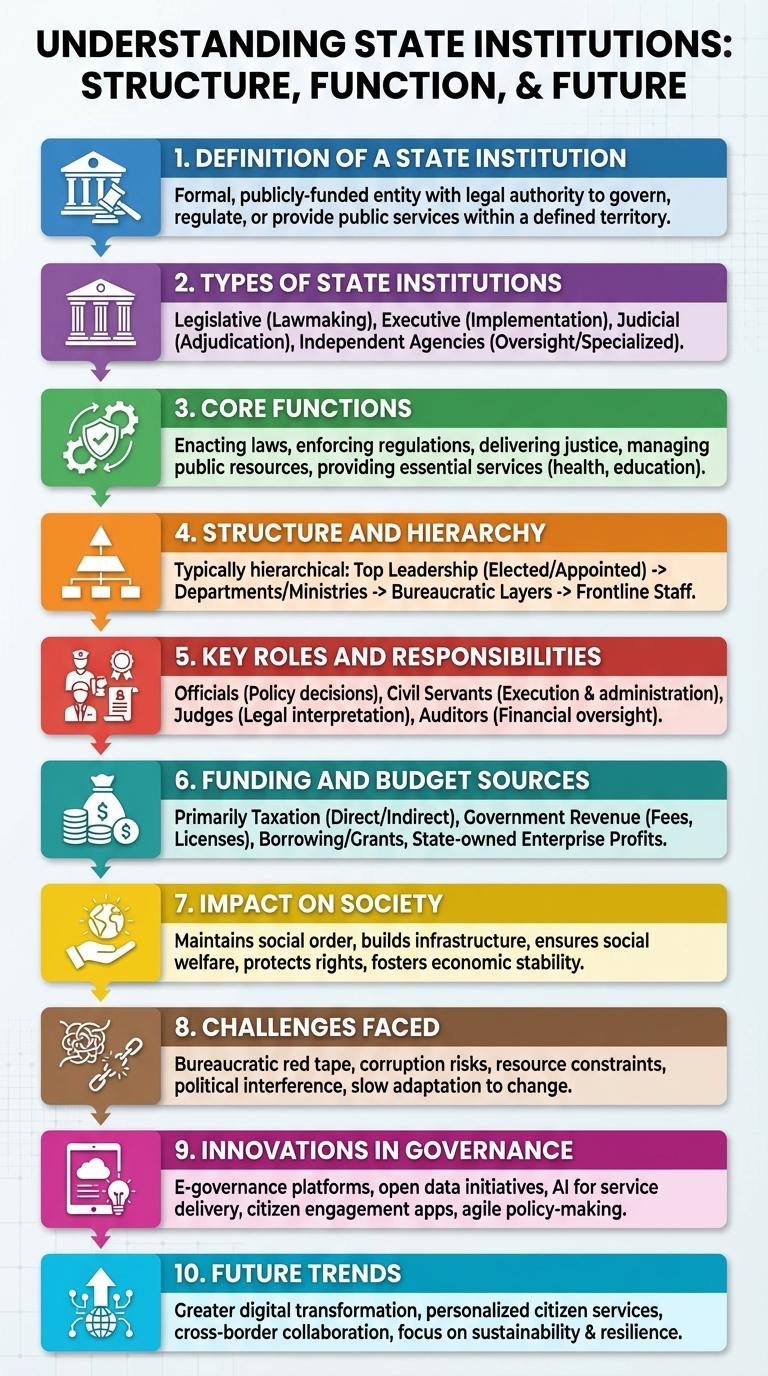
State institutions serve as the backbone of governance, implementing laws and policies to maintain order and provide public services. Understanding their structure and functions is essential for recognizing how government decisions impact daily life. This infographic breaks down key components and roles of state institutions for clearer insight.
Definition of a State Institution
A state institution is an organization established by the government to implement public policies and deliver services. These institutions operate under legal frameworks to maintain order and support societal development.
Examples include legislative bodies, judicial courts, and administrative agencies. They play a crucial role in governance, regulation, and public administration.
Types of State Institutions
State institutions form the backbone of governmental functions and public administration. Understanding their types clarifies how power and services are distributed across sectors.
- Executive Institutions - Responsible for implementing laws and policies, including the presidency and government ministries.
- Legislative Institutions - Tasked with creating and passing laws, typically comprising national parliaments or congresses.
- Judicial Institutions - Interpret laws and administer justice through courts, maintaining legal order and rights protection.
- Regulatory Bodies - Oversee specific sectors like finance, communications, or environmental protection, ensuring compliance with laws.
- Local Government Entities - Manage regional and municipal affairs, delivering services and governance at closer community levels.
Core Functions of State Institutions
| Core Function | Description |
|---|---|
| Legislation | Creating, amending, and repealing laws to regulate society and ensure justice. |
| Administration | Implementing laws, policies, and managing public services and resources efficiently. |
| Judiciary | Interpreting laws, resolving disputes, and upholding constitutional rights and legal order. |
| Security | Maintaining public order, protecting citizens, and ensuring national sovereignty. |
| Policy Formulation | Developing strategic plans and frameworks to guide national development and governance. |
Structure and Hierarchy
State institutions operate within a defined structure that delineates authority and responsibilities across various levels. The hierarchy typically begins with top executive bodies, followed by legislative and judicial branches, ensuring balanced governance. Clear organizational frameworks enable efficient policy implementation and public service delivery.
Key Roles and Responsibilities
State institutions serve as the backbone of government operations, ensuring the implementation of laws and public policies. Their key roles include maintaining order, delivering public services, and safeguarding citizens' rights. These institutions act as intermediaries between the government and the public, promoting transparency and accountability.
Funding and Budget Sources
State institutions rely on a mix of funding and budget sources to carry out public services efficiently. Understanding these sources helps clarify how government operations are financed and maintained.
- Tax Revenues - The primary funding source derived from income, sales, and property taxes collected by the government.
- Federal Grants - Allocations provided by the federal government to support state programs and projects.
- User Fees and Charges - Revenue generated from services like licensing, permits, and public utilities.
Effective allocation and management of these funding sources are critical for the sustainability of state institutions.
Impact on Society
How do state institutions impact society? State institutions create and enforce laws that maintain social order and protect citizens' rights. They provide essential services such as education, healthcare, and public safety that improve quality of life.
Challenges Faced by State Institutions
State institutions encounter numerous challenges that impact their efficiency and public trust. These obstacles often hinder their ability to implement policies and deliver services effectively.
- Resource Constraints - Limited budgets and insufficient staffing affect service delivery and operational capacity.
- Bureaucratic Inefficiencies - Complex procedures and outdated processes slow down decision-making and reduce responsiveness.
- Corruption and Accountability Issues - Lack of transparency and oversight lead to misuse of power and erosion of public trust.
Innovations in State Governance
State institutions are evolving by integrating advanced technologies to enhance governance efficiency. Innovations in state governance promote transparency, accountability, and citizen engagement.
Digital platforms enable real-time data sharing among government agencies, improving decision-making processes. Artificial intelligence assists in predictive analytics to address public needs proactively. Blockchain technology ensures secure, tamper-proof records for public services.