
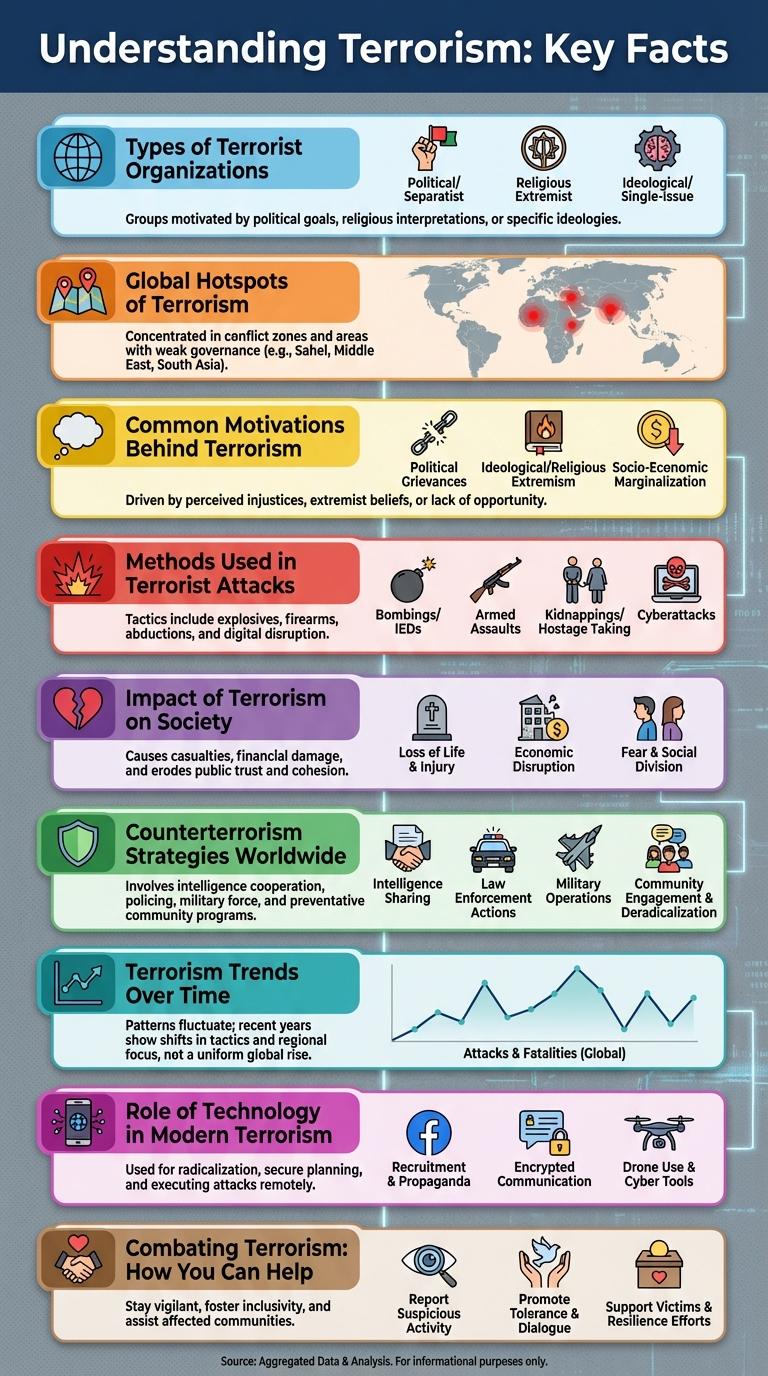
Terrorism profoundly impacts global security, causing widespread fear and disruption across societies. Infographics visualize complex data, revealing patterns in terrorist activities, methods, and affected regions. This powerful tool enhances understanding by making critical information accessible and engaging for diverse audiences.
Understanding Terrorism: Key Facts
Terrorism involves the use of violence to create fear and achieve political, religious, or ideological goals. It affects global security, destabilizing societies and economies worldwide.
Key facts reveal that terrorism targets civilians to maximize psychological impact and media attention. Understanding these elements is crucial for effective counterterrorism strategies and public awareness.
Types of Terrorist Organizations
Terrorism manifests through diverse organizations driven by different motives and structures. Understanding the types of terrorist organizations helps in analyzing their goals and strategies for counter-terrorism efforts.
The classification of terrorist groups often includes ideological, political, religious, separatist, and criminal organizations.
- Ideological Terrorist Organizations - These groups are motivated by extremist political or social ideologies, seeking to impose their beliefs through violence.
- Religious Terrorist Organizations - Groups that operate based on extremist interpretations of religion to justify acts of terror and advance their religious agendas.
- Separatist Terrorist Organizations - These organizations aim to create independent states or autonomous regions, often driven by ethnic or cultural identity.
- Political Terrorist Organizations - Groups focused on overthrowing governments or influencing political policies through coercion and violence.
- Criminal Terrorist Organizations - Entities combining terrorism with organized crime to fund operations and destabilize governments.
Global Hotspots of Terrorism
Terrorism remains a critical global security challenge, with certain regions experiencing persistent threats. Identifying these hotspots helps focus counterterrorism efforts and allocate resources effectively.
- Middle East - Countries like Syria, Iraq, and Yemen face ongoing terrorism fueled by conflicts and extremist groups.
- South Asia - Afghanistan and Pakistan experience frequent terrorist attacks due to political instability and militant presence.
- Sub-Saharan Africa - Nations such as Nigeria and Somalia encounter terrorism from groups like Boko Haram and Al-Shabaab.
Understanding the geographic concentration of terrorism aids in developing targeted strategies to enhance global security.
Common Motivations Behind Terrorism
Terrorism is driven by a range of motivations rooted in political, religious, and social grievances. Understanding these common motivations is essential for developing effective counterterrorism strategies.
Political motivations often include the desire to overthrow or challenge existing governments or policies. Religious extremism fuels terrorism when groups seek to impose their beliefs through violence. Social and economic factors, such as poverty and marginalization, also contribute to radicalization and terrorist acts.
Methods Used in Terrorist Attacks
Terrorist attacks commonly employ methods such as bombings, armed assaults, and cyberattacks. Suicide bombings remain a prevalent tactic for causing mass casualties and spreading fear. Cyberterrorism increasingly targets critical infrastructure, disrupting essential services and communication networks.
Impact of Terrorism on Society
| Aspect | Impact on Society |
|---|---|
| Loss of Lives | Thousands of civilians and security personnel killed globally each year due to terrorist attacks. |
| Economic Damage | Billions of dollars lost from infrastructure destruction, decreased tourism, and increased security costs. |
| Psychological Effects | Widespread fear, anxiety, and trauma affect communities long after attacks occur. |
| Social Division | Increased mistrust and polarization among ethnic, religious, and cultural groups. |
| Policy Changes | Stricter laws and enhanced security measures shape civil liberties and daily life. |
Counterterrorism Strategies Worldwide
Counterterrorism strategies worldwide focus on intelligence gathering, enhancing security measures, and international cooperation to prevent terrorist activities. Governments invest in advanced technology and training for law enforcement to detect and respond to threats swiftly. Public awareness campaigns and community engagement play a critical role in identifying radicalization early and disrupting terrorist networks.
Terrorism Trends Over Time
How have terrorism trends evolved over the past decades?
Terrorism incidents peaked globally in the early 2010s, with significant declines observed in recent years. Regions like the Middle East and South Asia experienced the highest levels of attacks, influenced by geopolitical conflicts and extremist groups.
Role of Technology in Modern Terrorism
Technology plays a crucial role in modern terrorism by enabling rapid communication, recruitment, and propaganda dissemination. Terrorist groups exploit social media platforms to spread extremist ideologies and coordinate attacks globally.
Advanced technologies such as encryption and anonymous messaging apps protect terrorist communications from law enforcement. Drones and cyberattacks have emerged as new tools used for both physical and digital terrorism activities.