
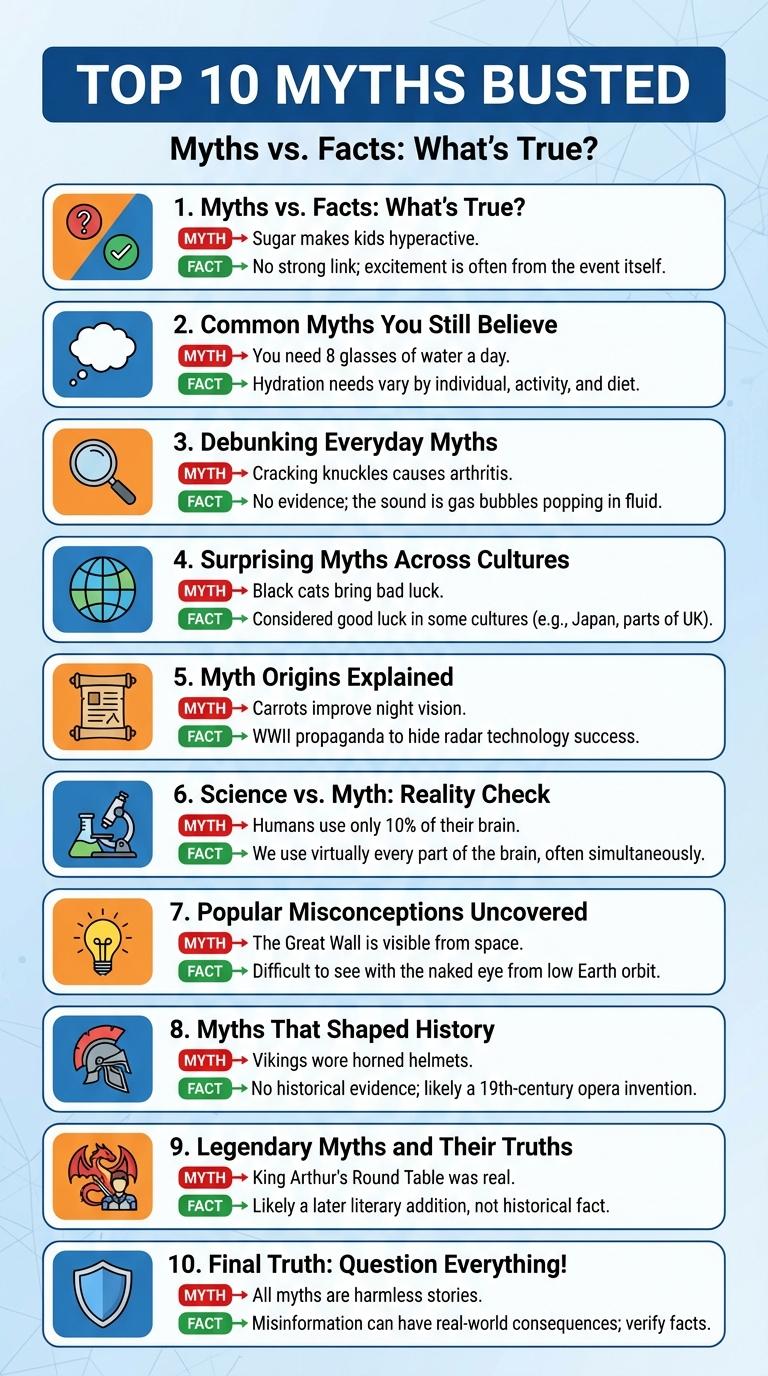
Infographics visually debunk common myths by presenting facts and data in an easy-to-understand format. They clarify misconceptions by highlighting evidence and expert insights, making complex information accessible. This approach helps readers quickly grasp truth and falsehoods in popular beliefs.
Top 10 Myths Busted
| Myth | Fact |
|---|---|
| Humans Only Use 10% of Their Brain | Brain imaging shows nearly all parts of the brain have a function and are active over time. |
| Lightning Never Strikes the Same Place Twice | Lightning often strikes the same place multiple times, especially tall structures. |
| Cracking Knuckles Causes Arthritis | No scientific evidence links knuckle cracking to arthritis development. |
| Goldfish Have a Three-Second Memory | Goldfish can remember information for months and are capable of complex learning. |
| Hair and Nails Continue to Grow After Death | Skin dehydration causes the illusion of growth after death; actual growth stops immediately. |
Myths vs. Facts: What's True?
Myths often distort reality, leading to widespread misconceptions. Understanding facts helps clarify truths and dispel false beliefs.
- Myth: Lightning never strikes the same place twice - Lightning can strike the same spot multiple times, especially tall structures or isolated objects.
- Myth: Humans use only 10% of their brain - Brain imaging shows that humans use nearly all parts of their brain throughout the day.
- Myth: Cracking knuckles causes arthritis - Research finds no evidence linking knuckle cracking to arthritis development.
Common Myths You Still Believe
Myths often shape our understanding of the world, yet many widely held beliefs are factually incorrect. Recognizing these myths helps improve critical thinking and informed decision-making.
Common myths persist across cultures despite evidence disproving them, influencing behavior and attitudes.
- Humans Only Use 10% of Their Brain - Brain imaging shows activity in multiple areas, proving nearly all parts have functions.
- Lightning Never Strikes the Same Place Twice - Lightning often strikes the same tall structures multiple times during storms.
- Vaccines Cause Autism - Extensive research confirms no causal link between vaccines and autism spectrum disorders.
Debunking Everyday Myths
Many everyday myths spread widely, shaping public perception despite lacking factual support. Debunking these myths helps promote accurate knowledge and informed decision-making.
Common myths range from health misconceptions to urban legends that persist through repetition. Scientific evidence often contradicts these beliefs, revealing misunderstandings or exaggerations. Understanding the truth behind myths fosters critical thinking and reduces misinformation.
Surprising Myths Across Cultures
Myths shape cultural identities and reveal common human experiences across the globe. They often contain surprising similarities despite originating from vastly different regions.
For example, creation myths from both Native American and African cultures emphasize the importance of nature and ancestral spirits. These stories highlight shared values like respect for the environment and community.
Myth Origins Explained
What are the origins of popular myths? Myths often stem from ancient storytelling traditions used to explain natural phenomena before modern science. These stories were passed down orally, evolving with each generation to reflect cultural values and fears.
How do myths influence culture and history? Myths serve as symbolic narratives that shape societal norms and collective beliefs. They provide insights into the worldview of ancient civilizations and are reflected in art, literature, and rituals worldwide.
Why do myths persist despite scientific knowledge? Myths fulfill psychological and social roles, offering meaning, comfort, and identity. Their allegorical nature makes them adaptable, allowing them to remain relevant across eras and cultures.
What role do myths play in education? Myths introduce complex concepts through engaging stories, making them accessible to all age groups. Educators use myths to teach morality, history, and human behavior in memorable ways.
How can understanding myth origins benefit modern society? Studying myth origins promotes cross-cultural understanding and critical thinking. It encourages appreciation of diverse perspectives and highlights the human quest for meaning throughout history.
Science vs. Myth: Reality Check
Science and myths often clash in explaining everyday phenomena. Understanding the difference between them is crucial for informed decisions.
- Myth: Humans use only 10% of their brain - Brain imaging studies show nearly all parts of the brain have identifiable functions and are active over a day.
- Myth: Vaccines cause autism - Numerous scientific studies have found no causal link between vaccines and autism.
- Myth: Lightning never strikes the same place twice - Lightning frequently strikes tall structures multiple times in the same area.
Scientific evidence consistently debunks myths by relying on rigorous observation and experimentation.
Popular Misconceptions Uncovered
Popular misconceptions often arise from cultural myths, outdated beliefs, and misinformation. Many widely held ideas, such as "we only use 10% of our brain," have been debunked by scientific research. Understanding the truth behind these myths helps promote accurate knowledge and critical thinking.
Myths That Shaped History
Myths have played a crucial role in shaping cultures and historical narratives across civilizations. They often blend facts with fiction, influencing beliefs and societal values over time.
Common myths have impacted everything from governance to scientific understanding, sometimes obscuring real events. Exploring these myths reveals how human perception and storytelling shape history itself.