
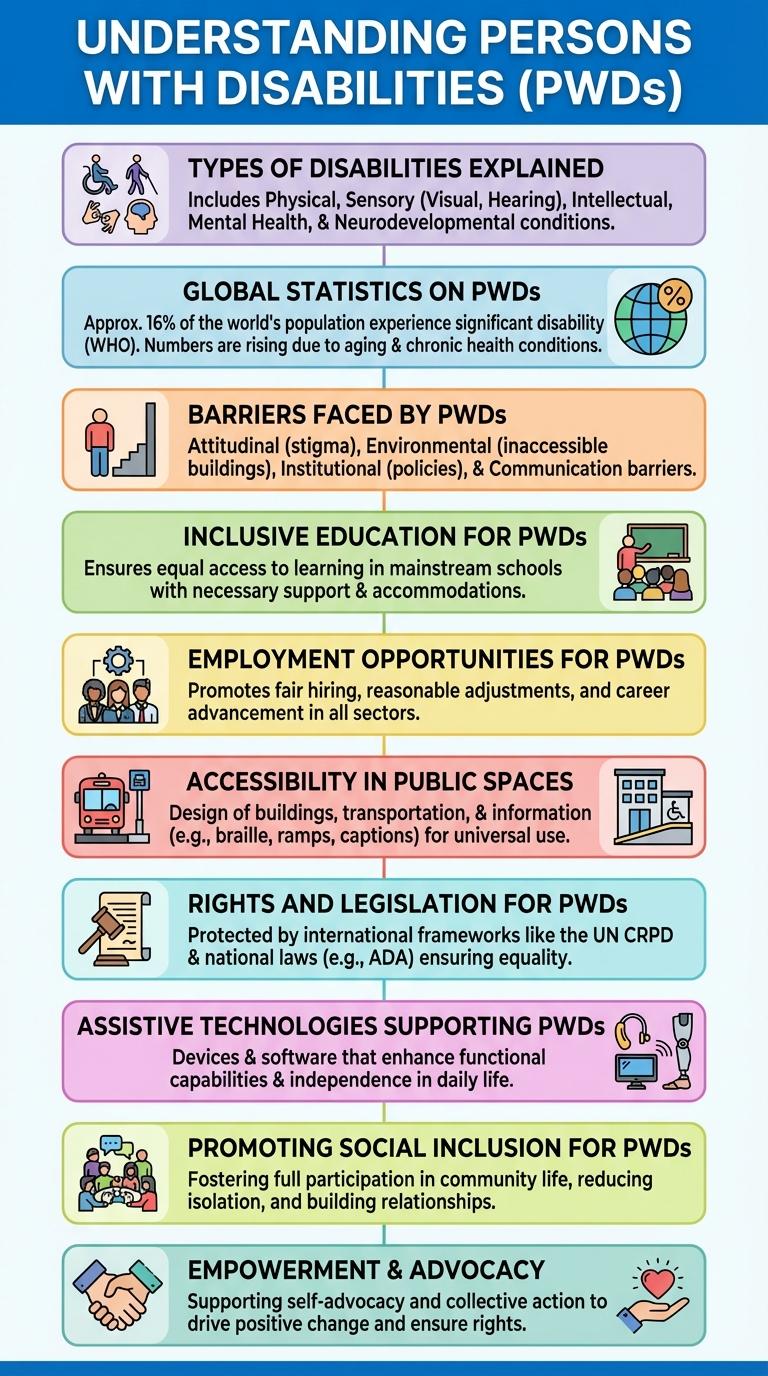
Infographics about persons with disabilities (PWDs) provide clear, concise visual data highlighting challenges, rights, and opportunities for inclusion. They effectively communicate important statistics and promote awareness to foster accessibility and equity. These graphics empower communities to develop supportive environments tailored to the needs of PWDs.
Understanding Persons with Disabilities (PWDs)
Persons with Disabilities (PWDs) encompass individuals with physical, sensory, intellectual, or mental impairments that may affect their daily activities and participation in society. Understanding PWDs involves recognizing diverse needs, promoting accessibility, and ensuring equal opportunities in education, employment, and social inclusion. Empowering PWDs requires inclusive policies, adaptive technologies, and community support to foster independence and improve quality of life.
Types of Disabilities Explained
People with Disabilities (PWDs) encompass a diverse range of conditions affecting physical, mental, sensory, and cognitive functions. Understanding the types of disabilities helps promote inclusion and accessibility across all environments.
- Physical Disabilities - Affect mobility or physical capacity, including conditions such as paralysis or amputations.
- Sensory Disabilities - Involve impairments in vision or hearing, like blindness or deafness.
- Mental Disabilities - Include intellectual or developmental disorders impacting cognitive functioning.
Global Statistics on PWDs
People with disabilities (PWDs) represent a significant portion of the global population, highlighting the importance of inclusive policies and accessibility. Accurate global statistics help in understanding the challenges faced by PWDs and promote better support systems.
The World Health Organization estimates that over 1 billion people worldwide live with some form of disability, accounting for about 15% of the global population.
- Prevalence of Disability - Approximately 15% of the world's population experience disabilities, making this group one of the largest minority populations globally.
- Disability and Age - The likelihood of having a disability increases with age, affecting an estimated 46% of people over 60 years old.
- Access to Employment - Only about 50% of working-age people with disabilities are employed compared to 75% of those without disabilities.
- Educational Barriers - Globally, children with disabilities are less likely to attend school, with enrollment rates significantly lower than those of non-disabled peers.
- Disability in Low-Income Countries - About 80% of people with disabilities live in low- and middle-income countries, where access to health and social services is often limited.
Barriers Faced by PWDs
Persons with Disabilities (PWDs) encounter various barriers that limit their full participation in society. These obstacles span physical, social, and institutional dimensions.
Physical barriers include inaccessible buildings and transportation systems that restrict mobility. Social barriers involve negative attitudes and stigma, leading to exclusion and discrimination.
Inclusive Education for PWDs
Inclusive education ensures that Persons With Disabilities (PWDs) have equal access to quality learning environments. It promotes an adaptable curriculum and accessible facilities to meet diverse needs.
Schools that implement inclusive education foster social integration and improve academic outcomes for PWDs. Training educators and providing assistive technologies are key components of this approach.
Employment Opportunities for PWDs
What are the key employment opportunities available for Persons with Disabilities (PWDs)? Employment sectors such as information technology, education, and customer service actively recruit PWDs to leverage their unique skills. Inclusive workplaces enhance productivity and foster innovation by integrating diverse talents.
How do companies support PWDs in the workplace? Many organizations implement reasonable accommodations, like flexible work hours and adaptive technologies, to facilitate job performance. These measures help create equitable environments where PWDs can thrive professionally.
Which government programs encourage the hiring of PWDs? Various initiatives, including tax incentives and vocational training programs, promote employment among PWDs. These support systems aim to reduce unemployment rates and empower PWDs economically.
What are the benefits of employing PWDs for businesses? Inclusive hiring improves company reputation and broadens market reach by reflecting diverse customer bases. Businesses also benefit from enhanced problem-solving abilities and employee loyalty.
How can PWDs enhance their employment prospects? Gaining specialized skills through training and certifications increases competitiveness in the job market. Networking and advocacy groups provide resources and support for career advancement.
Accessibility in Public Spaces
Accessibility in public spaces is essential for Persons With Disabilities (PWDs) to participate fully in society. Features like ramps, tactile paving, and audible signals ensure safe and independent navigation. Inclusive design fosters equality and improves the quality of life for all community members.
Rights and Legislation for PWDs
Persons with disabilities (PWDs) are protected under various laws that ensure their rights to equality, accessibility, and inclusion. These legislations promote non-discrimination and guarantee access to education, employment, and public services.
The United Nations Convention on the Rights of Persons with Disabilities (UN CRPD) is a key international treaty guiding national policies. Many countries have enacted specific laws such as the Americans with Disabilities Act (ADA) in the United States or the Rights of Persons with Disabilities Act in India. These laws mandate reasonable accommodations and accessibility standards to support full participation in society.
Assistive Technologies Supporting PWDs
Assistive technologies play a vital role in enhancing the independence and quality of life for persons with disabilities (PWDs). These innovations support various disabilities, enabling better communication, mobility, and daily functioning.
- Screen Readers - Software that converts text to speech, allowing visually impaired users to access digital content.
- Hearing Aids - Devices that amplify sound for individuals with hearing loss to improve auditory perception.
- Wheelchair Innovations - Advanced mobility aids including powered and customizable wheelchairs for enhanced movement.
- Speech Recognition - Technology that translates spoken words into text, aiding those with motor impairments.
- Adaptive Keyboards - Customized input devices designed to assist users with limited hand dexterity.
Integration of these assistive technologies fosters inclusivity and promotes equal opportunities for PWDs in various aspects of life.