
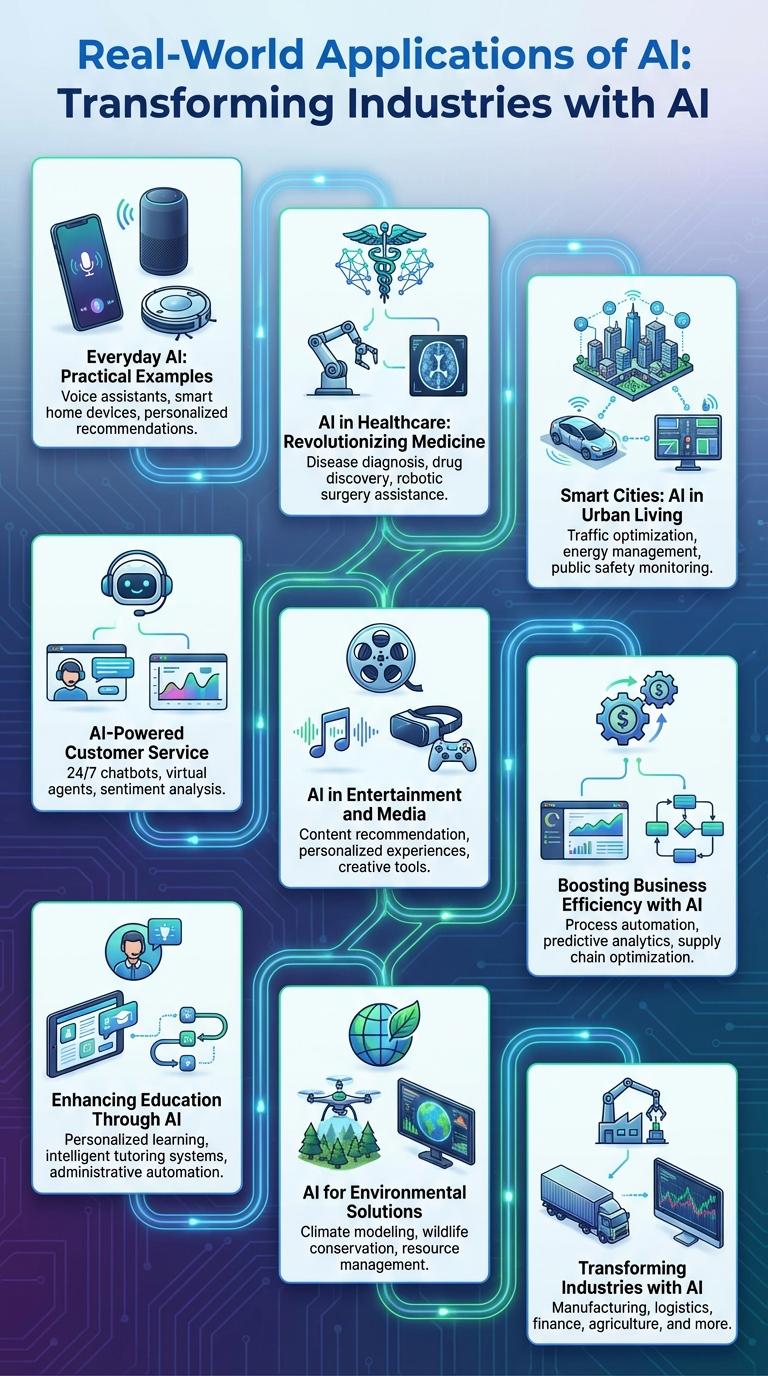
An infographic about AI example visually breaks down complex concepts into clear, engaging segments that highlight real-world applications and benefits. It uses data visualization to simplify the understanding of artificial intelligence technologies across industries such as healthcare, finance, and marketing. This approach enhances learning by making technical information accessible and memorable through striking graphics and concise explanations.
Real-World Applications of AI
Artificial Intelligence (AI) drives innovation across multiple industries by enabling machines to perform tasks that typically require human intelligence. Key real-world applications include healthcare diagnostics, autonomous vehicles, and personalized marketing. These uses illustrate AI's impact on efficiency, accuracy, and user experience in everyday life.
Transforming Industries with AI
Artificial intelligence (AI) is revolutionizing various industries by enhancing efficiency and unlocking new opportunities. Companies leverage AI technologies to streamline processes and improve decision-making.
- Healthcare Innovation - AI-driven diagnostics and personalized treatment plans improve patient outcomes significantly.
- Financial Services - AI algorithms enable fraud detection, risk assessment, and automated trading for better financial management.
- Manufacturing Automation - AI-powered robotics and predictive maintenance reduce downtime and increase production quality.
AI continues to transform industry landscapes by enabling smarter workflows and fostering innovation across sectors.
Everyday AI: Practical Examples
How is AI integrated into daily routines? AI simplifies tasks like managing schedules and smart home devices, making everyday life more efficient. Voice assistants such as Alexa and Siri offer hands-free control and quick information access.
What role does AI play in online shopping? Personalized recommendations powered by AI help users find relevant products based on browsing history and preferences. AI-driven chatbots provide instant customer service, improving the shopping experience.
How does AI enhance transportation? Navigation apps utilize AI to offer real-time traffic updates and route optimizations, reducing travel time. Self-driving car technology leverages AI to improve safety and convenience.
In what ways is AI used in healthcare at home? Wearable devices monitor vital signs and use AI to predict health issues before they become critical. Virtual health assistants remind patients to take medications and track symptoms.
How does AI assist with entertainment choices? Streaming platforms deploy AI algorithms to suggest movies, music, and shows tailored to user preferences. AI analyzes viewing habits to continuously refine content recommendations.
AI in Healthcare: Revolutionizing Medicine
Artificial Intelligence (AI) is transforming healthcare by enabling faster diagnoses and personalized treatment plans. AI algorithms analyze medical data to detect diseases early, improving patient outcomes.
Machine learning models assist in drug discovery and robotic surgeries, enhancing precision and efficiency. AI-powered tools reduce costs and streamline hospital operations, revolutionizing modern medicine.
Smart Cities: AI in Urban Living
AI is transforming urban living by creating smart cities that enhance efficiency and sustainability. These technologies integrate data-driven solutions to improve transportation, energy management, and public safety.
- Traffic Optimization - AI analyzes real-time traffic data to reduce congestion and improve commute times.
- Energy Management - Smart grids use AI to optimize energy consumption and reduce waste in buildings.
- Public Safety - AI-powered surveillance and predictive analytics enhance crime detection and emergency response.
AI-Powered Customer Service
AI-powered customer service revolutionizes how businesses interact with their clients by using advanced algorithms to provide instant, personalized support. This technology improves response time and customer satisfaction through automated chatbots and intelligent virtual assistants.
These AI systems analyze customer queries in real-time, delivering accurate solutions or routing complex issues to human agents. Companies benefit from reduced operational costs and increased efficiency in handling large volumes of customer interactions. The integration of natural language processing and machine learning enhances understanding and adapts responses to individual customer needs.
AI in Entertainment and Media
| AI Application | Example in Entertainment and Media |
|---|---|
| Content Recommendation | Streaming platforms like Netflix use AI algorithms to analyze user preferences and viewing habits, offering personalized movie and show suggestions. |
| Deepfake Technology | AI-driven deepfake tools enable realistic digital face swapping for visual effects in films and advertising campaigns. |
| Script Writing Assistance | AI-powered tools like OpenAI's GPT models help generate plot ideas, dialogue, and screenplays for creative professionals. |
| Virtual Reality (VR) Enhancement | AI enhances immersive VR experiences by adapting environments and interactions based on real-time user input. |
| Music Composition | AI systems such as AIVA and Amper Music compose original soundtracks and scores tailored to specific media projects. |
Boosting Business Efficiency with AI
Artificial intelligence (AI) transforms business operations by automating repetitive tasks and enhancing decision-making processes. Companies leveraging AI report significant improvements in efficiency and cost savings.
Boosting Business Efficiency with AI involves integrating smart technologies that streamline workflows and optimize resource allocation.
- Automated Customer Support - AI-powered chatbots handle customer inquiries instantly, reducing wait times and operational costs.
- Predictive Analytics - AI systems analyze data trends to forecast demand, enabling better inventory and supply chain management.
- Process Automation - Robotic Process Automation (RPA) streamlines routine tasks, freeing employees to focus on strategic work.
Enhancing Education Through AI
Artificial Intelligence (AI) is revolutionizing education by personalizing learning experiences and improving student outcomes. Intelligent tutoring systems analyze individual progress and adapt content to meet diverse learning needs.
AI-powered tools assist educators by automating administrative tasks and providing real-time insights into student performance. Virtual classrooms and AI-driven simulations create engaging, interactive environments that foster deeper understanding.