
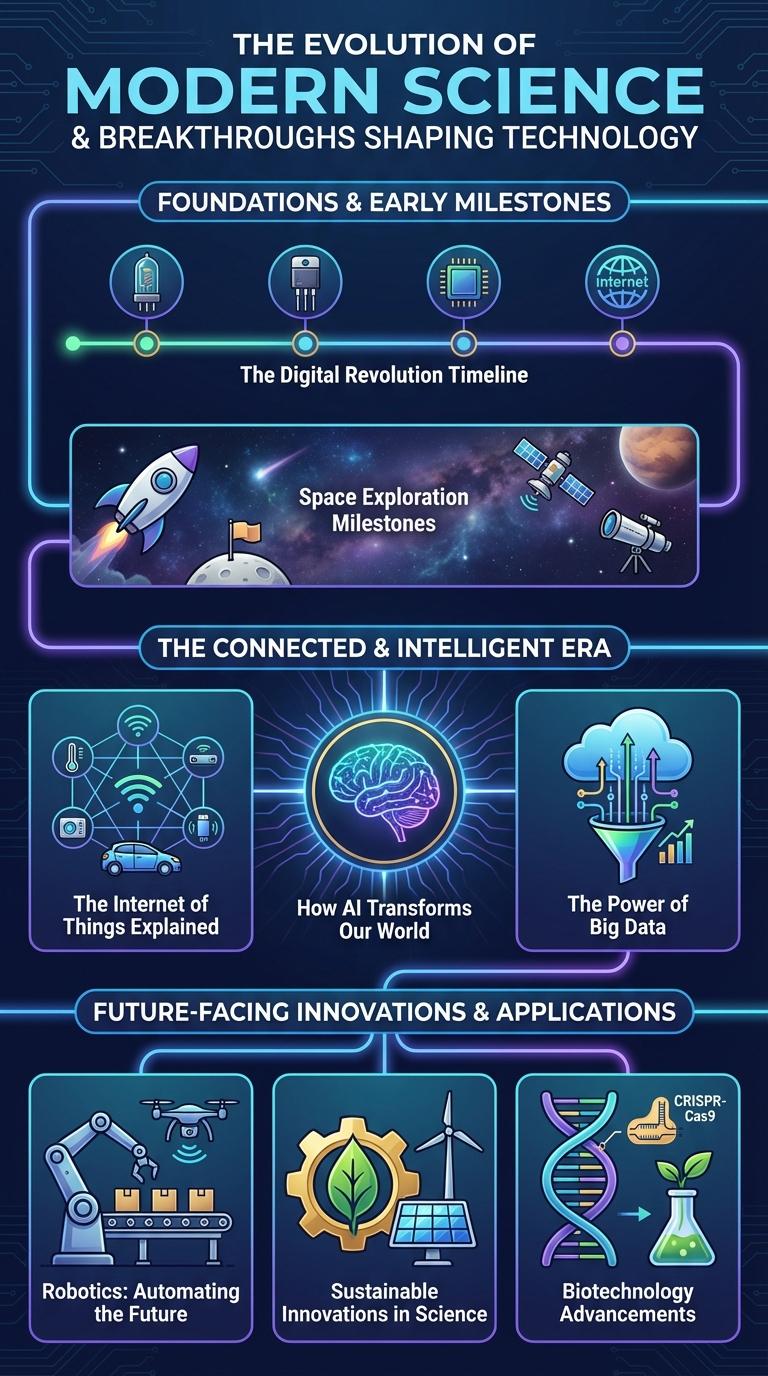
Science and technology drive innovation and shape the modern world through rapid advancements in research and development. Visualizing complex data and breakthroughs in an infographic makes it easier to understand trends, impacts, and key concepts. This infographic highlights the latest discoveries, emerging technologies, and their applications across various fields.
The Evolution of Modern Science
Science and technology have undergone significant transformations since the Renaissance, paving the way for modern innovations. Key developments in physics, chemistry, and biology established the foundation for contemporary scientific understanding.
Advancements during the Industrial Revolution accelerated technological progress, introducing machinery and new manufacturing processes. The 20th century witnessed breakthroughs in digital technology, genetics, and space exploration, reshaping human capabilities and knowledge.
Breakthroughs Shaping Technology
Recent breakthroughs in artificial intelligence and quantum computing are revolutionizing the technology landscape. Innovations like machine learning algorithms and quantum processors enable faster data analysis and problem-solving capabilities.
Advancements in renewable energy technologies, including solar and battery storage, contribute significantly to sustainable development. These scientific developments drive efficiency improvements across multiple industries worldwide.
How AI Transforms Our World
Artificial Intelligence (AI) is revolutionizing industries by automating complex tasks and enhancing decision-making processes. AI-driven technologies such as machine learning, natural language processing, and computer vision enable advancements in healthcare, finance, and transportation. These innovations improve efficiency, accuracy, and accessibility, fundamentally transforming how we live and work.
The Power of Big Data
What makes Big Data a driving force in science and technology? Big Data enables unprecedented analysis and insight by processing vast amounts of information at high speed. This capability transforms industries, fuels innovation, and improves decision-making in real time.
Sustainable Innovations in Science
Sustainable innovations in science focus on developing technologies that minimize environmental impact while maximizing efficiency. Breakthroughs in renewable energy, biodegradable materials, and waste reduction are transforming industries toward greener futures. These advancements contribute significantly to combating climate change and promoting ecological balance.
The Internet of Things Explained
The Internet of Things (IoT) connects everyday devices to the internet, enabling smart communication and automation. IoT technology transforms data into actionable insights, enhancing efficiency in various sectors.
- Connected Devices - IoT links physical objects like sensors, appliances, and vehicles to online networks for real-time data exchange.
- Data Collection - IoT devices gather and transmit data continuously to improve monitoring and decision-making processes.
- Automation and Control - IoT enables remote management and automation of systems across industries such as healthcare, agriculture, and manufacturing.
Robotics: Automating the Future
Robotics is transforming industries by automating complex tasks with precision and efficiency. Innovations in artificial intelligence and machine learning drive robots to perform adaptive and intelligent operations.
- Industrial Automation - Robots enhance manufacturing by increasing speed, accuracy, and safety in production lines.
- Healthcare Robotics - Surgical robots assist doctors in performing minimally invasive procedures with greater control.
- AI Integration - Machine learning enables robots to learn from data, improving decision-making and task execution.
Space Exploration Milestones
Space exploration has revolutionized our understanding of the universe, driving technological advancements and inspiring global collaboration. Key milestones mark humanity's journey from early rocketry to manned missions and robotic explorers.
The launch of Sputnik 1 in 1957 was the first artificial satellite orbiting Earth, igniting the space race. Apollo 11's moon landing in 1969 demonstrated human capability to explore extraterrestrial surfaces. Recent missions like the Mars rovers and the James Webb Space Telescope continue to expand knowledge beyond our planet.
Biotechnology Advancements
| Biotechnology Advancements | Impact and Description |
|---|---|
| CRISPR Gene Editing | Enables precise modification of DNA sequences, revolutionizing genetic research, disease treatment, and crop improvement. |
| Personalized Medicine | Uses genetic profiles to tailor treatments, improving drug efficacy and reducing side effects. |
| Synthetic Biology | Designs and constructs new biological parts and systems for applications in biofuels, pharmaceuticals, and industrial enzymes. |
| Regenerative Medicine | Develops therapies like stem cell treatments to repair or replace damaged tissues and organs. |
| Biosensors | Integrates biological components with electronic systems for real-time monitoring of health and environmental conditions. |