
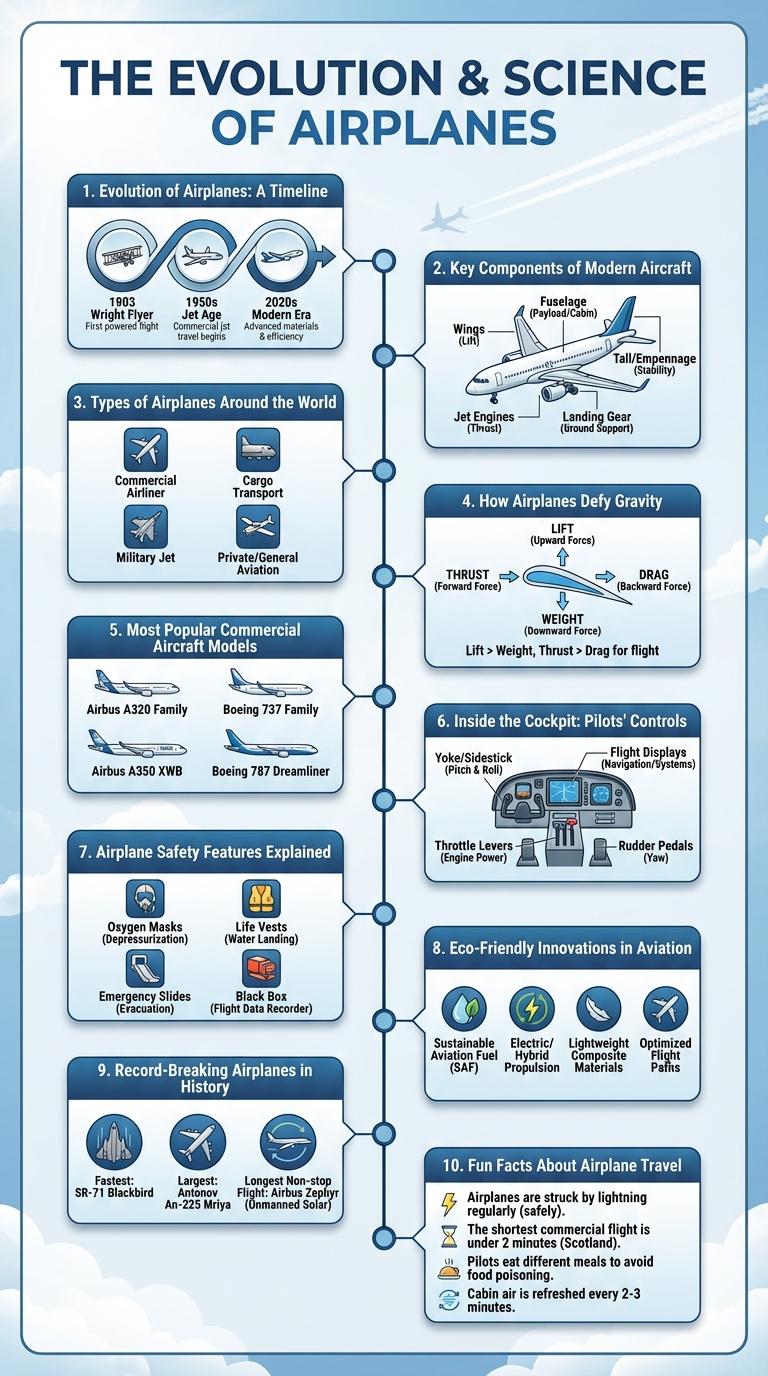
Airplanes have revolutionized global travel by significantly reducing journey times and connecting distant destinations. This infographic highlights key facts about their design, history, and impact on transportation. Explore how advancements in aviation technology continue to shape modern flight experiences.
Evolution of Airplanes: A Timeline
How have airplanes evolved over time? The development of airplanes marks a significant journey from simple gliders to advanced jet engines. Understanding this timeline highlights key innovations that shaped modern aviation.
| Year | Milestone |
| 1903 | Wright brothers achieve the first powered flight with Flyer I. |
| 1930s | Introduction of all-metal monoplanes improving speed and durability. |
| 1947 | Bell X-1 breaks the sound barrier, marking supersonic flight. |
| 1958 | First commercial jet airliner, Boeing 707, revolutionizes air travel. |
| 2005 | Introduction of fuel-efficient composite materials and fly-by-wire technology. |
Key Components of Modern Aircraft
Modern airplanes consist of essential components that ensure safety, performance, and efficiency. The fuselage houses passengers and cargo, while the wings generate lift for flight. Advanced avionics systems provide navigation, communication, and control functionalities crucial for modern aviation.
Types of Airplanes Around the World
Airplanes come in various types designed for different purposes and capabilities. Understanding the main types helps in recognizing their unique roles in aviation worldwide.
- Commercial Airplanes - Large aircraft used primarily for transporting passengers and cargo over long distances.
- Military Airplanes - Specialized planes built for defense, reconnaissance, and combat missions.
- General Aviation Airplanes - Smaller aircraft used for private, training, and recreational flying.
Each airplane type plays a critical role in the global air transportation ecosystem.
How Airplanes Defy Gravity
Airplanes defy gravity through the principle of lift generated by their wings. As air flows over and under the wings, the difference in pressure creates an upward force counteracting gravity.
The engines provide thrust to move the airplane forward, ensuring continuous airflow over the wings. This combination of lift and thrust allows airplanes to stay aloft and maneuver through the sky.
Most Popular Commercial Aircraft Models
| Aircraft Model | Key Features |
|---|---|
| Boeing 737 | Short to medium range, single-aisle, over 10,000 units produced |
| Airbus A320 | Single-aisle, fly-by-wire technology, widely used for domestic and regional flights |
| Boeing 777 | Long-range, wide-body, twin-engine, high fuel efficiency |
| Airbus A350 | Ultra long-range, composite materials, advanced aerodynamics |
| Boeing 787 Dreamliner | Mid-size, wide-body, composite structure, improved passenger comfort |
Inside the Cockpit: Pilots' Controls
The cockpit is the central command center of an airplane, housing all essential controls and instruments pilots need to operate the aircraft safely. It is equipped with advanced technology to monitor flight parameters and navigate through various conditions.
Pilots use a combination of control yokes, throttles, and pedals to manage the airplane's direction, speed, and altitude. Instrument panels provide critical data including airspeed, altitude, heading, and engine performance for precise control during every phase of flight.
Airplane Safety Features Explained
Airplanes are equipped with multiple safety features designed to protect passengers during flights. These features include advanced navigation systems, reinforced cockpit doors, and emergency oxygen masks.
Modern aircraft utilize radar and GPS technology to avoid collisions and navigate safely through varying weather conditions. Cabin pressure controls maintain oxygen levels, ensuring passenger comfort and safety at high altitudes. Emergency slides and life vests are standard, facilitating quick evacuation in case of emergencies.
Eco-Friendly Innovations in Aviation
Eco-friendly innovations in aviation focus on reducing carbon emissions and increasing fuel efficiency through advanced technologies. Airlines are adopting sustainable aviation fuels (SAFs), which can lower greenhouse gas emissions by up to 80% compared to traditional jet fuel. Electric and hybrid aircraft designs, along with improved aerodynamics, contribute to greener skies and a more sustainable future for air travel.
Record-Breaking Airplanes in History
Airplanes have transformed transportation and set numerous impressive records throughout history. These record-breaking aircraft showcase advancements in speed, size, and endurance.
- Concorde - The Concorde holds the record for the fastest commercial passenger airplane, reaching speeds over Mach 2.
- Lockheed SR-71 Blackbird - Known as the fastest jet-propelled aircraft, it could fly at speeds exceeding 2,193 mph.
- Antonov An-225 Mriya - This is the largest and heaviest cargo airplane ever built, capable of carrying over 250 tons.