
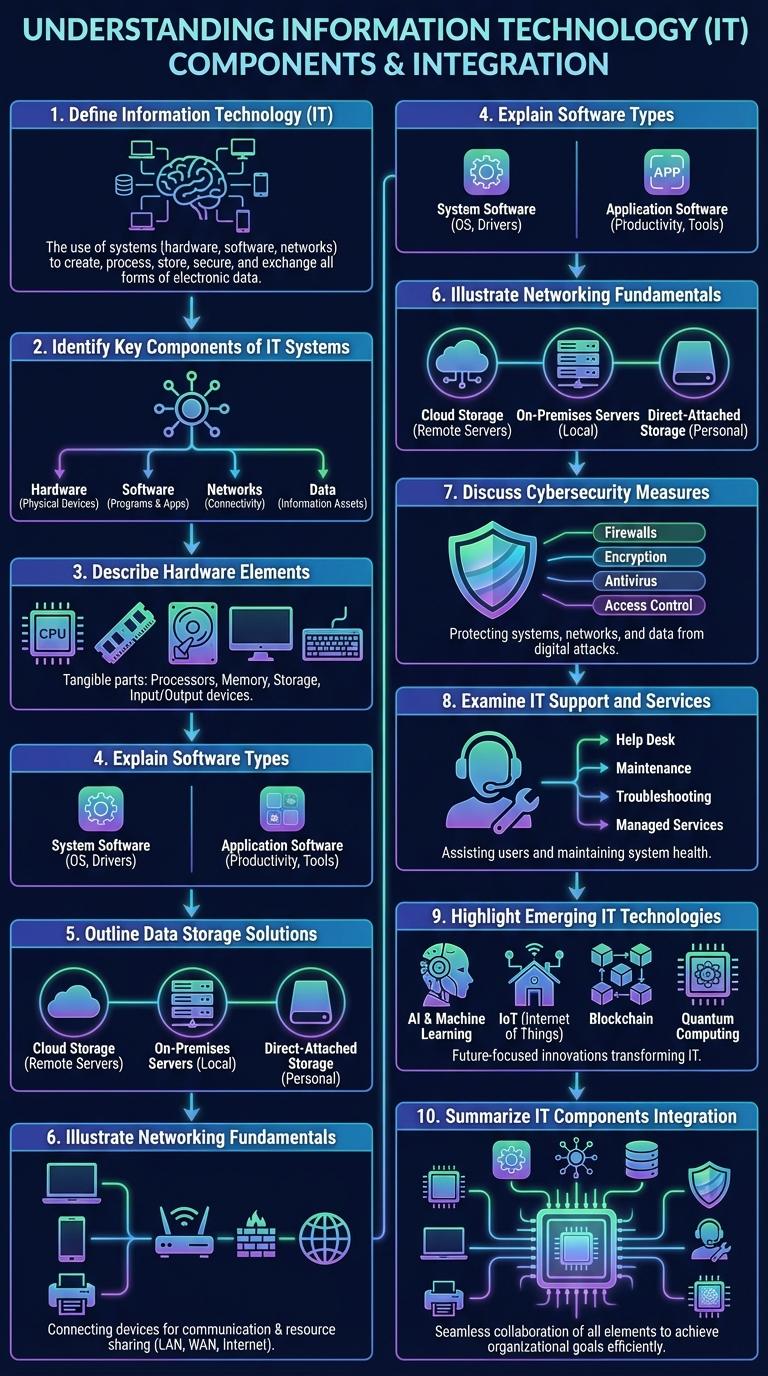
Identify and describe the key components of information technology systems, including hardware, software, networks, and data storage. Students should visually represent each element's function and how they interconnect within an IT infrastructure. Emphasizing clarity and accuracy helps convey complex concepts in an easily understandable format.
Define Information Technology (IT)
Information Technology (IT) refers to the use of computers, software, networks, and other electronic devices to store, process, and transmit data. IT encompasses various components that work together to manage information efficiently in organizations and daily life.
- Hardware - Physical devices such as computers, servers, and networking equipment that form the foundation of IT systems.
- Software - Programs and applications that instruct hardware to perform specific tasks and manage data.
- Networking - Communication systems that connect computers and devices to share resources and information securely.
Identify Key Components of IT Systems
An infographic assignment about IT components would likely ask students to identify key components of IT systems such as hardware, software, and network infrastructure. Students might be required to illustrate how these components interact to support overall system functionality. Emphasis on clearly labeling each part and explaining its role enhances understanding of IT system architecture.
Describe Hardware Elements
An infographic assignment about IT components would likely ask students to describe hardware elements clearly and concisely. Hardware consists of physical devices essential for computing operations.
Students should explain major hardware elements such as the central processing unit (CPU), which acts as the brain of the computer, handling instructions and processing data. Random Access Memory (RAM) temporarily stores data for quick access during tasks, improving system speed. Storage devices, like hard drives or solid-state drives, retain data permanently, ensuring information is saved and retrievable.
Explain Software Types
An infographic assignment about IT components would likely ask students to explain software types by categorizing them into system software, application software, and middleware. System software includes operating systems and utilities that manage hardware and provide a platform for applications. Application software refers to programs designed for specific tasks like word processing, while middleware connects different software systems for seamless communication.
Outline Data Storage Solutions
An infographic assignment about IT components would likely ask students to highlight various data storage solutions. Students need to illustrate the differences between primary and secondary storage options effectively.
Key data storage solutions include solid-state drives (SSD), hard disk drives (HDD), cloud storage, and optical discs. The infographic should emphasize capacity, speed, durability, and cost factors for each storage type.
Illustrate Networking Fundamentals
Networking fundamentals involve understanding the components that enable communication between devices. An infographic assignment about IT components would help students visualize these core concepts effectively.
- Network Interface Card (NIC) - A hardware component that connects a computer to a network, enabling data transmission.
- Router - A device that directs data packets between different networks, managing traffic and connectivity.
- Switch - A networking device that connects multiple devices within the same network, facilitating efficient data exchange.
Students should focus on illustrating how these components interact to form a functional network infrastructure.
Discuss Cybersecurity Measures
An infographic assignment about IT components would likely ask students to identify key cybersecurity measures essential for protecting digital assets. Students might need to illustrate how firewalls, antivirus software, and encryption safeguard information systems.
The assignment could also require explaining the importance of user authentication and regular software updates in maintaining security. Emphasizing best practices like strong passwords and multi-factor authentication helps prevent unauthorized access and data breaches.
Examine IT Support and Services
| IT Support | IT Services |
|---|---|
| Help Desk Assistance: Provides troubleshooting and technical support to users. | Cloud Services: Includes data storage, computing power, and software delivered remotely. |
| Network Management: Ensures connectivity, security, and optimal performance of IT networks. | Software Development: Custom applications and maintenance to meet business needs. |
| Hardware Maintenance: Repairs, upgrades, and installation of physical devices. | Cybersecurity Services: Protects systems against malware, breaches, and unauthorized access. |
| User Training: Educates employees about new systems and technology best practices. | IT Consulting: Provides expertise to improve technology strategies and infrastructure. |
Highlight Emerging IT Technologies
An infographic assignment about IT components encourages students to explore and present advanced technological trends. Students should focus on highlighting emerging IT technologies that are transforming the industry.
These technologies include innovations in computing, connectivity, and data management that drive digital evolution.
- Artificial Intelligence (AI) - AI enables machines to perform tasks that typically require human intelligence, enhancing automation and data analysis.
- Edge Computing - Edge computing processes data locally on devices to reduce latency and improve real-time decision making.
- Quantum Computing - Quantum computing leverages quantum mechanics to solve complex problems faster than classical computers.