
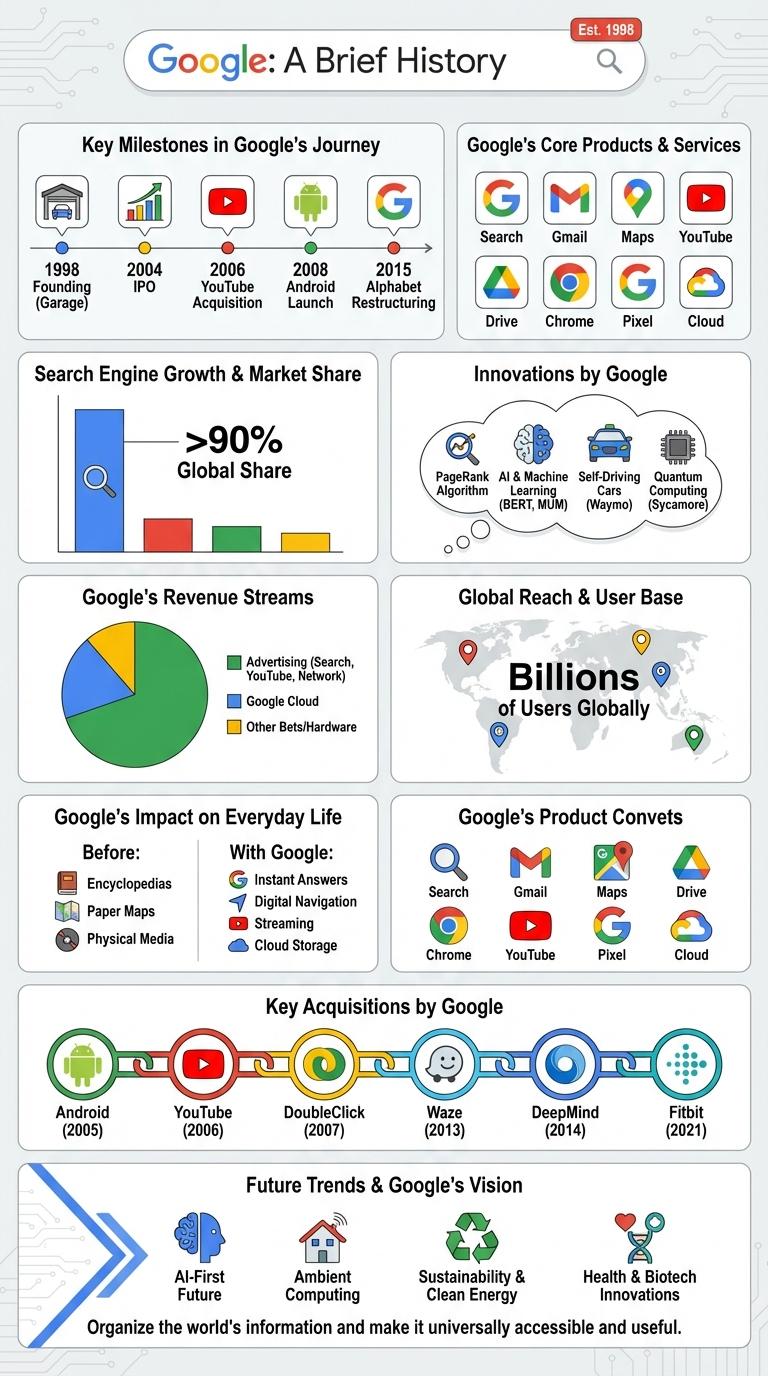
Google's extensive ecosystem spans search engines, advertising platforms, cloud services, and artificial intelligence technologies. This infographic visually breaks down key data points, user statistics, and market impacts of Google's innovations. Explore how Google's tools influence digital marketing, information retrieval, and global online connectivity.
Google: A Brief History
| Year | Milestone |
|---|---|
| 1996 | Google began as "Backrub," a research project by Larry Page and Sergey Brin at Stanford University. |
| 1998 | Officially founded as Google Inc.; the company launched its first search engine. |
| 2004 | Google went public with an initial public offering (IPO) raising $1.67 billion. |
| 2006 | Acquired YouTube, expanding its video content and advertising reach. |
| 2015 | Created Alphabet Inc. as the parent company, restructuring Google's core business. |
Key Milestones in Google's Journey
Google, founded in 1998 by Larry Page and Sergey Brin, revolutionized the internet with its powerful search engine. It quickly became the world's most popular search platform, handling billions of queries daily.
In 2004, Google launched its initial public offering (IPO), marking a significant milestone with widespread investor confidence. The company expanded its services with innovations like Gmail in 2004 and Android in 2005, shaping the future of digital communication and mobile technology.
Google's Core Products & Services
Google is a global technology leader known for its innovative internet-related products and services. The company's portfolio spans search, advertising, cloud computing, hardware, and software platforms.
- Google Search - The world's most widely used search engine providing billions of queries daily.
- Google Ads - An advertising platform driving targeted campaigns and revenue for businesses worldwide.
- Google Cloud - A comprehensive suite of cloud computing services supporting enterprise infrastructure and AI.
- Android OS - The leading mobile operating system powering billions of devices globally.
- Google Workspace - A productivity suite including Gmail, Docs, Drive, and Meet for collaboration.
Google continuously innovates to enhance user experience across its products and services.
Search Engine Growth & Market Share
Google dominates the search engine market with a global market share exceeding 90%. Its user base has consistently grown since its launch, reflecting widespread adoption and trust.
Year-over-year growth highlights Google's innovation in search algorithms and user experience. Competitors like Bing and Yahoo hold significantly smaller shares, underscoring Google's leadership position.
Innovations by Google
Google has revolutionized technology through continuous innovation in search algorithms, artificial intelligence, and user experience. Its advancements have shaped how billions access information daily.
Key innovations by Google include:
- PageRank Algorithm - The foundational search algorithm that ranks web pages based on their relevance and importance.
- Google AI and TensorFlow - Development of powerful machine learning frameworks that accelerate AI research and applications.
- Google Maps and Street View - Comprehensive mapping solutions offering real-time navigation and immersive street-level imagery.
Google's Revenue Streams
Google generates most of its revenue through advertising via Google Ads, which serves targeted ads across its search engine and partner websites. Other significant revenue streams include cloud computing services offered by Google Cloud and hardware sales such as Pixel phones and Nest devices. Additionally, subscription services like YouTube Premium and Google Workspace contribute to Google's diverse income sources.
Global Reach & User Base
How extensive is Google's global reach and user base? Google serves over 90% of the global internet population, with more than 4 billion active users worldwide. Its presence spans across more than 190 countries, facilitating information access in over 150 languages.
Google's Impact on Everyday Life
Google revolutionizes daily life by providing instant access to information and enhancing productivity through diverse digital tools. Its technologies support communication, education, and entertainment across the globe.
- Information Accessibility - Google Search processes over 8.5 billion searches per day, connecting users to knowledge effortlessly.
- Communication Tools - Gmail and Google Meet enable seamless email and video communication for over 1.5 billion users worldwide.
- Productivity Enhancement - Google Workspace integrates apps like Docs and Drive, improving collaboration for businesses and individuals.
Key Acquisitions by Google
Google has made several key acquisitions that significantly expanded its technological capabilities and market reach. Notable acquisitions include YouTube in 2006, Android in 2005, and DoubleClick in 2007. These purchases helped Google dominate online video, mobile operating systems, and digital advertising respectively.