
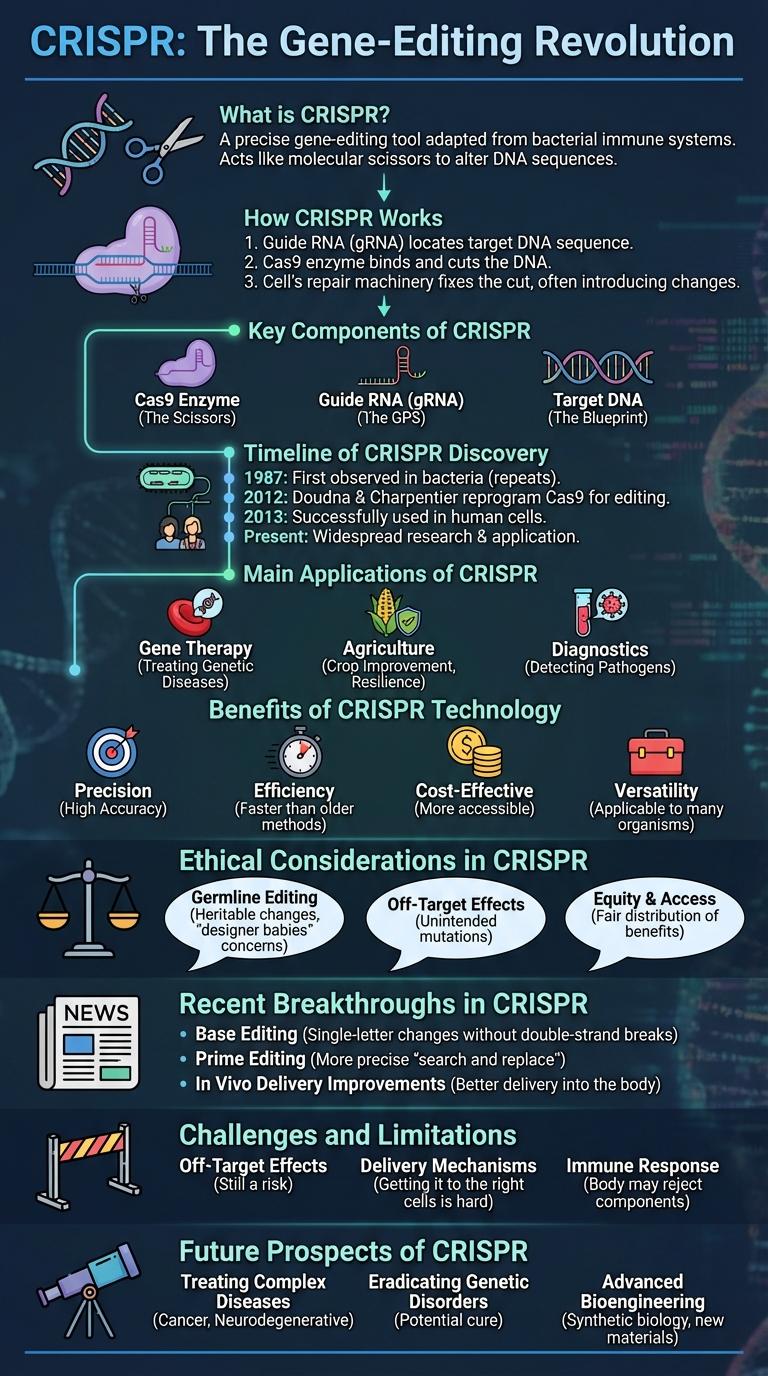
CRISPR technology revolutionizes genetic editing by enabling precise, efficient modifications to DNA sequences. This infographic highlights the mechanism behind CRISPR-Cas9, its applications in medicine, agriculture, and biotechnology, and the ethical considerations surrounding its use. Understanding these key aspects offers insight into how CRISPR shapes the future of genetic research and innovation.
What is CRISPR?
| Term | Description |
|---|---|
| CRISPR | Clustered Regularly Interspaced Short Palindromic Repeats, a technology for editing genes |
| Function | Enables precise modifications to DNA sequences in living organisms |
| Mechanism | Uses RNA-guided enzymes like Cas9 to cut DNA at specific sites |
| Origin | Derived from a natural defense system in bacteria against viruses |
| Applications | Genetic research, agriculture, medical therapies, and disease treatment |
How CRISPR Works
How does CRISPR work as a gene-editing tool?
CRISPR uses a guide RNA to locate specific DNA sequences within a genome. The Cas9 enzyme then cuts the DNA at the targeted location, allowing genes to be added, removed, or altered.
What role does the guide RNA play in CRISPR?
The guide RNA directs the Cas9 enzyme by matching the target DNA sequence precisely. This ensures accurate editing at the desired site within the genome.
How does Cas9 enzyme function in the gene-editing process?
Cas9 acts as molecular scissors that make a double-strand break in the DNA at the target location. This break triggers the cell's natural repair mechanisms to modify the genetic code.
What happens after Cas9 cuts the DNA?
The cell repairs the DNA break through non-homologous end joining or homology-directed repair. These repair pathways enable insertion, deletion, or correction of genetic material.
Why is CRISPR considered a precise gene-editing technology?
CRISPR's guide RNA provides sequence-specific targeting, minimizing off-target effects. This precision enables researchers to edit genes with high accuracy and efficiency.
Key Components of CRISPR
CRISPR technology relies on three key components: the Cas9 enzyme, guide RNA, and target DNA. Cas9 acts as molecular scissors that cut the DNA at precise locations specified by the guide RNA. The guide RNA binds specifically to the target DNA sequence, enabling accurate gene editing and modification.
Timeline of CRISPR Discovery
CRISPR, a revolutionary gene-editing technology, was first identified in bacteria in 1987. Researchers discovered that it functions as an adaptive immune system, protecting against viruses.
In 2012, Jennifer Doudna and Emmanuelle Charpentier developed the CRISPR-Cas9 tool, enabling precise DNA editing. Since then, CRISPR has transformed genetics, offering potential treatments for genetic diseases and advancements in biotechnology.
Main Applications of CRISPR
CRISPR technology revolutionizes genetic editing by enabling precise and efficient modifications to DNA sequences. Its applications span various fields, transforming research and treatments.
- Medical Therapeutics - CRISPR is used to correct genetic mutations causing inherited diseases like cystic fibrosis and sickle cell anemia.
- Agricultural Improvements - CRISPR enhances crop resistance to pests and environmental stress, increasing yield and nutritional value.
- Biomedical Research - CRISPR accelerates the study of gene functions by enabling targeted gene knockouts and modifications in model organisms.
- Gene Drives - CRISPR-based gene drives help control vector-borne diseases by spreading genetic changes through pest populations.
- Synthetic Biology - CRISPR aids in designing organisms with novel traits for industrial and environmental applications.
These main applications demonstrate CRISPR's broad impact on science, health, and agriculture worldwide.
Benefits of CRISPR Technology
CRISPR technology revolutionizes genetic engineering by enabling precise and efficient gene editing. It offers transformative benefits across medicine, agriculture, and biotechnology industries.
- Precision Editing - CRISPR allows targeted modifications at specific DNA sequences, reducing off-target effects compared to traditional methods.
- Accelerated Research - The simplicity and efficiency of CRISPR expedite functional gene studies and disease model development.
- Therapeutic Potential - CRISPR enables correction of genetic disorders, paving the way for innovative treatments and personalized medicine.
Ethical Considerations in CRISPR
CRISPR technology enables precise genetic editing with potential to cure genetic diseases. However, it raises significant ethical questions regarding its use in humans and the environment.
Ethical considerations focus on the risks of unintended mutations and long-term effects on the gene pool. Debates center on the morality of germline editing, which can pass changes to future generations. Regulation and public engagement are crucial to ensure responsible development and application.
Recent Breakthroughs in CRISPR
CRISPR technology continues to revolutionize genetic engineering with groundbreaking advancements. Recent breakthroughs have expanded its precision, efficiency, and therapeutic potential.
- Prime Editing Enhancements - New prime editing techniques enable more accurate DNA edits with reduced off-target effects.
- Base Editing Innovations - Improved base editors allow single-nucleotide changes without double-strand breaks, minimizing cell damage.
- In Vivo Gene Therapy Applications - Successful CRISPR-mediated treatments have been demonstrated in clinical trials for hereditary diseases.
- Expanded Target Range - Novel Cas variants broaden the range of editable genomic sites, increasing versatility in genetic modifications.
- Epigenetic Modulation - CRISPR tools now enable precise control of gene expression through targeted epigenetic changes.
Challenges and Limitations
CRISPR technology faces challenges including off-target effects, which can cause unintended genetic modifications. Delivery methods to target cells remain limited, reducing efficiency and safety in clinical applications. Ethical concerns and regulatory hurdles also restrict widespread use and development of CRISPR-based therapies.