
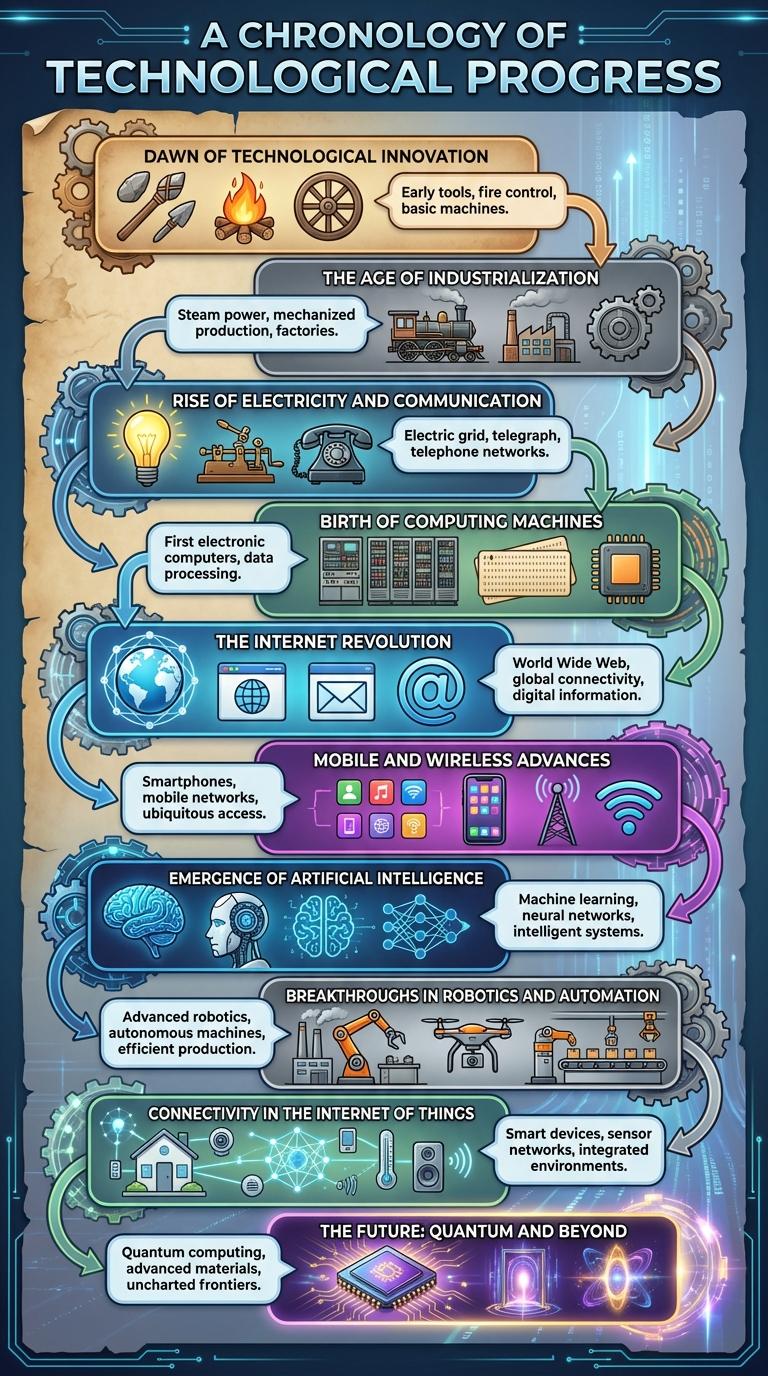
The evolution of technology reveals how innovations have shaped human progress from simple tools to advanced digital systems. Key milestones highlight breakthroughs in communication, transportation, and computing that transformed societies worldwide. Understanding this timeline provides insight into future technological trends and their potential impact.
Dawn of Technological Innovation
The dawn of technological innovation marks a pivotal era in human history, characterized by groundbreaking inventions that transformed everyday life. Early tools such as the wheel and fire harnessing laid the foundation for rapid progress in various civilizations.
These advancements spurred development in agriculture, transportation, and communication, setting the stage for future technological breakthroughs. The creation of simple machines and the discovery of metals revolutionized craftsmanship and societal organization.
The Age of Industrialization
The Age of Industrialization marked a pivotal shift in technology with the introduction of mechanized production methods in the late 18th and early 19th centuries. Innovations such as the steam engine revolutionized transportation and manufacturing processes, driving economic growth worldwide.
Factories emerged as central hubs for mass production, leading to rapid urbanization and the rise of industrial cities. This period laid the foundation for modern technological advancements by establishing the principles of automated and large-scale industrial operations.
Rise of Electricity and Communication
How did the rise of electricity transform technology?
The discovery and widespread use of electricity revolutionized industries by enabling new machinery and lighting solutions. It became the foundation for modern technological advancements throughout the 20th century.
What role did communication advancements play in technological evolution?
Innovations such as the telegraph, telephone, and radio dramatically improved information exchange speeds. These developments connected people globally and paved the way for today's digital communication networks.
Birth of Computing Machines
The birth of computing machines marks a pivotal moment in technological history, beginning with Charles Babbage's design of the Analytical Engine in the 1830s. Early mechanical computers paved the way for electronic advancements, such as the ENIAC in the 1940s, which was the first general-purpose digital computer. These innovations laid the foundation for modern computing, transforming data processing and automation.
The Internet Revolution
The Internet Revolution transformed global communication, enabling instant access to information and connecting billions of people worldwide. It sparked the rise of e-commerce, social media, and cloud computing, reshaping industries and daily life. Key innovations include the World Wide Web, broadband connectivity, and mobile internet, driving continuous technological advancement.
Mobile and Wireless Advances
The evolution of mobile and wireless technology has dramatically transformed communication and data access in the digital era. Innovations in this field continue to enhance connectivity, speed, and convenience for users worldwide.
- 1G Networks - Introduced in the 1980s, 1G brought the first generation of analog voice communication to mobile phones.
- 4G LTE Technology - Enabled faster internet speeds and improved multimedia streaming, revolutionizing mobile broadband in the 2010s.
- 5G Networks - Offer ultrafast data transfer and low latency, supporting IoT expansion and advanced mobile applications.
Continuous advancements in wireless standards and mobile devices are shaping the future of global connectivity and communication efficiency.
Emergence of Artificial Intelligence
The evolution of technology has rapidly transformed society, with artificial intelligence emerging as a pivotal development in recent decades. AI has revolutionized industries by enabling automation, enhancing data analysis, and fostering innovation.
Artificial intelligence refers to machines capable of performing tasks that typically require human intelligence, such as learning, reasoning, and problem-solving.
- Early AI Research (1950s) - Conceptual foundations laid with algorithms simulating human thought processes.
- Machine Learning Breakthroughs (1990s) - Introduction of data-driven models improving AI accuracy and capabilities.
- Modern AI Integration (2010s-Present) - AI technologies embedded in everyday applications, including virtual assistants and autonomous systems.
Breakthroughs in Robotics and Automation
| Year | Technological Breakthrough |
|---|---|
| 1954 | Unimate: First Industrial Robot introduced for automotive assembly lines. |
| 1969 | Development of Shakey the Robot, the first mobile robot with AI capabilities. |
| 1981 | Introduction of SCARA robot for precise, high-speed assembly tasks. |
| 2000s | Advancement of collaborative robots (cobots) designed to work alongside humans safely. |
| 2020s | Integration of AI and machine learning in robotics leading to autonomous operations in manufacturing and logistics. |
Connectivity in the Internet of Things
The evolution of technology has dramatically enhanced connectivity within the Internet of Things (IoT). Devices today communicate seamlessly, creating smart environments that improve efficiency and convenience.
IoT connectivity relies on advanced communication protocols such as Wi-Fi, Bluetooth, and 5G networks to link billions of devices globally. This interconnected ecosystem supports real-time data exchange, enabling smarter decision-making in homes, industries, and cities. Enhanced connectivity drives innovations like smart homes, autonomous vehicles, and precision agriculture, transforming daily life and business operations.