
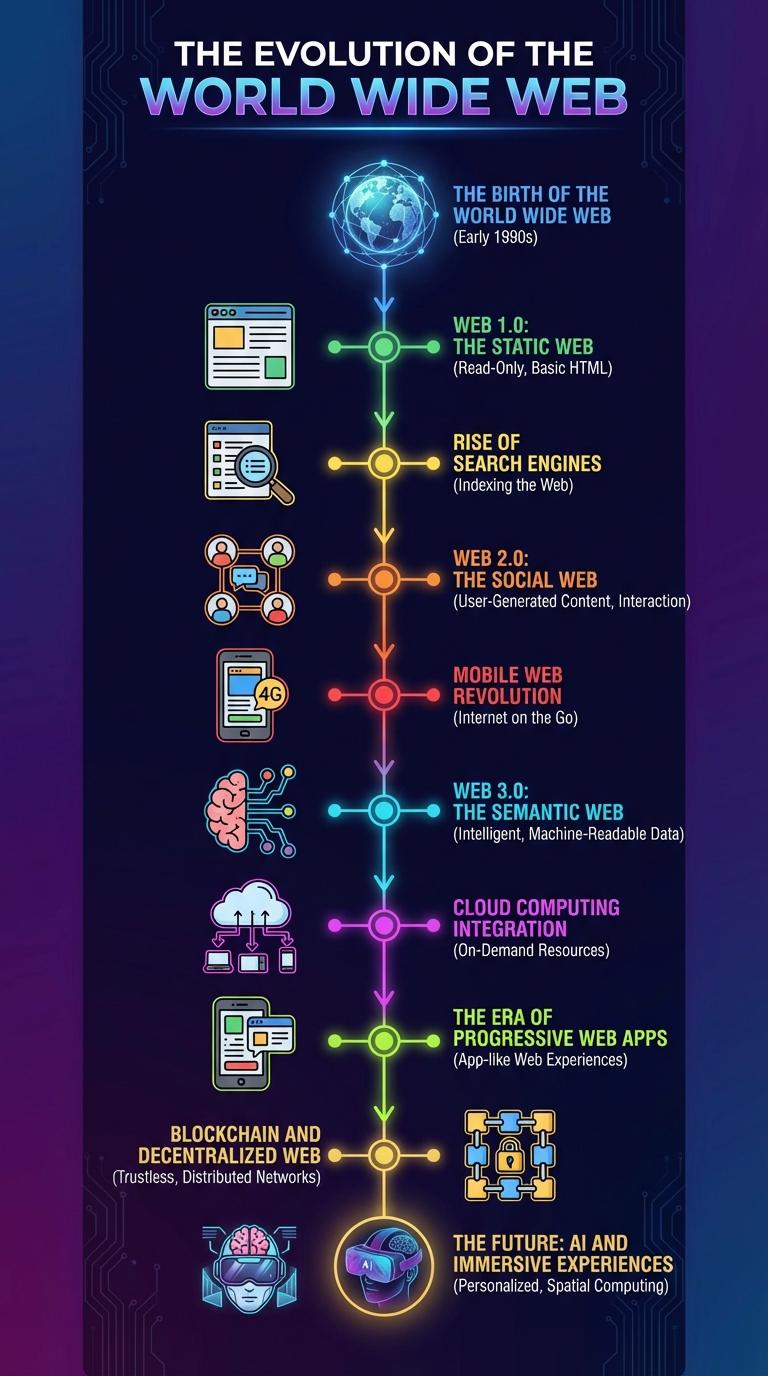
The evolution of the web traces the rapid transformation from static pages to dynamic, interactive platforms that shape modern digital experiences. Innovations like Web 2.0 introduced user-generated content and social connectivity, while emerging technologies such as Web 3.0 emphasize decentralization and semantic understanding. This infographic visually captures the milestones and technological shifts that define the web's ongoing development.
The Birth of the World Wide Web
The Birth of the World Wide Web revolutionized global communication by introducing a system to share information over the internet. Tim Berners-Lee developed this groundbreaking technology in 1989 while working at CERN.
- Invention of HTML - Tim Berners-Lee created Hypertext Markup Language (HTML) to format documents for the web.
- Development of HTTP - Hypertext Transfer Protocol (HTTP) was designed to enable communication between web browsers and servers.
- First web browser - The WorldWideWeb browser, later called Nexus, allowed users to access and navigate web pages.
Web 1.0: The Static Web
Web 1.0, known as the Static Web, emerged in the early 1990s and featured simple, read-only websites with fixed content. This era emphasized static HTML pages without interactive elements, relying heavily on text and images for information display. Users primarily consumed content, with limited opportunities for engagement or content creation.
Rise of Search Engines
The evolution of the web saw a pivotal shift with the rise of search engines in the 1990s, transforming how users accessed information online. Search engines like Yahoo, AltaVista, and eventually Google introduced algorithms that indexed and ranked web pages, making information retrieval faster and more relevant. This innovation fueled the growth of the internet by connecting users to vast digital content through keyword searches.
Web 2.0: The Social Web
Web 2.0, known as the Social Web, transformed the internet into an interactive platform centered on user-generated content and social networking. This evolution enabled collaboration, sharing, and real-time communication, shaping modern digital experiences.
- Interactive Platforms - Web 2.0 introduced websites that allow users to interact, create, and share content effortlessly.
- Social Networking Growth - Platforms like Facebook, Twitter, and LinkedIn emerged, connecting billions globally.
- User-Generated Content - Blogs, wikis, and forums empowered users to contribute and influence online information.
Mobile Web Revolution
The evolution of the web has been deeply shaped by the Mobile Web Revolution, transforming how users access and interact with online content. Mobile devices have driven new standards in responsive design, faster connectivity, and app development.
- Smartphone Adoption - The rapid increase in smartphone users globally has shifted web traffic heavily towards mobile platforms.
- Responsive Design - Websites adapted to various screen sizes, ensuring seamless user experiences across mobile devices.
- App Ecosystems - The rise of mobile applications expanded functionality and accessibility beyond traditional browsers.
Mobile connectivity continues to enhance web accessibility, fueling innovation in digital services and user engagement.
Web 3.0: The Semantic Web
| Aspect | Details |
|---|---|
| Definition | Web 3.0, known as the Semantic Web, is an extension of the current web that enables machines to understand, interpret, and respond to complex human requests based on meaning and context. |
| Core Technologies | Ontologies, RDF (Resource Description Framework), SPARQL, OWL (Web Ontology Language), Linked Data |
| Key Features | Data Interoperability, Intelligent Agents, Contextual Search, Personalization, Decentralized Data Control |
| Benefits | Improved Information Accuracy, Enhanced User Experience, Smarter Data Integration, Automated Reasoning, Better Decision Making |
| Impact on Web Evolution | Transforms Web from static content (Web 1.0) and interactive platforms (Web 2.0) into a data-driven, interconnected ecosystem that understands user intent and semantics. |
Cloud Computing Integration
Cloud computing has revolutionized the web by enabling scalable, on-demand access to computing resources over the internet. This integration allows websites and applications to leverage powerful servers and storage without investing in physical infrastructure.
Major cloud platforms like Amazon Web Services, Microsoft Azure, and Google Cloud have driven the adoption of cloud services across industries. Their global data centers ensure low latency and high availability, transforming web development and deployment models.
The Era of Progressive Web Apps
What defines the Era of Progressive Web Apps (PWAs)? PWAs combine the best of web and mobile apps, delivering fast, reliable, and engaging user experiences. These apps work offline, load quickly, and can send push notifications, blurring the line between native and web applications.
How did Progressive Web Apps revolutionize web usage? By leveraging modern web technologies like service workers and web app manifests, PWAs enable seamless offline functionality and instant loading. Major companies such as Twitter, Starbucks, and Pinterest adopted PWAs to enhance performance and user engagement.
What are key features that set PWAs apart? PWAs provide app-like interactions with features including installability, offline support, and background sync. These capabilities increase user retention and reduce data consumption compared to traditional websites.
Which technologies underpin Progressive Web Apps? Service workers handle caching and offline access while the web app manifest defines homescreen icons and launch behavior. HTTPS ensures security and trust, essential for PWAs to function correctly.
What impact have PWAs had on the web ecosystem?
| Impact | Effect |
|---|---|
| Performance | Site speeds improved by up to 50% |
| User Engagement | Increase in session length and return visits |
| Storage Savings | Reduced app installation size vs native apps |
| Cross-Platform | Works seamlessly on desktop and mobile browsers |
| Cost Efficiency | Lower development and maintenance expenses |
Blockchain and Decentralized Web
The evolution of the web has progressed from static pages to dynamic content and interactive platforms. A significant shift is towards Blockchain technology and the Decentralized Web, aiming to enhance security and user control.
Blockchain enables secure, transparent transactions through distributed ledgers, eliminating the need for central authorities. The Decentralized Web leverages this by creating peer-to-peer networks, promoting data privacy and resistance to censorship.