
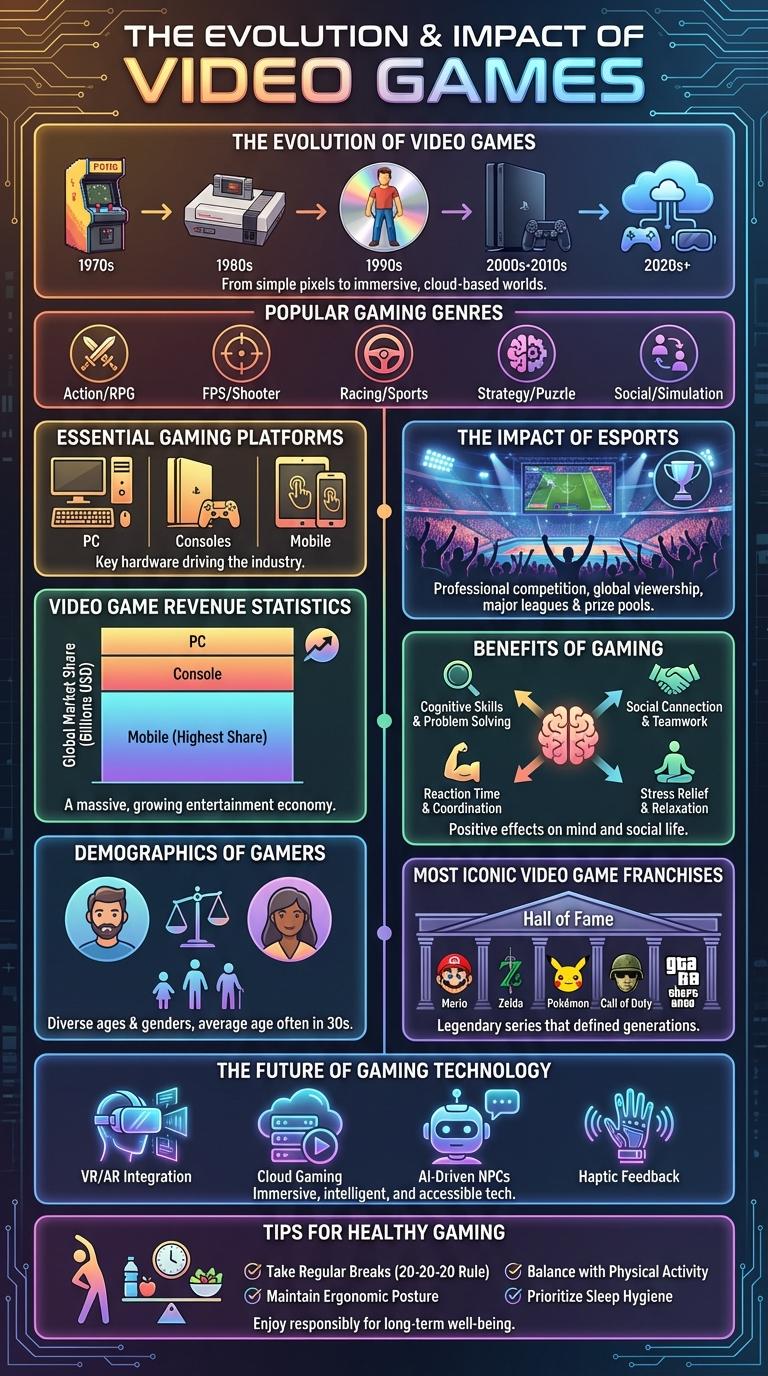
Video games combine immersive storytelling, innovative graphics, and interactive gameplay to captivate millions worldwide. Infographics visually break down complex data about gaming trends, player demographics, and industry growth. This infographic highlights key statistics and insights, showcasing the dynamic landscape of video games.
The Evolution of Video Games
How have video games evolved over the decades? Video games started as simple pixelated graphics and basic gameplay in the 1970s and 1980s. Today, they feature hyper-realistic visuals, complex storylines, and immersive virtual reality experiences.
What technological advancements propelled the evolution of video games? The introduction of 3D graphics, improved AI, and faster processors transformed gaming from 2D sprites to fully immersive 3D worlds. Online multiplayer capabilities also expanded the social aspect of gaming globally.
Which consoles marked significant milestones in video game history? The Atari 2600 popularized home gaming, the Nintendo Entertainment System revived the industry in the 1980s, and the PlayStation series advanced 3D gaming and media capabilities. Modern consoles like the Xbox Series X and PlayStation 5 deliver cutting-edge performance and graphics.
How have genres and gameplay styles changed over time? Early games focused on arcade-style challenges, while current games feature diverse genres including open-world RPGs, battle royales, and narrative-driven adventures. Player customization and interactive storytelling have become key elements.
What is the impact of video games on culture and entertainment? Video games have grown into a multi-billion-dollar industry influencing art, music, and storytelling. Esports and streaming platforms have turned gaming into a mainstream form of entertainment and community building worldwide.
Popular Gaming Genres
Video games attract millions of players worldwide, offering diverse experiences through various genres. Each gaming genre caters to different player interests and play styles.
- Action - Fast-paced gameplay requiring quick reflexes and hand-eye coordination.
- Role-Playing Games (RPGs) - Players assume character roles, immersing in storylines and character development.
- Sports - Simulates real-life sports including soccer, basketball, and racing competitions.
- Strategy - Focuses on tactical planning and decision-making to achieve objectives.
- Simulation - Emulates real-world activities such as farming, flying, or city building.
Understanding popular gaming genres helps developers design engaging content tailored to player preferences.
Essential Gaming Platforms
| Platform | Key Features |
|---|---|
| PC Gaming | Highly customizable hardware, vast game library, support for mods and multiplayer communities |
| PlayStation | Exclusive titles, advanced graphics, integrated VR support |
| Xbox | Cross-platform play with PC, Xbox Game Pass subscription, strong online multiplayer |
| Nintendo Switch | Portable and docked play modes, innovative gameplay, family-friendly exclusives |
| Mobile Gaming | Wide accessibility, touch controls, large, diverse player base |
The Impact of Esports
The rise of esports has transformed competitive gaming into a global phenomenon, attracting millions of viewers and players. This industry drives significant economic growth and cultural influence worldwide.
- Global Audience Growth - Esports reached over 450 million viewers in 2023, showcasing exponential audience expansion.
- Economic Impact - The global esports market generated $1.38 billion in revenue in 2023, highlighting its financial significance.
- Career Opportunities - Esports creates diverse job roles including players, coaches, analysts, and event managers, expanding professional pathways.
Video Game Revenue Statistics
The global video game industry generated over $200 billion in revenue in 2023, making it one of the largest entertainment markets worldwide. Mobile gaming contributed approximately 50% of this revenue, reflecting the growing popularity of mobile devices. Console and PC games together accounted for the remaining income, driven by blockbuster titles and digital sales.
Benefits of Gaming
Video games offer numerous cognitive and social benefits that enhance mental agility and teamwork skills. Engaging in gameplay can improve problem-solving abilities and hand-eye coordination.
Playing video games stimulates brain regions responsible for attention, memory, and spatial navigation. Multiplayer games foster collaboration and communication among players, promoting social interaction. Studies also suggest that gaming can reduce stress and improve mood, contributing to overall well-being.
Demographics of Gamers
The demographics of gamers are diverse, spanning various age groups, genders, and geographic regions. Understanding these demographics helps developers and marketers tailor gaming experiences and content effectively.
Approximately 59% of the global population engages in video gaming, with the average gamer age around 34 years. Gender distribution is nearly balanced, with about 46% of gamers identifying as female and 54% as male.
Most Iconic Video Game Franchises
Video games have spawned some of the most iconic franchises that define the entertainment industry. Titles like Super Mario, The Legend of Zelda, and Pokemon have captivated millions globally with their innovative gameplay and memorable characters. These franchises set standards for storytelling, design, and player engagement throughout decades.
The Future of Gaming Technology
The future of gaming technology is rapidly evolving, driven by advances in hardware, software, and immersive experiences. Cutting-edge innovations promise to transform player engagement and game design.
Emerging technologies such as cloud gaming, AI integration, and virtual reality are reshaping the gaming landscape.
- Cloud Gaming Expansion - Cloud platforms enable players to stream high-quality games on any device without needing expensive hardware.
- AI-Driven Gameplay - Artificial intelligence enhances game realism by powering adaptive NPCs and personalized player experiences.
- Virtual and Augmented Reality - VR and AR technologies provide immersive environments that blur the line between the game and reality.