
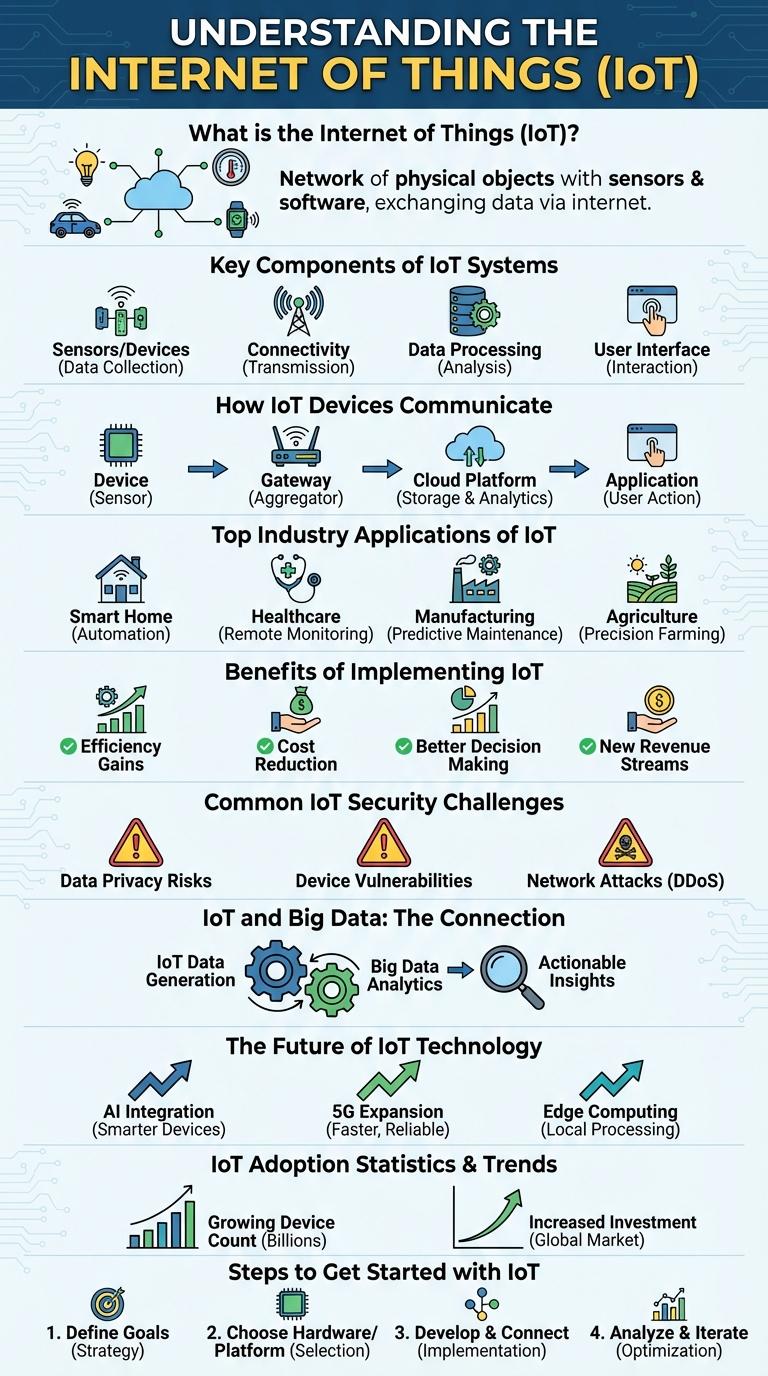
The Internet of Things (IoT) connects everyday devices through the internet, enabling seamless data exchange and automation. This infographic highlights key statistics, benefits, and applications of IoT technology across various industries. Understanding these insights reveals how IoT drives efficiency, innovation, and smart decision-making.
What is the Internet of Things (IoT)?
The Internet of Things (IoT) refers to the network of physical devices connected to the internet, enabling them to collect and exchange data. These devices range from everyday household items to complex industrial tools.
IoT enhances automation and efficiency by allowing devices to communicate without human intervention. It supports smart homes, wearable technology, and smart cities, transforming how people interact with technology. Security and data management remain key considerations as IoT continues to expand.
Key Components of IoT Systems
| Component | Description |
|---|---|
| Sensors | Devices that collect data from the environment or physical objects, such as temperature, humidity, motion, or light sensors. |
| Connectivity | Communication protocols and networks that enable data transmission between devices and cloud platforms, including Wi-Fi, Bluetooth, Zigbee, and cellular networks. |
| Data Processing | Systems that analyze and process collected data, often utilizing edge computing or cloud computing to interpret information and trigger actions. |
| User Interface | Platforms such as mobile apps or web dashboards that allow users to monitor, control, and interact with IoT devices and data. |
| Security | Measures and technologies to protect IoT systems from unauthorized access, data breaches, and cyber threats, including encryption and authentication protocols. |
How IoT Devices Communicate
IoT devices communicate through a variety of wireless and wired protocols to share data and perform tasks efficiently. This communication is critical for IoT ecosystems to function seamlessly across smart homes, industries, and cities.
- Wi-Fi Connectivity - Enables high-speed data transfer and internet access for IoT devices within local networks.
- Bluetooth and BLE - Facilitates short-range, low-energy communication between nearby IoT devices.
- Zigbee and Z-Wave - Provide mesh networking capabilities for reliable and scalable smart home device connections.
- Cellular Networks - Support wide-area communication for IoT devices traveling or located in remote areas.
- MQTT Protocol - A lightweight messaging protocol optimized for minimizing bandwidth and resource usage in IoT communications.
Top Industry Applications of IoT
The Internet of Things (IoT) connects devices across various industries, enabling real-time data exchange and smarter decision-making. Its extensive applications transform operations by enhancing efficiency and reducing costs.
Top industry applications of IoT include manufacturing, healthcare, agriculture, smart cities, and logistics. Each sector leverages IoT technology to optimize resource management, improve safety, and boost productivity.
Benefits of Implementing IoT
Implementing IoT enhances operational efficiency by enabling real-time data collection and automation across various industries. It reduces costs through predictive maintenance and optimized resource management. IoT also improves customer experiences by providing personalized services and faster response times.
Common IoT Security Challenges
Internet of Things (IoT) devices face numerous security challenges that threaten data integrity and user privacy. Common issues include weak authentication, unsecured communication channels, and insufficient software updates. Addressing these vulnerabilities is crucial to protect connected systems from cyberattacks and unauthorized access.
IoT and Big Data: The Connection
The Internet of Things (IoT) generates vast amounts of data from connected devices, enabling real-time analytics and decision-making. Big Data processes and analyzes this information to uncover patterns and insights that drive innovation and efficiency.
- Data Collection - IoT devices continuously collect diverse data types such as temperature, location, and usage statistics.
- Data Volume - The massive volume of IoT data requires scalable Big Data storage and processing solutions.
- Data Analytics - Big Data analytics transforms raw IoT data into actionable intelligence for businesses and industries.
The synergy between IoT and Big Data fosters smarter systems and enhanced operational performance across multiple sectors.
The Future of IoT Technology
What advancements will shape the future of IoT technology? IoT is evolving rapidly with innovations in AI integration and edge computing enhancing device autonomy and data processing speed. Enhanced security protocols and 5G connectivity will expand IoT applications across industries, improving efficiency and real-time decision-making.
IoT Adoption Statistics & Trends
Internet of Things (IoT) adoption continues to grow rapidly across industries, driven by increased connectivity and smart device integration. Businesses leverage IoT data to enhance efficiency, reduce costs, and innovate products.
Worldwide IoT adoption rates show significant trends in device deployment and investment growth, highlighting the technology's expanding impact.
- Global IoT Market Size Expected to Reach $1.5 Trillion by 2027 - The IoT market is projected to grow annually at a compound rate exceeding 22%, fueled by industrial and consumer demand.
- Over 75 Billion Connected IoT Devices Forecasted by 2025 - Growth in smart sensors and embedded systems is driving exponential increases in connected devices globally.
- Industrial IoT (IIoT) Adoption Surpasses 45% in Manufacturing - Manufacturers are increasingly integrating IoT for predictive maintenance and operational optimization.