
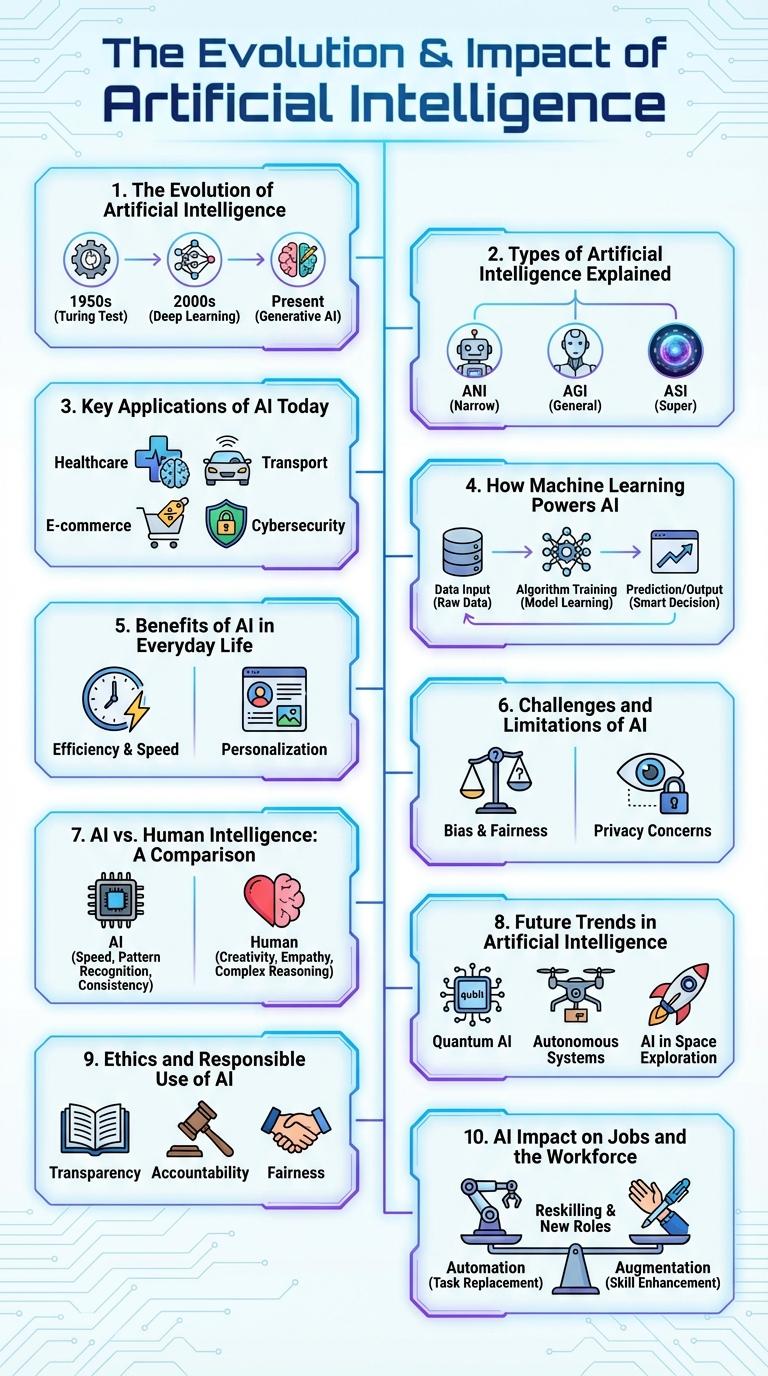
Artificial intelligence (AI) transforms industries by enabling machines to learn, analyze, and make decisions with human-like intelligence. This infographic highlights key AI technologies, applications, and trends shaping the future of innovation. Visual data representations clarify complex concepts, making AI accessible to diverse audiences.
The Evolution of Artificial Intelligence
Artificial Intelligence (AI) has rapidly evolved from basic computational models to complex systems capable of learning and reasoning. This infographic highlights key milestones in the development of AI, showcasing its transformative journey.
- Early AI Research - In the 1950s, pioneers like Alan Turing and John McCarthy laid foundational concepts of machine intelligence and coined the term "artificial intelligence."
- Machine Learning Emergence - The 1980s introduced algorithms allowing machines to learn from data, marking a shift from rule-based programming to adaptive systems.
- Deep Learning Breakthrough - Post-2010, advances in neural networks and big data computing propelled AI into capabilities such as image recognition and natural language processing.
Types of Artificial Intelligence Explained
Artificial Intelligence (AI) encompasses various types categorized by capability and function. Narrow AI, also known as Weak AI, specializes in specific tasks like speech recognition or image analysis. In contrast, General AI aims to perform any intellectual task that a human can do, while Superintelligent AI surpasses human intelligence across all domains.
Key Applications of AI Today
| Key Applications of AI | Description |
|---|---|
| Natural Language Processing | AI enables computers to understand, interpret, and generate human language for applications like chatbots, voice assistants, and translation services. |
| Computer Vision | AI powers image and video analysis for facial recognition, autonomous vehicles, medical imaging, and security surveillance. |
| Predictive Analytics | Machine learning algorithms analyze historical data to forecast trends in finance, healthcare, marketing, and supply chain management. |
| Robotic Process Automation | AI automates repetitive business processes such as data entry, invoicing, and customer service tasks to improve efficiency. |
| Personalized Recommendations | AI drives customized content and product suggestions on platforms like e-commerce sites, streaming services, and social media. |
How Machine Learning Powers AI
Artificial intelligence (AI) relies heavily on machine learning to analyze vast amounts of data and improve decision-making processes. Machine learning algorithms enable AI systems to learn from experience and adapt without explicit programming.
- Data Processing - Machine learning processes large datasets to identify patterns and insights that inform AI behavior.
- Algorithm Training - AI models are trained using labeled data to recognize features and make accurate predictions.
- Continuous Improvement - Machine learning allows AI systems to refine their performance through iterative feedback loops.
Machine learning is the foundational technology that empowers AI to perform complex tasks with increasing accuracy over time.
Benefits of AI in Everyday Life
How does artificial intelligence improve daily life? AI enhances convenience by automating routine tasks, saving time and effort. It also personalizes experiences in areas like shopping and entertainment, making interactions more relevant to individual preferences.
What are the healthcare benefits of AI? AI-driven diagnostics and predictive analytics enable early disease detection and personalized treatment plans. These advancements contribute to improved patient outcomes and more efficient healthcare delivery.
In what ways does AI impact home automation? Smart home devices use AI to optimize energy usage and increase security through intelligent monitoring. This technology creates safer and more energy-efficient living environments.
How does AI enhance productivity at work? AI-powered tools assist with data analysis, scheduling, and communication, streamlining workflows. This leads to higher efficiency and reduced human error in various professional settings.
What role does AI play in transportation? AI technologies enable advancements in autonomous vehicles and traffic management systems. These innovations improve safety, reduce congestion, and lower emissions in urban environments.
Challenges and Limitations of AI
Artificial intelligence (AI) faces significant challenges that impact its development and deployment. Understanding these limitations is essential for advancing AI technologies responsibly.
- Data Dependency - AI systems require large, high-quality datasets to perform accurately and generalize well across tasks.
- Bias and Fairness - AI models can inherit biases present in training data, leading to unfair or discriminatory outcomes.
- Interpretability - Many AI algorithms operate as "black boxes," making it difficult to explain their decision-making processes.
- Computational Resources - Advanced AI demands significant computational power, which can limit accessibility and sustainability.
- Ethical Concerns - Deploying AI raises ethical issues related to privacy, surveillance, and autonomous decision-making.
AI vs. Human Intelligence: A Comparison
Artificial Intelligence (AI) mimics human cognitive functions, enabling machines to learn, reason, and solve problems. Human intelligence is characterized by emotional depth, creativity, and complex social interactions.
AI processes large data sets rapidly and performs repetitive tasks with accuracy, outperforming humans in speed and consistency. Humans excel in understanding context, empathy, and making moral decisions, which AI currently cannot replicate fully. The ongoing development of AI aims to complement human abilities rather than replace them.
Future Trends in Artificial Intelligence
Artificial Intelligence (AI) is rapidly evolving, with future trends focusing on enhanced machine learning algorithms and increased integration across various industries. These advancements will lead to more autonomous systems and improved decision-making capabilities.
AI-driven technologies such as natural language processing and computer vision are set to revolutionize human-computer interaction. Ethical AI development and explainability will remain critical as AI systems become more widespread in everyday applications.
Ethics and Responsible Use of AI
Artificial Intelligence (AI) ethics focus on ensuring transparency, fairness, and accountability in AI systems. Responsible AI use involves protecting user privacy, preventing bias, and maintaining human oversight throughout AI development and deployment. Organizations adopt ethical guidelines to promote trust and mitigate risks associated with AI technologies.