
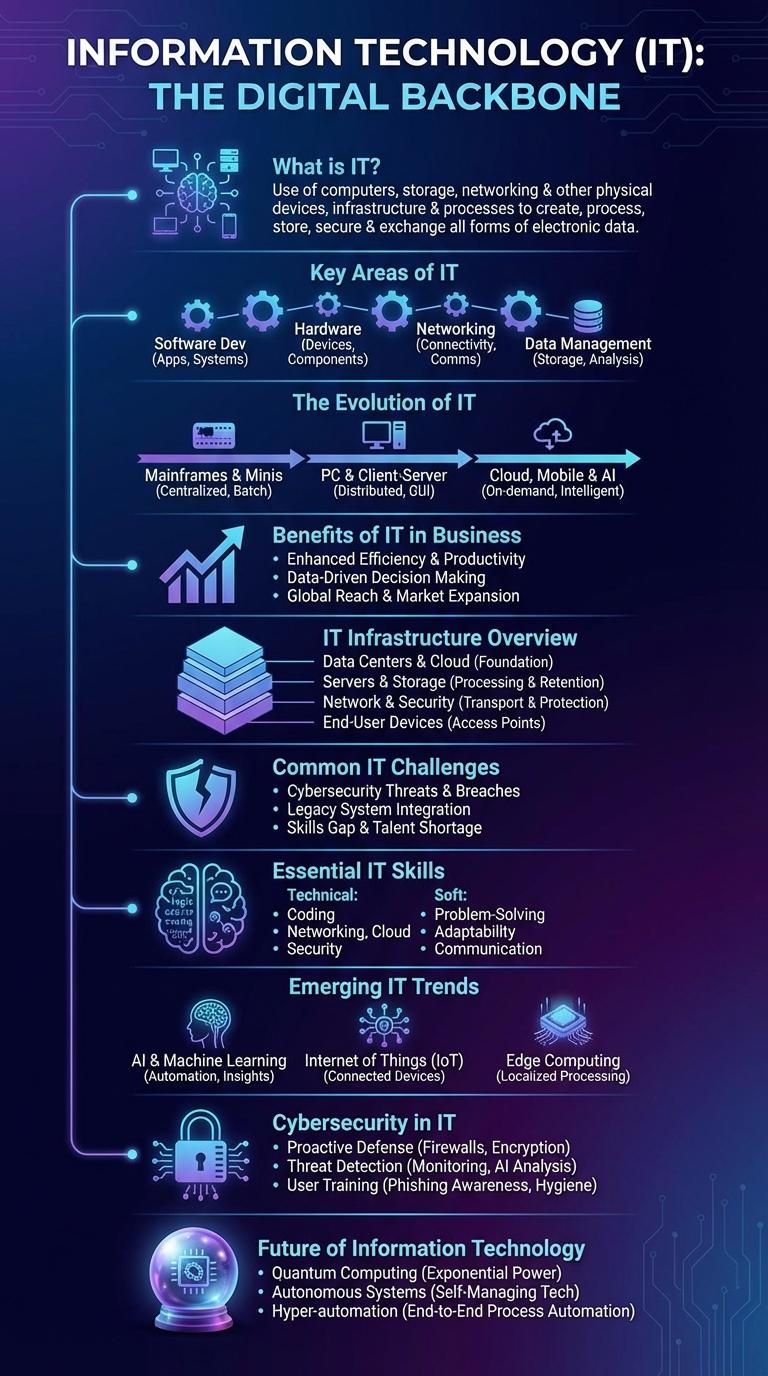
An infographic about IT visually presents complex information, making technical concepts easier to understand and retain. By combining graphics, data, and concise text, it enhances learning and quickens decision-making. This format is essential for effectively sharing trends, statistics, and insights within the tech industry.
What is IT?
Information Technology (IT) encompasses the use of computers, software, and networks to store, process, and transmit data. It plays a critical role in managing digital information and supporting business operations.
IT includes various components such as hardware, software, databases, and cybersecurity measures. This field drives innovation and efficiency across industries through automation and data analysis.
Key Areas of IT
Information Technology (IT) encompasses various critical areas that enable organizations to manage and deploy technology effectively. Understanding these key areas helps optimize business processes and improve technological infrastructure.
- Network Management - Involves designing, implementing, and maintaining communication networks to ensure data flow and connectivity.
- Cybersecurity - Protects systems, networks, and data from digital attacks and unauthorized access.
- Software Development - Focuses on creating, testing, and maintaining applications to solve business challenges.
- Data Management - Entails organizing, storing, and analyzing data for decision-making and operational efficiency.
- IT Support - Provides technical assistance and troubleshooting to ensure continuous IT system functionality.
The Evolution of IT
How has Information Technology evolved over the decades?
Information Technology has transformed from simple data processing systems to complex, interconnected networks that support global communication and business. Innovations like cloud computing, artificial intelligence, and cybersecurity have redefined IT's role in everyday life.
| Era | Key Advancement |
|---|---|
| 1950s-1960s | Mainframe computing and batch processing |
| 1970s-1980s | Introduction of personal computers and networking |
| 1990s | Rise of the internet and client-server architecture |
| 2000s | Emergence of cloud computing and mobile technology |
| 2010s-Present | Advancements in AI, big data, and cybersecurity |
Benefits of IT in Business
Information technology (IT) plays a crucial role in transforming modern business operations. It enhances efficiency, communication, and decision-making processes.
- Increased Productivity - IT solutions automate routine tasks, allowing employees to focus on higher-value work.
- Improved Communication - Advanced IT systems enable seamless collaboration across teams and global locations.
- Data-Driven Decisions - IT tools provide real-time data analytics, supporting informed business strategies.
Leveraging IT in business results in competitive advantages and sustainable growth.
IT Infrastructure Overview
IT infrastructure encompasses the collective hardware, software, network resources, and services required for the existence, operation, and management of an enterprise IT environment. It forms the foundation for delivering digital services and supports business operations seamlessly.
Core components include servers, data centers, networking equipment, and storage systems. Effective IT infrastructure ensures scalability, security, and high availability, enabling businesses to adapt to evolving technology demands.
Common IT Challenges
Common IT challenges include cybersecurity threats, data management complexities, and system integration issues. Organizations often struggle with outdated infrastructure and insufficient technical expertise. Addressing these challenges is crucial for maintaining operational efficiency and securing sensitive information.
Essential IT Skills
Mastering essential IT skills is crucial for career advancement in the technology sector. These skills enable professionals to solve complex problems and improve system efficiency.
Key IT skills include programming languages such as Python and Java, which form the backbone of software development. Knowledge of cloud computing platforms like AWS and Azure is vital for managing scalable infrastructure. Cybersecurity expertise protects data and ensures compliance with industry standards.
Emerging IT Trends
Information technology is rapidly evolving, driven by advancements that reshape business and daily life. Emerging IT trends offer innovative solutions enhancing efficiency, security, and user experience.
Understanding these trends is crucial for staying competitive in a technology-driven world.
- Artificial Intelligence and Machine Learning - AI and ML enable automated decision-making and personalized experiences through advanced data analysis.
- Edge Computing - Edge computing processes data closer to the source, reducing latency and improving real-time responsiveness.
- Quantum Computing - Quantum computing promises to solve complex problems faster than traditional systems by leveraging quantum mechanics.
Cybersecurity in IT
Cybersecurity in IT safeguards digital assets and infrastructure from cyber threats such as malware, phishing, and ransomware. It employs advanced technologies including firewalls, encryption, and multi-factor authentication to protect sensitive data. Organizations prioritize cybersecurity to ensure business continuity, maintain customer trust, and comply with regulatory requirements.
| Cybersecurity Aspect | Key Focus |
|---|---|
| Threat Detection | Real-time monitoring and anomaly detection |
| Data Protection | Encryption and secure access controls |
| Access Management | Multi-factor authentication and user policies |
| Incident Response | Rapid containment and recovery procedures |
| Compliance | Adherence to GDPR, HIPAA, and other standards |