
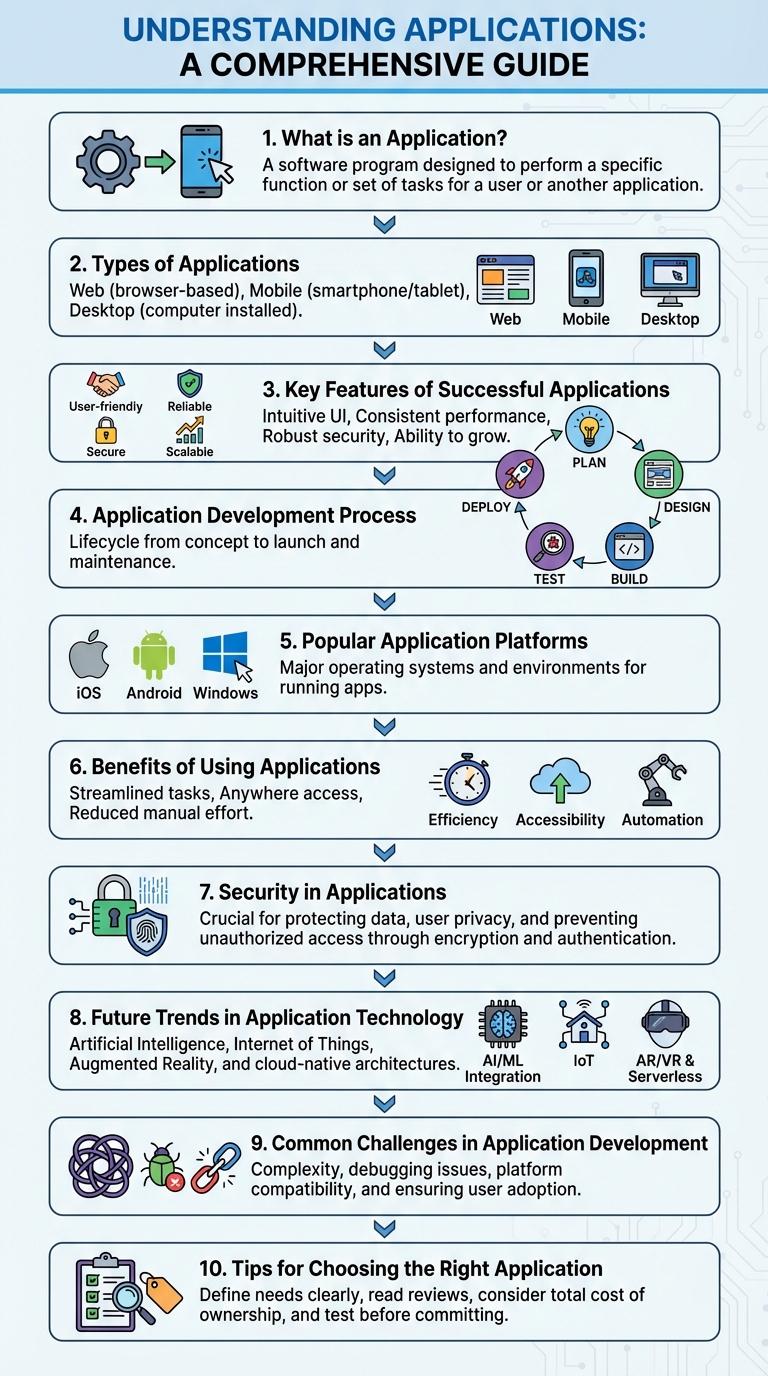
An infographic about application design visually highlights key features, user benefits, and functionality in a clear, engaging format. It combines concise text with compelling graphics to simplify complex information and enhance user understanding. This approach boosts communication effectiveness and captures the audience's attention quickly.
What is an Application?
An application is a software program designed to perform specific tasks for users. It can run on various devices, including computers, smartphones, and tablets.
Applications enhance productivity, entertainment, and communication by providing tailored functionalities.
- Types of Applications - Includes web apps, mobile apps, desktop apps, and enterprise software.
- User Interface - Allows interaction between the user and the software through graphical elements.
- Functionality - Executes specific operations such as data processing, gaming, or content creation.
Types of Applications
Applications are software programs designed to perform specific tasks for users. They come in various types tailored to different needs and platforms.
Common types of applications include mobile apps, desktop applications, web applications, and enterprise software. Mobile apps run on smartphones and tablets, offering convenience and accessibility. Desktop applications are installed on personal computers for a wide range of functionalities, while web applications operate through internet browsers without installation.
Key Features of Successful Applications
Successful applications combine intuitive design with robust functionality to meet user needs effectively. Key features often include seamless navigation, fast performance, and strong security protocols.
Personalization options and real-time updates enhance user engagement, creating a tailored experience. Integration capabilities with other platforms and comprehensive support also contribute to an application's success.
Application Development Process
The Application Development Process involves several key stages, starting from planning and design to coding and testing. Each phase ensures that the application meets user requirements, functions correctly, and provides a seamless experience. Continuous feedback and iteration are essential for delivering a high-quality, reliable product.
Popular Application Platforms
| Application Platform | Key Features |
|---|---|
| iOS (Apple) | High security, seamless integration with Apple devices, robust App Store ecosystem |
| Android (Google) | Open-source flexibility, wide device compatibility, Google Play Store access |
| Windows | Strong enterprise support, compatibility with legacy software, Microsoft Store availability |
| macOS (Apple) | Optimized for Apple hardware, strong creative application support, integrated with Apple ecosystem |
| Linux | Open-source, customizable environments, popular for developers and servers |
Benefits of Using Applications
Applications enhance productivity by automating routine tasks and providing user-friendly interfaces. They facilitate seamless communication and collaboration across various devices and platforms.
Using applications increases accessibility to services and information anytime and anywhere. They also offer personalized experiences through customizable features and data-driven insights.
Security in Applications
Application security is a critical aspect of software development that protects programs from vulnerabilities and cyber threats. Ensuring robust security measures reduces the risk of data breaches and unauthorized access.
- Authentication - Verifies user identities to prevent unauthorized access to sensitive information.
- Encryption - Secures data transmission and storage by converting information into coded formats.
- Regular Updates - Fixes security flaws by applying patches and software improvements promptly.
Implementing these security practices strengthens application resilience against evolving cyber threats.
Future Trends in Application Technology
Future trends in application technology emphasize the rise of artificial intelligence integration, enhancing user personalization and automation. Progressive Web Apps (PWAs) are gaining traction, providing seamless performance across devices without requiring installation. Edge computing adoption is increasing, enabling faster data processing and improved app responsiveness by decentralizing cloud services.
Common Challenges in Application Development
What are the common challenges faced in application development?
Application development often encounters issues like unclear requirements, which cause delays and increased costs. Managing cross-functional teams and integrating diverse technologies can lead to communication gaps and technical conflicts.
How does security impact application development?
Security is a critical challenge, requiring constant updates to protect against evolving threats. Developers must balance functionality with robust security measures to prevent data breaches and maintain user trust.
What role does scalability play in application challenges?
Ensuring scalability is essential for accommodating growth and traffic spikes. Poor scaling planning can result in performance bottlenecks and degraded user experience.
Why is testing a frequent hurdle in application projects?
Comprehensive testing is necessary to identify bugs and ensure quality. Limited testing resources or time constraints often lead to undetected errors and unstable releases.
How does changing technology affect application development?
Rapid technological advancements challenge developers to continuously update skills and tools. Staying current is necessary to leverage new features while maintaining compatibility with existing systems.