
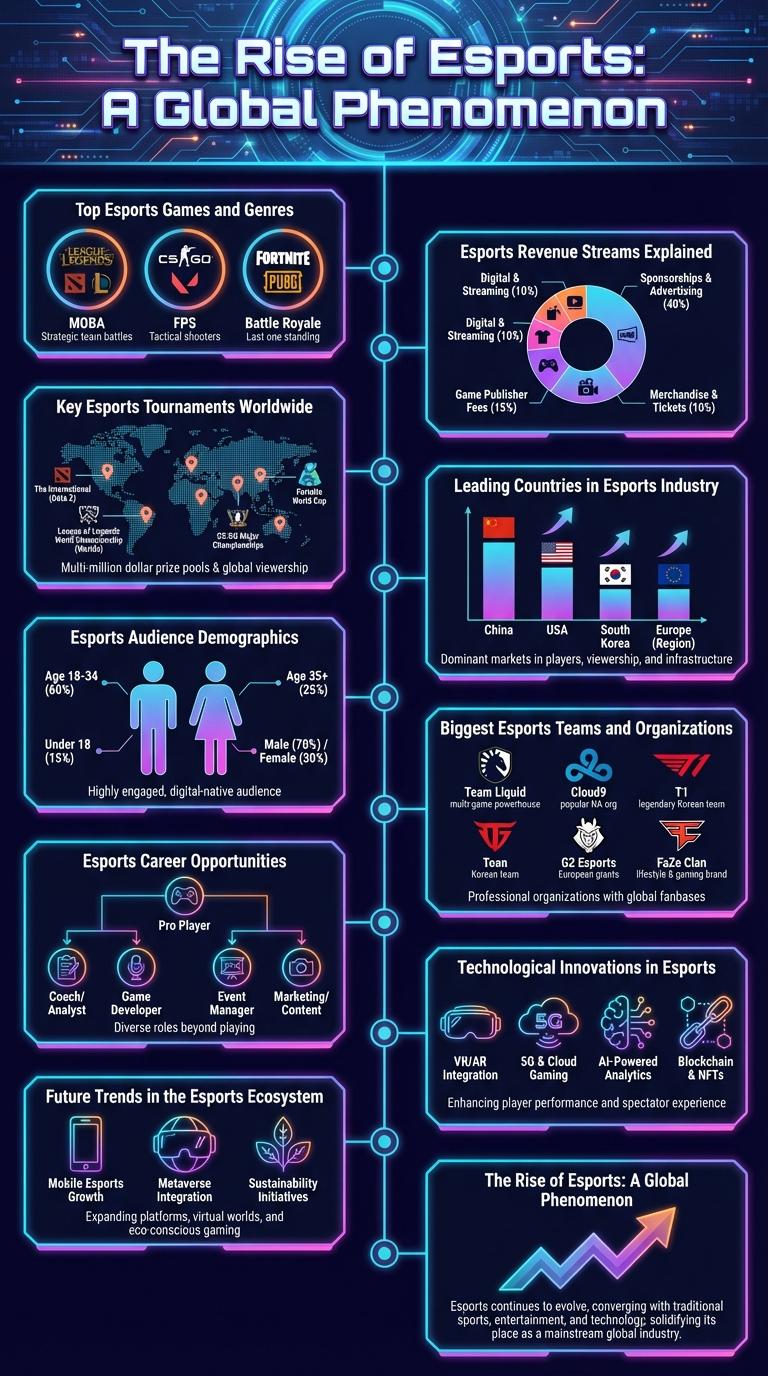
Esports has transformed competitive gaming into a global phenomenon, attracting millions of fans and players worldwide. This infographic highlights key statistics, popular game titles, and the economic impact of the esports industry. Understanding these trends reveals the rapid growth and future potential of esports as a mainstream entertainment sector.
The Rise of Esports: A Global Phenomenon
The rise of esports has transformed competitive gaming into a global entertainment powerhouse. This rapidly growing industry captivates millions of fans worldwide and drives substantial economic impact.
Esports tournaments now attract larger audiences than many traditional sports events. Major brands and investors are fueling growth through sponsorships and partnerships.
- Massive Audience Growth - Over 450 million people watch esports globally, with projections reaching 650 million by 2025.
- Multi-Billion Dollar Industry - Esports revenue exceeded $1.3 billion in 2023, driven by media rights, advertising, and merchandise sales.
- Global Tournament Reach - International esports competitions command prize pools upwards of $40 million, showcasing worldwide participation.
Top Esports Games and Genres
Esports has rapidly evolved into a global phenomenon, attracting millions of players and viewers. Popular games in this industry span multiple genres, each offering unique competitive experiences.
Top esports games include titles like League of Legends, Dota 2, and Counter-Strike: Global Offensive. The primary genres dominating esports are Multiplayer Online Battle Arena (MOBA), First-Person Shooter (FPS), and Real-Time Strategy (RTS). These genres emphasize teamwork, strategy, and fast-paced action, fueling intense competition worldwide.
Esports Revenue Streams Explained
Esports revenue streams encompass various sources such as sponsorships, advertising, media rights, merchandise, and ticket sales. These revenue channels collectively drive the rapid financial growth of the esports industry, attracting global brands and millions of viewers.
Sponsorships and advertising form the largest portion of esports income, with companies investing heavily in teams and tournament promotions. Media rights and streaming platforms generate substantial revenue by broadcasting events to international audiences, while merchandise sales and ticketing provide additional income directly from fans.
Key Esports Tournaments Worldwide
Esports has grown into a global phenomenon, captivating millions of fans and players worldwide. Major tournaments highlight the competitive spirit and cultural impact of this digital sport.
- The International - The premier Dota 2 championship offering one of the largest prize pools in esports history.
- League of Legends World Championship - An annual event drawing massive viewership for the highly strategic MOBA game.
- Fortnite World Cup - A popular battle royale tournament known for its high cash prizes and wide player participation.
These tournaments set the standard for competitive excellence and showcase the diversity of esports disciplines globally.
Leading Countries in Esports Industry
| Country | Esports Market Value (USD Billion) |
|---|---|
| United States | 1.4 |
| South Korea | 1.1 |
| China | 1.7 |
| Germany | 0.3 |
| Sweden | 0.2 |
Esports Audience Demographics
The global esports audience reached over 500 million in 2023, with a strong concentration of viewers aged 18-34. Male viewers make up approximately 70% of the audience, while female viewers account for 30%, showing increasing gender diversity. Key markets include North America, Asia-Pacific, and Europe, which dominate esports viewership and revenue generation.
Biggest Esports Teams and Organizations
Esports has grown into a global phenomenon, supported by some of the largest and most influential teams and organizations. These entities drive competitive gaming through extensive fan bases and substantial financial backing.
- Team Liquid - Founded in 2000, Team Liquid has become a powerhouse in multiple esports titles, known for its consistent top-tier performance and large global fanbase.
- T1 - Based in South Korea, T1 is renowned for its dominance in League of Legends, especially through legendary player Faker.
- Cloud9 - Cloud9 is a major North American organization with championship titles in various esports including CS:GO and Valorant.
Esports Career Opportunities
Esports offers diverse career opportunities beyond playing, including roles in game development, event management, and content creation. Professionals in marketing, coaching, and broadcasting contribute significantly to the industry's growth. The global esports market revenue is expected to surpass $2 billion by 2025, highlighting expanding job prospects.
Technological Innovations in Esports
What technological innovations are transforming the esports industry?
Advanced hardware such as high-refresh-rate monitors and low-latency peripherals improve player performance and gaming experiences. Artificial intelligence and machine learning enable real-time analytics and strategy optimization during competitions.
How is virtual reality impacting esports?
Virtual reality (VR) creates immersive environments, allowing players and spectators to engage more deeply in esports events. VR enhances training simulations and offers new game formats tailored for immersive interaction.
What role does cloud gaming play in esports evolution?
Cloud gaming technology enables seamless streaming of high-quality esports titles without requiring powerful local hardware. This accessibility expands the audience and supports cross-platform competitive play.
How do advanced broadcasting technologies enhance esports viewership?
Technologies like 4K streaming, augmented reality overlays, and multi-angle camera setups enrich the viewing experience. Enhanced broadcasts increase fan engagement and provide detailed insights into gameplay.
What impact does 5G connectivity have on esports?
5G networks reduce latency and improve data transmission speed, enabling smoother online competitions and real-time interactions. Reliable connectivity supports global tournaments and large-scale esports events.