
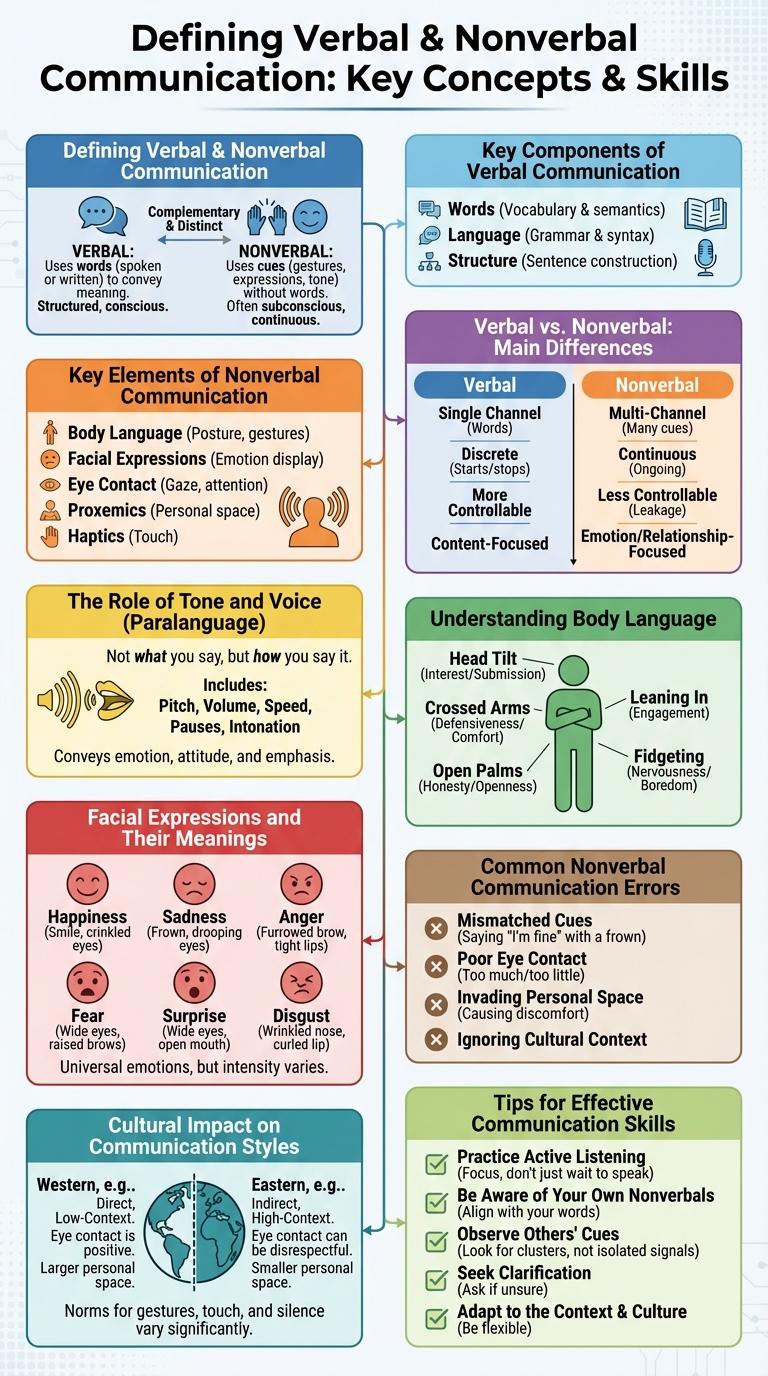
Effective communication relies heavily on both verbal and nonverbal cues to convey messages clearly. Verbal communication involves the use of spoken or written words, while nonverbal communication includes body language, facial expressions, and gestures. Understanding the interplay between these forms enhances interaction and helps interpret underlying emotions and intentions accurately.
Defining Verbal and Nonverbal Communication
Verbal and nonverbal communication are essential components of how humans exchange information. Verbal communication involves words, while nonverbal communication includes gestures and body language.
Understanding both types improves interaction and comprehension in personal and professional settings.
- Verbal Communication - The use of spoken or written words to convey messages precisely and clearly.
- Nonverbal Communication - Expressing feelings and intentions through facial expressions, gestures, posture, and tone of voice.
- Complementary Roles - Verbal and nonverbal cues work together to provide context and meaning in communication.
Key Components of Verbal Communication
Verbal communication relies on the clear and effective use of language to convey messages. Understanding its key components enhances clarity and efficiency in interactions.
- Vocabulary - The choice of words directly impacts the accuracy and reception of the message.
- Tone of Voice - Modulates the emotional context and can change the meaning of spoken words.
- Clarity and Brevity - Ensures that the message is easy to understand and free from unnecessary complexity.
Key Elements of Nonverbal Communication
What are the key elements of nonverbal communication? Nonverbal communication involves the transmission of messages without words. It relies heavily on body language, facial expressions, gestures, posture, and eye contact to convey meaning.
| Element | Description |
|---|---|
| Facial Expressions | Convey emotions such as happiness, anger, or sadness. |
| Gestures | Include movements of hands or arms to express ideas or feelings. |
| Posture | Indicates attitude, confidence, and engagement level. |
| Eye Contact | Reflects attentiveness, interest, and honesty. |
| Proxemics | Use of personal space to communicate intimacy or distance. |
Verbal vs. Nonverbal: Main Differences
Verbal communication involves the use of spoken or written words to convey messages, while nonverbal communication relies on body language, facial expressions, and gestures. Verbal communication is explicit and clear, whereas nonverbal communication often provides context and emotional undertones. Understanding both types enhances overall communication effectiveness and reduces misunderstandings.
The Role of Tone and Voice
Understanding Body Language
Understanding body language is crucial for effective communication. It conveys emotions and intentions beyond spoken words.
Nonverbal cues such as facial expressions, gestures, and posture reveal true feelings. Mastering these signals enhances interpersonal relationships and professional interactions.
Facial Expressions and Their Meanings
Facial expressions are a vital part of both verbal and nonverbal communication, conveying emotions without words. They often provide immediate insight into a person's feelings and intentions.
Common facial expressions include happiness, sadness, anger, surprise, fear, and disgust. Each expression involves specific muscle movements around the eyes, mouth, and eyebrows. Understanding these expressions enhances interpersonal communication and emotional intelligence.
Common Nonverbal Communication Errors
Verbal and nonverbal communication are essential for effective interaction, but nonverbal cues often carry more weight in conveying emotions and intentions. Misinterpretations in nonverbal communication can lead to misunderstandings and conflicts.
Common nonverbal communication errors include inconsistent body language, such as nodding while saying no, which confuses the message. Poor eye contact or excessive fidgeting may signal disinterest or nervousness, undermining the speaker's credibility.
Cultural Impact on Communication Styles
Verbal and nonverbal communication styles vary significantly across cultures, influencing how messages are interpreted and conveyed. High-context cultures often rely on nonverbal cues, such as gestures and facial expressions, to communicate meaning beyond words. Understanding these cultural differences is essential for effective intercultural communication and reducing misunderstandings.