
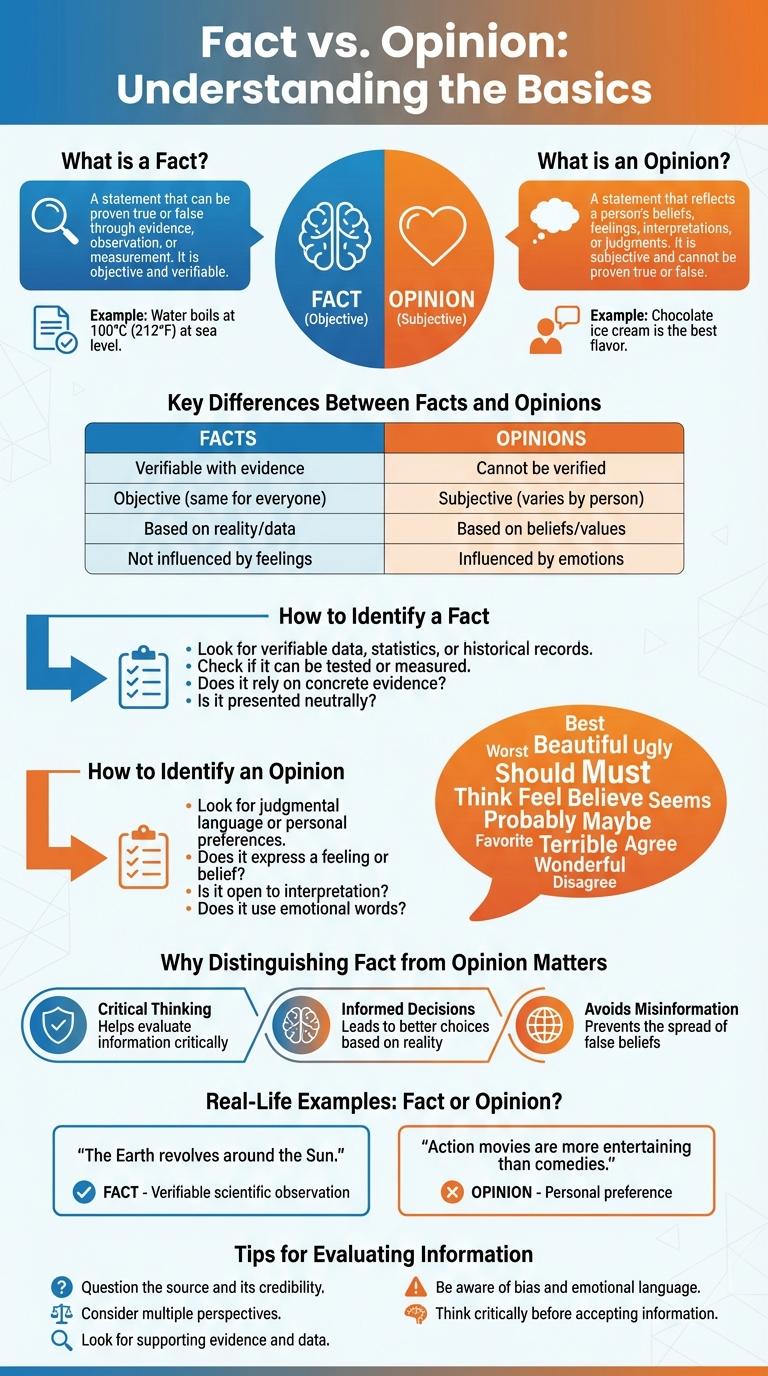
Understanding the difference between fact and opinion is essential for critical thinking and effective communication. Facts are objective statements supported by evidence, while opinions reflect personal beliefs or interpretations. This infographic breaks down the key characteristics of each to help you distinguish between them clearly.
Fact vs. Opinion: Understanding the Basics
Facts are objective statements that can be proven true or false through evidence or data. Opinions are subjective beliefs or feelings that reflect personal views and cannot be proven.
Understanding the difference between fact and opinion is essential for critical thinking and effective communication.
- Fact - A factual statement is verifiable by empirical evidence or reliable sources.
- Opinion - An opinion expresses personal judgment, preference, or interpretation.
- Purpose - Facts inform and provide clarity; opinions persuade or express emotions.
What is a Fact?
A fact is a statement that can be proven true or false through evidence or observation. Facts are objective and verifiable, meaning they do not depend on personal feelings or interpretations. Examples of facts include measurable data, historical dates, and scientific findings.
What is an Opinion?
What is an opinion? An opinion is a personal belief or judgment that is not founded on proof or certainty. It reflects individual feelings, thoughts, or preferences rather than objective facts.
Key Differences Between Facts and Opinions
Facts are objective statements that can be proven true or false through evidence and verification. Opinions express personal beliefs, feelings, or judgments that cannot be universally proven.
Facts remain consistent regardless of individual perspectives or emotions. Opinions vary between people and are influenced by personal experiences and biases.
How to Identify a Fact
Facts are statements that can be proven true or false through evidence, observation, or reliable sources. To identify a fact, check for objective data, verified information, or official records that support the claim. Avoid statements based on feelings, beliefs, or personal interpretations, as these are opinions rather than facts.
How to Identify an Opinion
Distinguishing between fact and opinion is essential for critical thinking and effective communication. Identifying an opinion involves recognizing subjective language and personal beliefs rather than objective truths.
- Look for subjective language - Opinions often include words like "best," "worst," "should," or "believe" that indicate personal judgment.
- Check for evidence - Facts can be proven or verified with data, while opinions rely on personal feelings or interpretations.
- Assess the statement's objectivity - An opinion reflects a person's viewpoint and can vary between individuals, unlike facts which remain consistent regardless of perspective.
Words Commonly Used in Opinions
Opinions often include words that express personal feelings or beliefs. Common opinion words help distinguish subjective statements from objective facts.
Words like "believe," "feel," "think," and "suggest" frequently appear in opinion statements. These terms signal that the information is based on personal viewpoint rather than proven fact.
Why Distinguishing Fact from Opinion Matters
| Why Distinguishing Fact from Opinion Matters | Description |
|---|---|
| Enhances Critical Thinking | Identifying facts versus opinions sharpens analytical skills and promotes logical decision-making. |
| Prevents Misinformation | Separating factual information from personal viewpoints reduces the spread of false or misleading content. |
| Supports Informed Decision-Making | Understanding facts and distinguishing opinions enables choices based on evidence rather than bias. |
| Improves Communication | Clear recognition of facts and opinions encourages respectful discussions and reduces misunderstandings. |
| Builds Media Literacy | Critical evaluation of content empowers individuals to navigate news and social media responsibly. |
Real-Life Examples: Fact or Opinion?
Understanding the difference between fact and opinion is essential for critical thinking. Real-life examples help clarify how to distinguish objective truths from personal beliefs.
- The Earth revolves around the Sun - This is a fact supported by scientific evidence and observation.
- Chocolate ice cream is the best flavor - This is an opinion based on personal taste preferences.
- New York City has over 8 million residents - This is a fact confirmed by census data.
- Summer is the most enjoyable season - This opinion varies depending on individual experiences.
- Water boils at 100degC at sea level - This is a fact proven through controlled experiments.
Recognizing these examples helps improve media literacy and informed decision-making.