
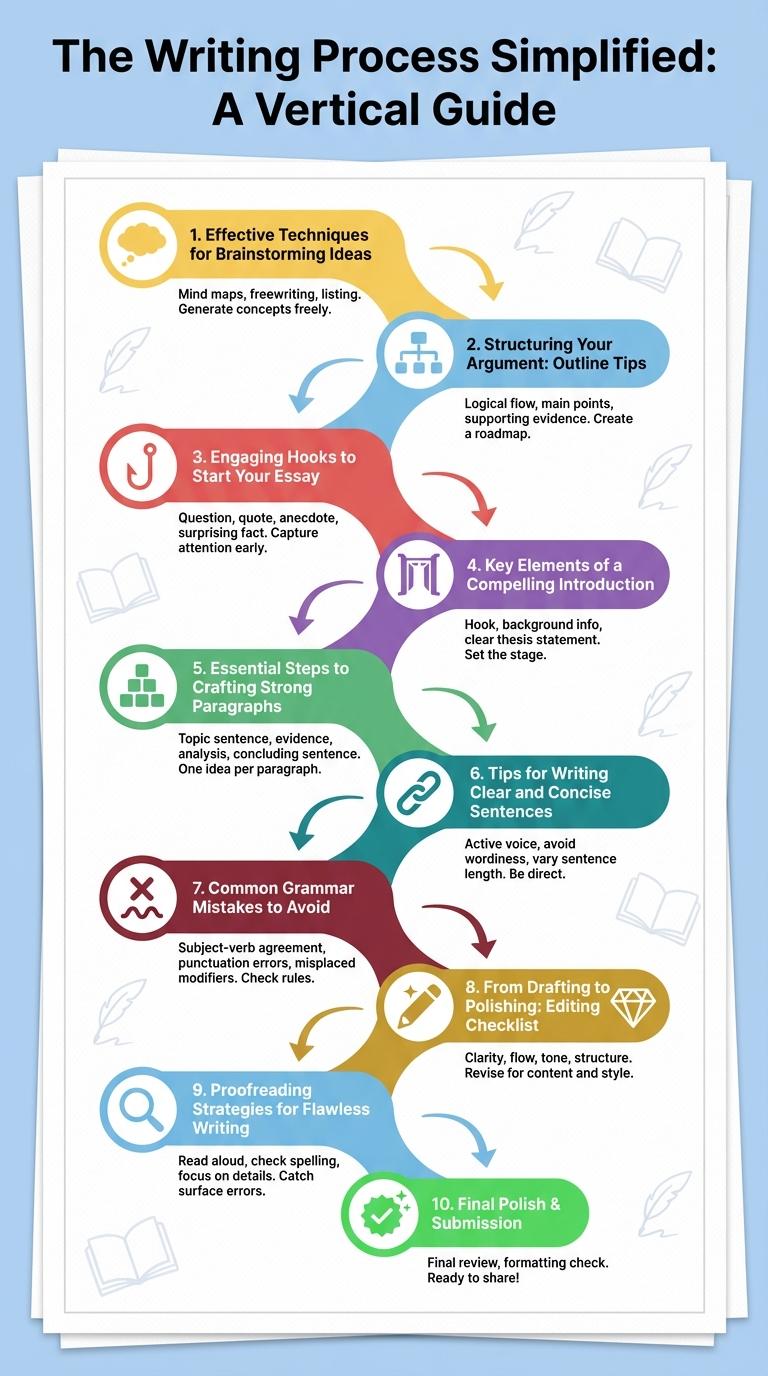
Effective writing combines clarity, creativity, and structure to engage readers and convey messages powerfully. Visual aids like infographics simplify complex writing techniques, making them easier to understand and apply. Mastering these key elements transforms ideas into compelling content that resonates with audiences.
The Writing Process Simplified
The writing process involves a series of steps that help transform ideas into clear, effective text. Understanding each stage ensures better organization and communication of thoughts.
Start with brainstorming to generate ideas, followed by drafting to put those ideas into sentences. Then, revise to improve content, edit for grammar and style, and finally, publish the finished work.
Essential Steps to Crafting Strong Paragraphs
| Step | Description |
|---|---|
| Topic Sentence | Introduce the main idea or purpose of the paragraph clearly. |
| Supporting Details | Provide evidence, examples, or facts that reinforce the topic sentence. |
| Coherence | Use logical order and transitions to ensure smooth flow between sentences. |
| Unity | Keep all sentences focused on the single main idea presented. |
| Concluding Sentence | Summarize the paragraph's main point or provide a transition to the next paragraph. |
Common Grammar Mistakes to Avoid
Understanding common grammar mistakes improves writing clarity and professionalism. Avoiding these errors helps convey your message effectively to any audience.
Mastering grammar basics prevents confusion and enhances the impact of your writing.
- Subject-Verb Agreement - Ensure the subject and verb match in number for correct sentence structure.
- Misplaced Modifiers - Place modifiers close to the words they describe to avoid ambiguity.
- Incorrect Pronoun Usage - Use pronouns that clearly refer to the correct noun to maintain coherence.
- Run-on Sentences - Break complex ideas into separate sentences to improve readability.
- Confusion Between Homophones - Choose words like "their," "there," and "they're" correctly to prevent misunderstanding.
Key Elements of a Compelling Introduction
The introduction sets the tone of your writing and grabs the reader's attention immediately. It serves as the gateway to your entire piece, enticing the audience to continue reading.
Key elements include a strong hook, a clear thesis statement, and relevant background information. These components establish context and highlight the purpose of the text effectively.
From Drafting to Polishing: Editing Checklist
Creating a well-crafted piece begins with a strong draft that captures your main ideas clearly. Use the editing checklist to refine your content, focusing on grammar, clarity, and coherence. Final polishing enhances readability and ensures your writing leaves a lasting impact.
Effective Techniques for Brainstorming Ideas
Effective brainstorming techniques enhance creativity and improve idea generation. Utilizing structured methods helps organize thoughts and encourages diverse perspectives.
Start with mind mapping to visually connect related concepts and expand ideas organically. Use the SCAMPER technique to modify existing ideas through substitution, combination, adaptation, and other strategies. Set time limits to maintain focus and prevent overthinking, fostering a rapid flow of ideas.
Structuring Your Argument: Outline Tips
Structuring your argument effectively enhances clarity and persuasion in writing. An organized outline helps maintain logical flow and supports strong reasoning.
- Thesis Statement - Clearly define your main argument to guide the entire outline.
- Main Points - List key supporting ideas that reinforce the thesis in a logical order.
- Evidence and Examples - Include relevant data or anecdotes under each main point to strengthen your case.
Tips for Writing Clear and Concise Sentences
How can you write sentences that are both clear and concise? Clear and concise sentences improve readability by eliminating unnecessary words. Focus on using precise vocabulary and keeping sentence structures straightforward.
Engaging Hooks to Start Your Essay
Starting an essay with an engaging hook captures the reader's attention and sets the tone for the entire piece. Effective hooks make your introduction memorable and invite readers to explore further.
- Ask a Question - Engage readers by posing a thought-provoking question related to your essay topic.
- Use a Quote - Incorporate a relevant and powerful quote to lend credibility and spark interest.
- Share a Fact - Present surprising or interesting facts to intrigue your audience and establish context.
Strong hooks enhance readability and encourage readers to continue through your essay with curiosity.