
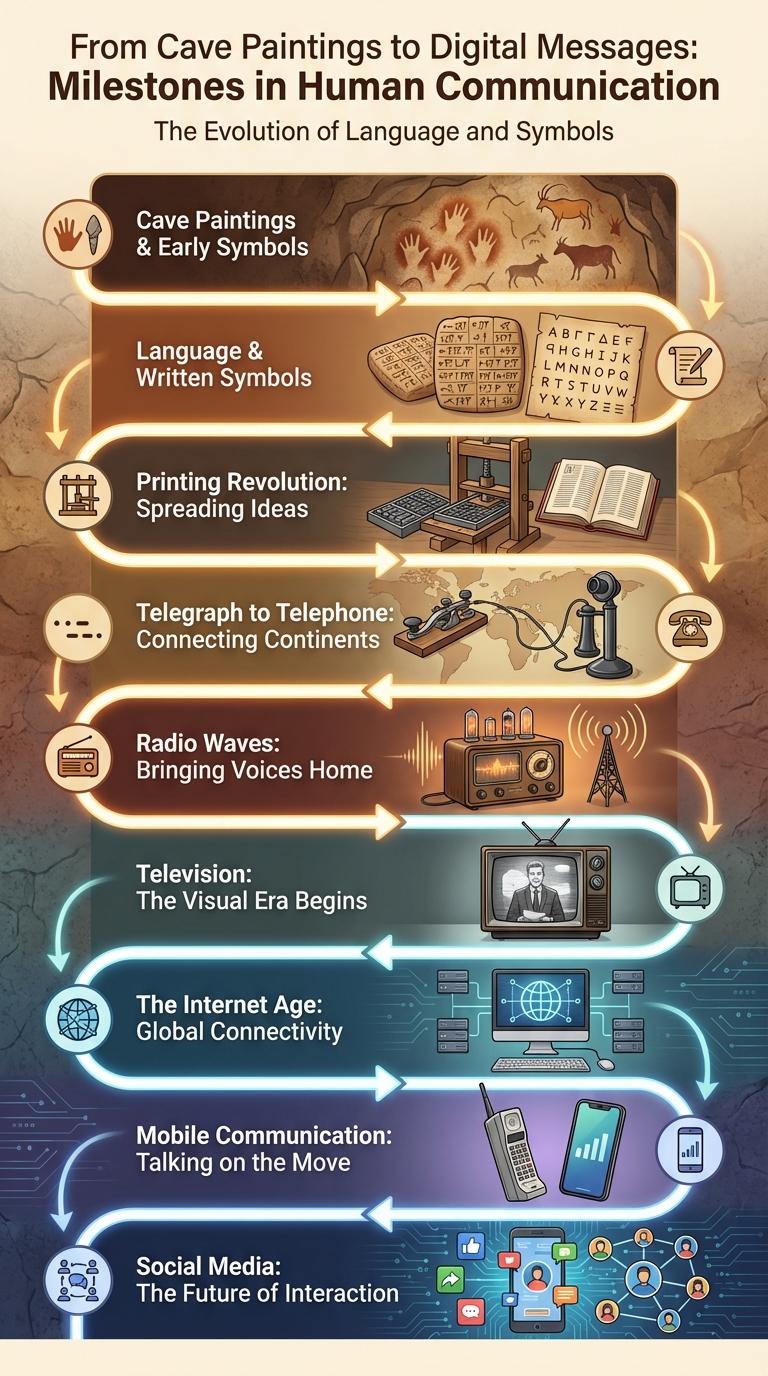
The evolution of communication highlights transformative shifts from ancient symbols to digital interactions, showcasing humanity's continual quest to connect. Advances in technology have revolutionized how messages are created, shared, and received across diverse platforms. This infographic visually maps key milestones, illustrating the impact of innovations on global communication dynamics.
From Cave Paintings to Digital Messages
Communication has evolved dramatically from primitive visual symbols to instantaneous digital interactions. This transformation highlights the advancement of human expression and technology over millennia.
- Cave Paintings - Early humans used cave paintings to record stories, events, and ideas visually on stone surfaces.
- Written Language - The invention of alphabets enabled precise encoding of complex information and facilitated long-distance communication.
- Printing Press - Mechanical printing revolutionized the spread of knowledge by mass-producing texts and making information accessible.
- Telegraph and Telephone - Electric communication devices introduced real-time voice and message transmission across vast distances.
- Digital Messaging - The rise of internet-based platforms allows instant, multimedia communication globally through texts, images, and videos.
Milestones in Human Communication
The evolution of human communication marks significant milestones that have shaped societies and cultures globally. From primitive symbols to digital messages, communication methods continuously transform our interaction.
The earliest milestone includes the development of spoken language, enabling complex expression. The invention of writing systems allowed information preservation and dissemination across generations. The digital age revolutionized communication with instant connectivity worldwide.
The Evolution of Language and Symbols
The evolution of language and symbols marks a critical transformation in human communication, enabling complex ideas to be conveyed efficiently across generations.
From primitive gestures to intricate writing systems, language and symbols have continually adapted to meet the needs of society and culture.
- Primitive Symbols - Early humans used cave paintings and carvings as basic symbolic communication to record events and express ideas.
- Development of Spoken Language - Oral language emerged as a dynamic system for sharing information and facilitating social interaction.
- Written Language - The invention of writing systems like cuneiform and hieroglyphics allowed for the preservation and transmission of knowledge.
- Alphabetic Systems - Alphabets streamlined communication by representing sounds with letters, increasing literacy and accessibility.
- Digital Communication - Modern symbols such as emojis and icons complement text, enhancing emotional expression and cross-cultural understanding.
Printing Revolution: Spreading Ideas
The Printing Revolution marked a pivotal moment in the evolution of communication, enabling the mass production of written materials. This breakthrough facilitated the rapid spread of ideas across Europe and beyond during the 15th century.
Invented by Johannes Gutenberg around 1440, the printing press drastically reduced the cost and time required to produce books and pamphlets. It empowered literacy, education, and the dissemination of knowledge on an unprecedented scale.
Telegraph to Telephone: Connecting Continents
| Year | Communication Milestone |
|---|---|
| 1837 | Invention of the Telegraph by Samuel Morse revolutionizes long-distance communication with Morse code signals transmitted over wires. |
| 1844 | First successful telegraph message, "What hath God wrought," sent between Washington, D.C., and Baltimore, establishing continent-wide connectivity. |
| 1876 | Alexander Graham Bell invents the Telephone, enabling real-time voice communication and enhancing personal and business interactions. |
| 1885 | Telephone exchanges grow, linking cities and expanding networks, effectively connecting continents through various wired systems. |
| Late 19th Century | Integration of telegraph and telephone lines facilitates faster, reliable communication, laying groundwork for modern global communication systems. |
Radio Waves: Bringing Voices Home
Radio waves revolutionized communication by enabling wireless transmission of voices over long distances. This breakthrough allowed people to connect without physical wires, fostering real-time conversations across cities and countries. The technology laid the foundation for modern broadcasting and mobile communication systems.
Television: The Visual Era Begins
The evolution of communication entered a new visual dimension with the advent of television in the early 20th century. Television combined audio and visual elements, transforming information delivery and entertainment worldwide. It became a powerful medium, influencing culture, politics, and society by broadcasting real-time events directly into people's homes.
The Internet Age: Global Connectivity
How has the Internet transformed global communication? The Internet Age ushered in unprecedented global connectivity, enabling instant information exchange across continents. It has revolutionized social interaction, business, and access to knowledge through digital platforms.
Mobile Communication: Talking on the Move
Mobile communication revolutionized how people connect by enabling talking on the move. This innovation transformed social, business, and emergency interactions worldwide.
- First Mobile Phones - Early mobile phones in the 1980s offered limited portability but initiated wireless voice communication.
- Smartphones Emergence - Smartphones integrated calling, texting, and internet access into a single, portable device.
- Global Network Expansion - Widespread 4G and 5G networks improved connection speed and reliability for mobile users.
Mobile communication continues to evolve, shaping real-time, location-independent connectivity across the globe.