
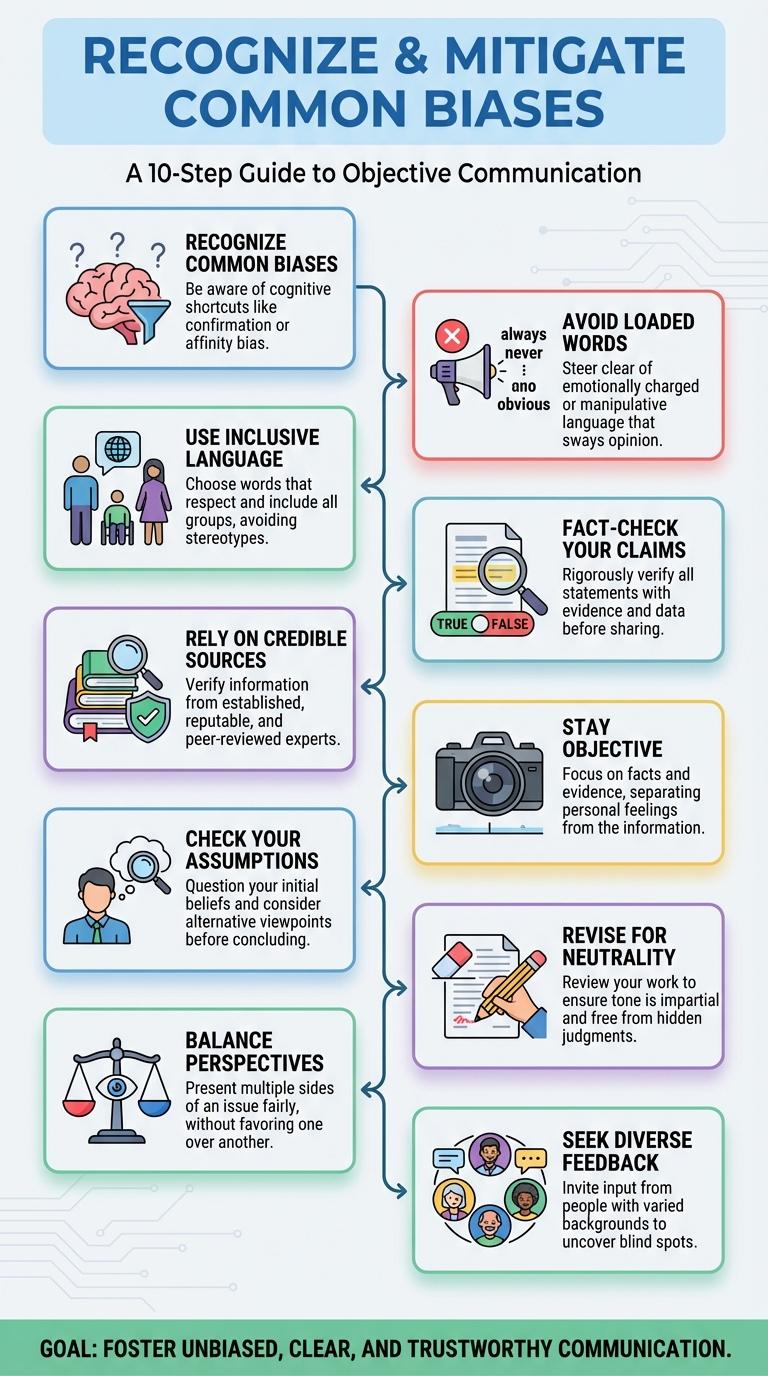
Avoiding biased writing requires awareness of language that may unintentionally favor one perspective or group over another. Using neutral terms, presenting multiple viewpoints, and fact-checking sources are essential strategies to maintain objectivity. This infographic highlights practical tips to help writers create fair, balanced, and inclusive content.
Recognize Common Biases
Recognizing common biases is essential for creating fair and objective writing. Awareness of these biases helps writers present balanced perspectives and build credibility with their audience.
- Confirmation Bias - Tendency to favor information that supports existing beliefs, leading to one-sided arguments.
- Stereotyping - Making generalized assumptions about groups that can distort facts and reduce accuracy.
- Selective Reporting - Highlighting only certain facts or data that align with a preferred narrative while ignoring others.
Use Inclusive Language
Using inclusive language ensures your writing respects and represents all audiences fairly. Avoid gender-specific terms by opting for gender-neutral alternatives like "they" or "chairperson." Embrace diverse perspectives by steering clear of stereotypes and language that marginalizes any group.
Rely on Credible Sources
Avoiding biased writing begins with relying on credible sources to ensure accurate and trustworthy information. Credible sources provide balanced perspectives that reduce the risk of unintentional bias.
- Verify Author Credentials - Confirm the author's expertise to ensure authoritative content.
- Check Publication Reputation - Use sources from well-established and respected publishers.
- Cross-Reference Information - Compare multiple credible sources to validate facts and reduce bias.
Consistently using credible sources enhances the integrity and fairness of your writing.
Check Your Assumptions
Check your assumptions by questioning the origin of your beliefs and the evidence supporting them. Identifying personal biases helps ensure the writing remains fair and factual.
Review your language for subjective or generalized statements that may reflect stereotypes. Actively seek diverse perspectives to balance and strengthen your argument.
Balance Perspectives
Maintaining balanced perspectives is crucial to avoid biased writing. Presenting multiple viewpoints allows readers to make informed judgments.
Include diverse sources and evidence to support each side of the argument. Acknowledge opposing opinions respectfully without dismissing them. Strive for neutral language that does not favor any particular perspective.
Avoid Loaded Words
Using neutral language is crucial to avoid biased writing and to present information fairly. Loaded words carry emotional weight that can influence readers' perceptions unconsciously. Choosing objective, clear terms helps maintain credibility and encourages unbiased understanding.
Fact-Check Your Claims
Ensuring accuracy in your writing prevents the spread of misinformation and enhances credibility. Fact-checking your claims helps eliminate bias and supports balanced, objective content.
- Verify Sources - Cross-reference information with reputable and multiple sources to confirm reliability.
- Check Dates and Context - Ensure facts are current and presented within the appropriate context to avoid misleading interpretations.
- Use Primary Data - Rely on original research or direct evidence rather than secondhand reports or opinions.
Stay Objective
Maintaining objectivity is crucial to avoid biased writing. Focus on presenting facts without letting personal opinions influence the content.
Use neutral language and avoid emotionally charged words that may sway readers. Supporting claims with verified data enhances credibility and fairness.
Revise for Neutrality
| Tip | Description |
|---|---|
| Use Inclusive Language | Choose words that do not favor any gender, ethnicity, or group to maintain fairness. |
| Avoid Stereotypes | Eliminate generalizations that can perpetuate unfair assumptions about people or ideas. |
| Check Tone | Ensure the tone is objective, professional, and free from emotional bias or judgment. |
| Verify Facts | Confirm all information with reputable sources to prevent misinformation and partiality. |
| Seek Feedback | Have diverse readers review the text to identify and correct unintended biases. |