
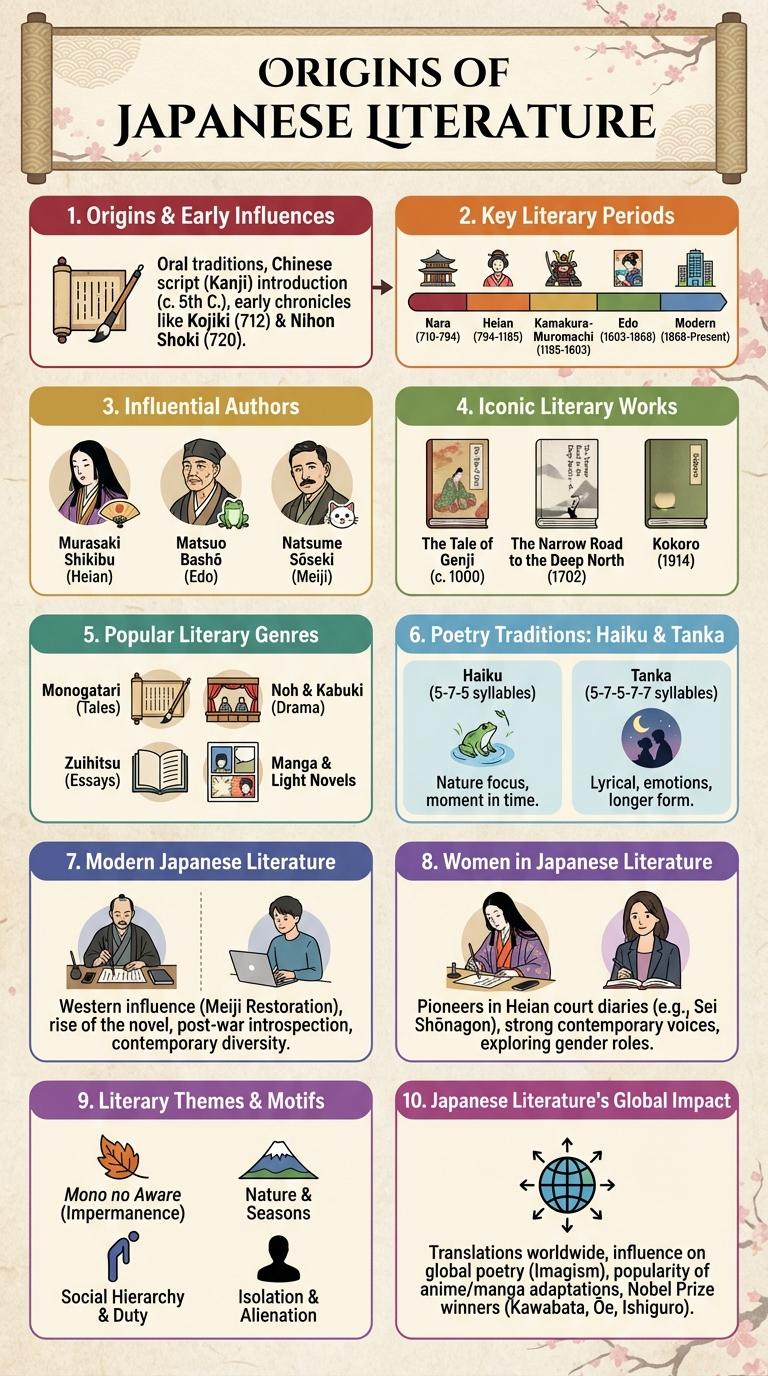
Japanese literature offers a rich tapestry of storytelling that spans centuries, blending ancient traditions with modern narratives. Iconic works from classical poetry to contemporary novels showcase the deep cultural heritage and innovation of Japanese writers. Exploring these literary treasures through an infographic reveals key themes, influential authors, and the evolution of Japan's unique literary landscape.
Origins of Japanese Literature
Japanese literature originated during the Nara period (710-794 AD), influenced heavily by Chinese culture and writing systems. Early works included poetry and historical chronicles, such as the Kojiki and Nihon Shoki, which documented Japan's mythology and history.
The Heian period (794-1185 AD) marked the development of native Japanese literary styles, with the emergence of kana script enabling more expressive and personal writing. Classic works like "The Tale of Genji" by Murasaki Shikibu represent the pinnacle of early Japanese prose and court literature.
Key Literary Periods
Japanese literature is rich and diverse, spanning centuries of cultural and historical development. It reflects the evolution of Japanese society through distinct literary periods.
The earliest period is the Heian era (794-1185), known for classical works like "The Tale of Genji," considered the world's first novel. The Edo period (1603-1868) introduced vibrant urban literature and haiku poetry, with masters like Matsuo Basho. Modern Japanese literature began in the Meiji period (1868-1912), blending Western influences with traditional themes.
Influential Authors
Japanese literature boasts a rich history with influential authors whose works have shaped both national and global literary landscapes. These writers explore themes of nature, existentialism, and societal change, resonating with diverse audiences over centuries.
Notable figures include Murasaki Shikibu, author of "The Tale of Genji," widely considered the world's first novel. Modern authors like Haruki Murakami blend surrealism and contemporary issues, maintaining Japan's literary prominence worldwide.
Iconic Literary Works
Japanese literature boasts a rich heritage of iconic works that have shaped its cultural and literary landscape. These masterpieces reflect Japan's history, philosophy, and aesthetics through diverse genres and styles.
- The Tale of Genji - Often considered the world's first novel, this 11th-century work by Murasaki Shikibu explores court life and human emotions with lyrical prose.
- Manyoshu - The oldest existing collection of Japanese poetry from the 8th century featuring over 4,500 poems depicting nature, love, and everyday life.
- Kokoro - A profound 20th-century novel by Natsume Soseki that delves into human psychology and the conflicts of modernization in Meiji-era Japan.
These literary classics continue to inspire readers and scholars worldwide, defining the essence of Japanese storytelling.
Popular Literary Genres
Japanese literature boasts a rich diversity of genres that reflect its cultural depth and history. These literary genres continue to influence both contemporary Japanese writing and global literature.
- Haiku - A concise form of poetry with a 5-7-5 syllable structure, emphasizing nature and seasons.
- Monogatari - Narrative tales blending fiction and history, often featuring romantic or heroic events.
- Light Novels - Popular, often illustrated novels targeted at young adults, mixing fantasy, romance, and adventure.
- Waka - Classical poetry with a 5-7-5-7-7 syllable pattern, historically significant in court literature.
- Manga - Graphic novels combining visual art and storytelling, widely popular across all age groups.
Poetry Traditions: Haiku & Tanka
Japanese literature features rich poetry traditions with Haiku and Tanka as prominent forms. These concise styles capture vivid emotions and natural imagery in minimal syllables.
- Haiku Structure - Consists of three lines with a 5-7-5 syllable pattern reflecting nature and seasons.
- Tanka Format - Comprises five lines following a 5-7-5-7-7 syllable count, often expressing personal feelings.
- Historical Significance - Both forms date back over a thousand years and remain influential in contemporary Japanese poetry.
Modern Japanese Literature
Modern Japanese literature emerged during the Meiji period (1868-1912), blending traditional themes with Western literary influences. Prominent authors such as Natsume Soseki and Ryunosuke Akutagawa introduced psychological depth and modern narrative techniques. This era laid the foundation for contemporary Japanese literary movements, reflecting social changes and individualism.
Women in Japanese Literature
Women in Japanese literature have significantly shaped the cultural and literary landscape from the Heian period to modern times. Prominent figures such as Murasaki Shikibu, author of "The Tale of Genji," introduced profound narrative techniques and emotional depth. Contemporary female writers continue to explore themes of identity, society, and tradition, contributing to the evolving discourse in Japanese literature.
Literary Themes & Motifs
| Theme / Motif | Description |
|---|---|
| Mono no Aware | Sensitivity to the ephemeral beauty of life and an awareness of its transient nature, central to classic Japanese literature such as "The Tale of Genji". |
| Nature | Symbolizes beauty, impermanence, and spiritual reflection, frequently appearing in haiku and poetry by Matsuo Basho. |
| Isolation | Explores themes of loneliness and alienation, often found in modern Japanese novels like those by Haruki Murakami. |
| Duty and Honor | Reflects societal expectations and personal sacrifices, prevalent in samurai literature and works by Yukio Mishima. |
| Supernatural | Incorporates ghosts, spirits, and mythological creatures to explore human fears and cultural beliefs, common in folklore and Edo period literature. |