
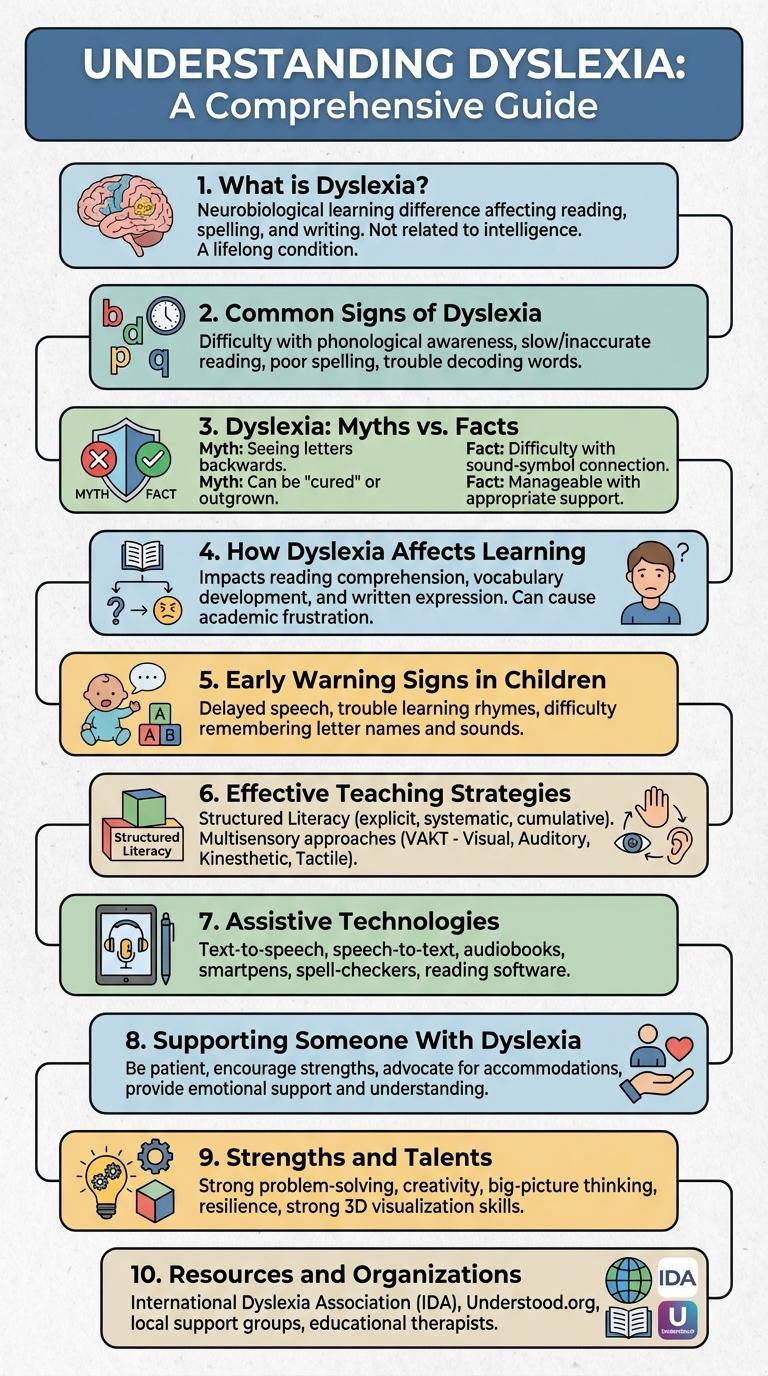
Dyslexia affects individuals' ability to read and process language, posing unique challenges in learning and communication. Understanding the symptoms, causes, and effective strategies is essential for support and inclusion. This infographic presents key facts and insights to raise awareness and foster empathy towards those with dyslexia.
What is Dyslexia?
What is Dyslexia?
Dyslexia is a common learning difficulty that primarily affects reading and spelling skills. It is a neurological condition with a genetic basis, impacting the way the brain processes written language.
Common Signs of Dyslexia
Dyslexia is a common learning difference that primarily affects reading and spelling skills. Individuals with dyslexia often struggle with letter recognition, decoding words, and reading fluently. Early signs include difficulty with phonological processing, frequent spelling mistakes, and slow reading speed.
Dyslexia: Myths vs. Facts
Dyslexia is a common learning difference affecting reading, writing, and spelling skills. Many believe dyslexia signifies low intelligence, but individuals with dyslexia often have average or above-average intelligence. Understanding myths and facts helps promote better support and inclusivity for those with dyslexia.
| Myths | Facts |
|---|---|
| Dyslexia is caused by laziness. | Dyslexia results from brain-based differences in processing language. |
| Only children struggle with dyslexia. | Dyslexia affects people of all ages. |
| Dyslexia can be outgrown. | Dyslexia is a lifelong condition, manageable with strategies and support. |
| Dyslexia means poor vision. | Dyslexia is unrelated to vision problems. |
| People with dyslexia cannot succeed academically. | Many with dyslexia achieve high academic and career success. |
How Dyslexia Affects Learning
Dyslexia is a learning difference that impacts the brain's ability to process written and spoken language. It primarily affects reading, spelling, and writing skills, making academic tasks more challenging.
- Reading Difficulties - Individuals with dyslexia often struggle to decode words quickly and accurately, affecting reading fluency.
- Spelling Challenges - Dyslexia can cause frequent spelling mistakes due to difficulty connecting sounds to letters.
- Writing Problems - Writing may be slow and laborious, with frequent errors in grammar and punctuation.
Understanding how dyslexia affects learning helps educators create effective teaching strategies to support students.
Early Warning Signs in Children
Dyslexia is a common learning difficulty that affects reading and writing skills in children. Early identification can significantly improve learning outcomes and provide targeted support.
Children with dyslexia often show early warning signs such as difficulty recognizing letters and matching letters to sounds. They may struggle with phonological processing, making it hard to decode words. Delays in speech development and trouble following directions can also indicate dyslexia.
Effective Teaching Strategies for Dyslexia
| Teaching Strategy | Description |
|---|---|
| Multisensory Instruction | Engages visual, auditory, and kinesthetic learning pathways simultaneously to reinforce reading skills. |
| Explicit Phonics Teaching | Systematic instruction in letter-sound relationships to improve decoding and word recognition. |
| Structured Literacy Programs | Uses sequential, cumulative lessons focusing on phonology, morphology, syntax, and semantics. |
| Small Group or One-on-One Support | Provides personalized attention to address individual reading challenges effectively. |
| Use of Assistive Technology | Incorporates tools like text-to-speech software to support reading and comprehension. |
Assistive Technologies for Dyslexia
Assistive technologies play a crucial role in supporting individuals with dyslexia by enhancing reading, writing, and comprehension skills. These tools are designed to reduce learning barriers and promote academic success.
Popular assistive technologies include text-to-speech software, which converts written text into spoken words, aiding reading fluency and understanding. Speech-to-text applications enable users to dictate instead of writing, improving written communication for those with dyslexia.
Supporting Someone With Dyslexia
Supporting someone with dyslexia involves understanding their unique learning needs and providing tailored assistance. Effective strategies can significantly improve their confidence and academic outcomes.
- Offer Clear Instructions - Use simple, concise language and break tasks into manageable steps to aid comprehension.
- Use Multi-Sensory Learning - Incorporate visual, auditory, and tactile methods to reinforce reading and writing skills.
- Provide Positive Feedback - Encourage effort and celebrate progress to boost motivation and self-esteem.
Strengths and Talents of People With Dyslexia
People with dyslexia often possess unique cognitive strengths that contribute to creative problem-solving and innovative thinking. Their talents in visual-spatial reasoning and big-picture analysis make them valuable in diverse fields.
- Creative Thinking - Dyslexic individuals excel at generating original ideas and thinking outside the box.
- Visual-Spatial Skills - Many demonstrate strong abilities in interpreting and manipulating visual information.
- Problem-Solving - Dyslexia can enhance the capacity to approach problems from different angles and find novel solutions.