
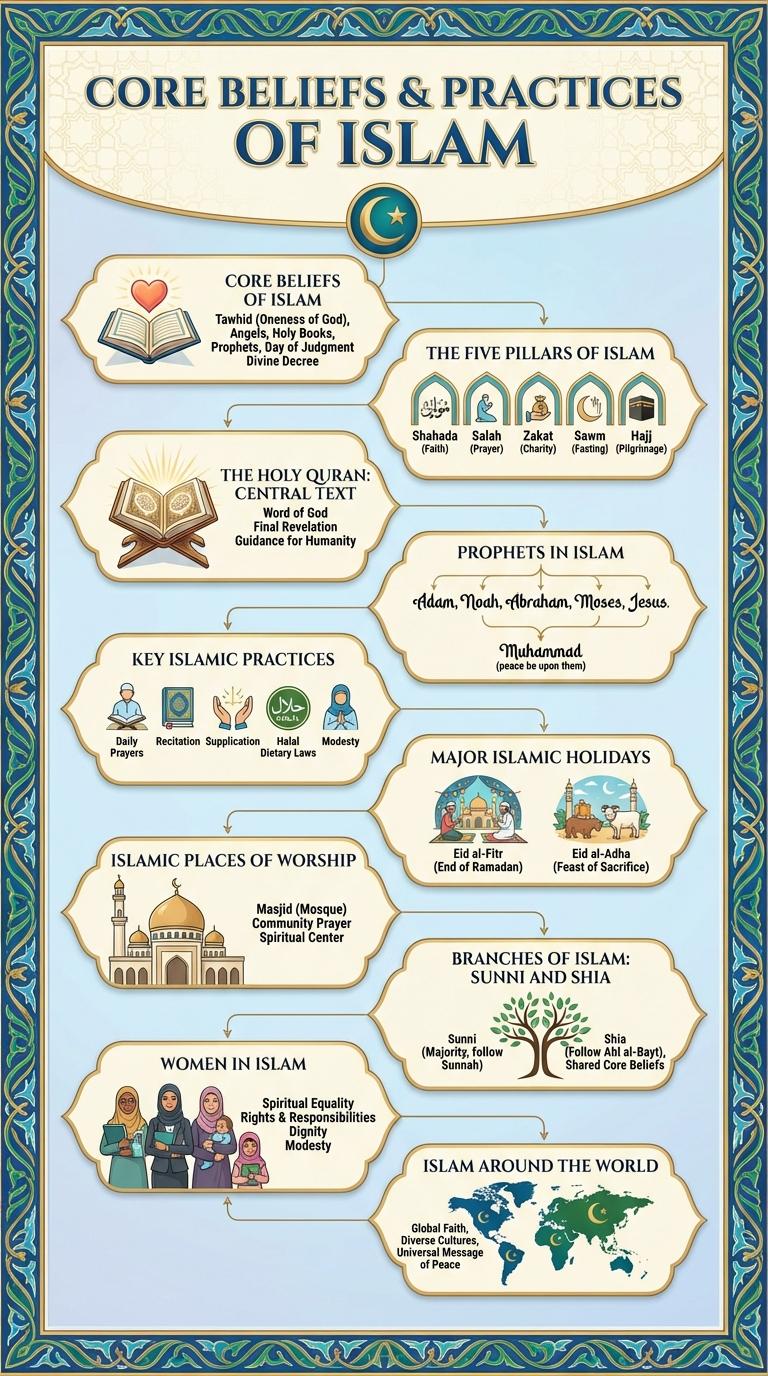
Islam is a major world religion with over a billion followers globally, known for its rich cultural heritage and profound spiritual teachings. This infographic highlights key aspects of Islam, including its core beliefs, practices, and historical significance. Understanding these elements provides a clearer picture of the faith's impact on societies and its role in shaping diverse cultures.
Core Beliefs of Islam
What are the core beliefs of Islam? Islam is founded on the Five Pillars that guide a Muslim's faith and practices. These pillars include the declaration of faith, prayer, fasting, charity, and pilgrimage.
Why is the declaration of faith important in Islam? The declaration, or Shahada, professes the belief in one God and Muhammad as His prophet. It is the fundamental statement that unites all Muslims worldwide.
How does prayer function in Islam? Muslims pray five times daily facing Mecca to maintain a strong connection with God. This ritual emphasizes discipline, spirituality, and community unity.
What role does fasting play during Ramadan? Fasting during the month of Ramadan is a time for self-purification and reflection. It teaches self-control and empathy for those less fortunate.
What is the significance of charity in Islam? Giving Zakat, a fixed portion of wealth, supports the needy and promotes social justice. Charity in Islam symbolizes compassion and communal responsibility.
The Five Pillars of Islam
The Five Pillars of Islam are the core acts of worship that define a Muslim's faith and practices. These pillars structure daily life and spiritual growth, guiding Muslims worldwide in their devotion to Allah.
Shahada is the declaration of faith, affirming the oneness of God and Muhammad as His prophet. Salat requires performing five daily prayers at specific times, fostering discipline and spiritual connection.
Zakat involves giving a fixed portion of one's wealth to charity, supporting the needy and promoting social equality. Sawm is fasting from dawn to sunset during Ramadan, emphasizing self-control and empathy for the less fortunate.
Hajj is the pilgrimage to Mecca that every Muslim must undertake at least once if physically and financially able. It represents unity and submission to Allah, drawing millions together in a powerful spiritual journey.
The Holy Quran: Central Text
| Aspect | Details |
|---|---|
| Title | The Holy Quran: Central Text of Islam |
| Revelation | Believed to be revealed to Prophet Muhammad over 23 years (610-632 CE) |
| Language | Classical Arabic, preserved in original form since revelation |
| Structure | 114 chapters (Surahs) varying in length, arranged mostly by length |
| Core Themes | Monotheism, guidance for personal conduct, social justice, law, and spirituality |
Prophets in Islam
Islam is a monotheistic religion founded in the 7th century by the Prophet Muhammad, who is regarded as the final prophet. Prophets in Islam serve as messengers of God's guidance to humanity.
Islam recognizes many prophets, including Adam, Noah, Abraham, Moses, and Jesus, who all conveyed God's message before Muhammad. Each prophet preached the oneness of God and moral righteousness. The Quran, Islam's holy book, mentions 25 prophets by name, emphasizing their role in guiding believers.
Key Islamic Practices
Islam is a major world religion centered on the belief in one God and the teachings of the Prophet Muhammad. Its key practices guide the spiritual and daily lives of over a billion followers worldwide.
The Five Pillars of Islam represent the core religious duties for Muslims to maintain faith and devotion.
- Shahada (Faith) - Declaration of faith affirming the oneness of God and Muhammad as His messenger.
- Salah (Prayer) - Performing five daily prayers facing Mecca to foster spiritual discipline.
- Zakat (Charity) - Giving a fixed portion of wealth annually to support the needy and promote social justice.
Major Islamic Holidays
Islam celebrates two major holidays each year: Eid al-Fitr and Eid al-Adha. Eid al-Fitr marks the end of Ramadan, the holy month of fasting, while Eid al-Adha commemorates the willingness of Ibrahim to sacrifice his son as an act of obedience to God. Both holidays involve communal prayers, feasts, and acts of charity across Muslim communities worldwide.
Islamic Places of Worship
Islamic places of worship are called mosques, known as Masjid in Arabic. They serve as community centers for prayer, education, and social gatherings.
Mosques feature a prayer hall, a mihrab indicating the direction of Mecca, and a minaret used for the call to prayer. Famous mosques include Al-Masjid al-Haram in Mecca and Al-Masjid an-Nabawi in Medina.
Branches of Islam: Sunni and Shia
Islam is one of the world's major religions, with two primary branches: Sunni and Shia. These branches differ in beliefs, practices, and historical leadership succession.
- Sunni Islam - Represents about 85-90% of Muslims worldwide and emphasizes the elected caliphate as leadership.
- Shia Islam - Constitutes roughly 10-15% of Muslims and believes leadership should remain within the Prophet Muhammad's family, particularly his cousin Ali.
- Key Differences - Sunni and Shia differ in religious rituals, jurisprudence, and interpretations of Islamic law.
Women in Islam
Islam offers a comprehensive framework regarding the rights and roles of women, emphasizing both spiritual equality and social responsibilities. Understanding women's position in Islam helps dispel common misconceptions and highlights their multifaceted contributions in Muslim societies.
- Spiritual Equality - Women and men are regarded as equal in the eyes of God, with equal opportunities for worship and spiritual growth.
- Legal Rights - Islamic law grants women rights to education, property ownership, and inheritance, ensuring financial independence and protection.
- Social Roles - Women in Islam participate actively in family, community, and sometimes leadership roles, balancing tradition with modern societal needs.
Women's rights and roles in Islam reflect a balance of faith-based principles and cultural interpretations across different Muslim communities.