
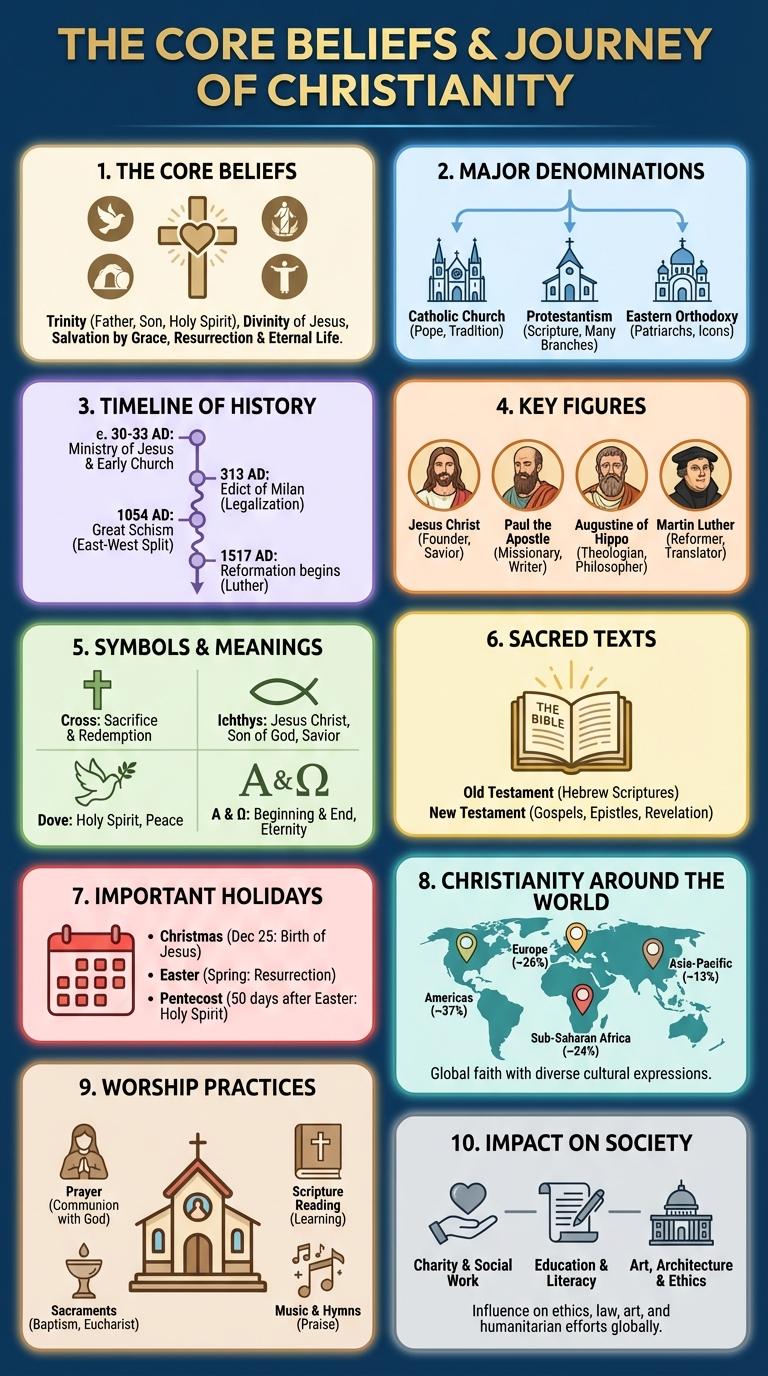
Christianity, one of the world's largest religions, centers on the life and teachings of Jesus Christ. This infographic highlights key beliefs, historical milestones, and major denominations within Christianity. Visual data offers insights into its global distribution and cultural impact.
The Core Beliefs of Christianity
Christianity centers on the life, teachings, and resurrection of Jesus Christ as the foundation of faith. Its core beliefs shape the moral and spiritual framework for millions worldwide.
- Belief in the Trinity - Christianity teaches the existence of one God in three persons: Father, Son, and Holy Spirit.
- Salvation through Jesus Christ - Followers believe that faith in Jesus' death and resurrection grants forgiveness and eternal life.
- The Bible as Sacred Scripture - The Bible is considered the inspired word of God and the authoritative guide for faith and practice.
Major Christian Denominations
Christianity is a diverse religion with several major denominations that vary in beliefs and practices. These denominations share core Christian doctrines while expressing unique traditions and worship styles.
- Roman Catholicism - The largest Christian denomination, centered on the authority of the Pope and sacraments administered by clergy.
- Eastern Orthodoxy - Emphasizes continuity with early Christianity through ancient liturgies and autocephalous church governance.
- Protestantism - Originated from the Reformation, focusing on scripture authority and justification by faith.
- Anglicanism - Combines Catholic and Protestant traditions with the Archbishop of Canterbury as a spiritual leader.
- Pentecostalism - Known for charismatic worship and emphasis on the Holy Spirit's gifts, such as speaking in tongues.
Timeline of Christianity's History
Christianity, one of the world's major religions, has a rich history spanning over two millennia. Its development includes significant events that shaped its doctrines, practices, and global influence.
- 1st Century CE: Birth of Christianity - Christianity began with the teachings of Jesus Christ and the spread of his message by his apostles across the Roman Empire.
- 313 CE: Edict of Milan - Emperor Constantine legalized Christianity, allowing it to flourish and gain political power within the Roman Empire.
- 1054 CE: The Great Schism - The Christian Church divided into Western Roman Catholicism and Eastern Orthodoxy, shaping diverse traditions and practices.
- 16th Century: Protestant Reformation - Reformers like Martin Luther challenged Catholic doctrines, leading to the emergence of Protestant denominations.
- 20th Century: Global Expansion - Christianity spread worldwide through missionary work, becoming the largest religion with diverse cultural expressions.
The history of Christianity continues to evolve, influencing culture, politics, and societies globally.
Key Figures in Christianity
Christianity centers on several key figures who shaped its beliefs and practices. Jesus Christ, regarded as the Son of God, is the foundational figure whose life and teachings are chronicled in the New Testament.
The Apostle Paul significantly contributed to the spread of Christianity through his missionary journeys and epistles. Saint Peter, one of Jesus' closest disciples, is traditionally considered the first pope and a leader of the early Church.
Symbols and Their Meanings
Christianity uses various symbols to convey deep spiritual meanings and beliefs. The cross represents the sacrifice of Jesus Christ and is the most widely recognized Christian symbol. Other important symbols include the fish, symbolizing faith and baptism, and the dove, which represents the Holy Spirit and peace.
Christian Sacred Texts
Christianity's sacred texts primarily include the Bible, divided into the Old Testament and the New Testament. The Old Testament contains texts shared with Judaism, featuring books like Genesis and Psalms. The New Testament focuses on the life and teachings of Jesus Christ, with key books such as the Gospels and the Epistles.
Important Christian Holidays
| Christian Holiday | Significance |
|---|---|
| Christmas | Celebrates the birth of Jesus Christ on December 25. |
| Easter | Commemorates the resurrection of Jesus from the dead. |
| Good Friday | Marks the crucifixion and death of Jesus Christ. |
| Pentecost | Celebrates the descent of the Holy Spirit on the apostles. |
| Advent | Season leading up to Christmas, focusing on anticipation and preparation. |
Christianity Around the World
Christianity is the world's largest religion, with over 2.4 billion followers globally. It is practiced across every continent, making it a truly global faith.
Christianity is divided into three major branches: Roman Catholicism, Protestantism, and Eastern Orthodoxy. The largest populations of Christians are found in the Americas, Europe, and Sub-Saharan Africa. Countries such as the United States, Brazil, and Russia have some of the highest numbers of adherents.
Worship Practices in Christianity
What are the key worship practices in Christianity? Christian worship commonly includes prayer, singing hymns, reading scripture, and participating in sacraments such as Communion and Baptism. These practices vary among denominations but aim to foster a spiritual connection with God and community fellowship.
| Worship Practice | Description |
|---|---|
| Prayer | Personal or communal communication with God, expressing praise, requests, and thanksgiving. |
| Hymns and Music | Singing spiritual songs that praise God and reinforce faith teachings. |
| Scripture Reading | Reading from the Bible to reflect on God's word and guidance. |
| Communion (Eucharist) | Ritual of consuming bread and wine symbolizing Christ's body and blood. |
| Baptism | Initiation rite signifying purification and admission to the Christian community. |