
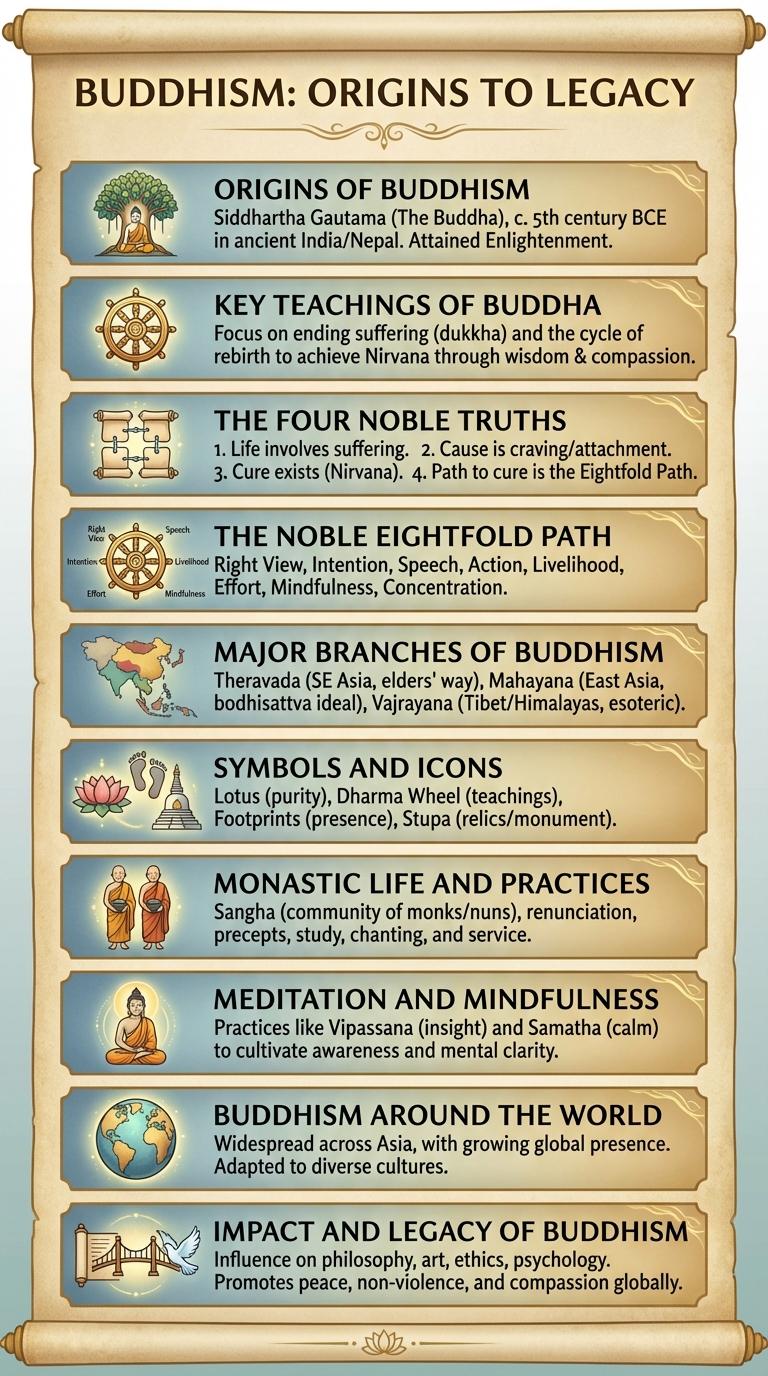
Buddhism is a spiritual tradition that emphasizes mindfulness, compassion, and the pursuit of enlightenment. Its core teachings revolve around the Four Noble Truths and the Eightfold Path, guiding individuals toward inner peace and liberation from suffering. Visualizing these concepts through an infographic offers a clear and concise way to understand the philosophy and practices of Buddhism.
Origins of Buddhism
Buddhism originated in the 6th century BCE in ancient India. It was founded by Siddhartha Gautama, known as the Buddha.
- Historical Context - Buddhism emerged during a period of spiritual questioning in the Indian subcontinent.
- Siddhartha Gautama - A prince who attained enlightenment and shared his insights to help others end suffering.
- Core Teachings - The Four Noble Truths and the Eightfold Path form the foundation of Buddhist philosophy.
Key Teachings of Buddha
Buddhism centers around the teachings of Siddhartha Gautama, known as the Buddha. His insights guide millions in the pursuit of spiritual awakening and inner peace.
The Four Noble Truths form the foundation of Buddhist philosophy: life involves suffering, suffering is caused by desire, ending desire ends suffering, and following the Eightfold Path leads to liberation. The Eightfold Path consists of right understanding, right intention, right speech, right action, right livelihood, right effort, right mindfulness, and right concentration. Meditation and ethical living are essential practices to achieve enlightenment and freedom from the cycle of rebirth.
The Four Noble Truths
Buddhism centers on the Four Noble Truths which outline the essence of human suffering and the path to liberation. These truths are: the truth of suffering, the cause of suffering, the cessation of suffering, and the path leading to the cessation. Understanding and practicing these principles guide followers toward enlightenment and inner peace.
The Noble Eightfold Path
| Aspect | Description |
|---|---|
| Right View | Understanding the nature of reality and the path of transformation |
| Right Intention | Commitment to ethical and mental self-improvement |
| Right Speech | Speaking truthfully and avoiding harmful language |
| Right Action | Behaving peacefully and harmoniously; refraining from harmful deeds |
| Right Livelihood | Engaging in a profession that does not cause harm and is ethically wholesome |
| Right Effort | Making a persistent effort to improve and prevent unwholesome states |
| Right Mindfulness | Developing awareness of the body, feelings, mind, and phenomena |
| Right Concentration | Practicing deep meditation to achieve mental focus and tranquility |
Major Branches of Buddhism
Buddhism is a major world religion with diverse traditions and teachings. It primarily branches into three major schools, each with unique interpretations of Buddha's teachings.
- Theravada Buddhism - Known as the "Teaching of the Elders," it emphasizes monastic life and meditation, mainly practiced in Sri Lanka, Thailand, and Myanmar.
- Mahayana Buddhism - Focuses on the path of the bodhisattva, promoting compassion and enlightenment for all beings, popular in China, Japan, and Korea.
- Vajrayana Buddhism - Incorporates esoteric rituals and tantra, practiced mainly in Tibet, Bhutan, and Mongolia, combining Mahayana philosophy with mystical elements.
Each branch contributes uniquely to the global understanding and practice of Buddhism.
Symbols and Icons
Buddhism uses a variety of symbols and icons to convey its teachings and principles. These symbols often represent key concepts like enlightenment, peace, and the path to spiritual awakening.
The Dharma Wheel symbolizes the Buddha's teaching and the cycle of birth, life, and rebirth. The Lotus Flower represents purity and spiritual growth amidst the challenges of life.
Monastic Life and Practices
Buddhist monastic life centers on simplicity, meditation, and ethical conduct. Monks and nuns follow the Vinaya, a code of discipline that dictates daily routines and moral behavior. Meditation practices such as Vipassana and Metta cultivate mindfulness, compassion, and insight into the nature of existence.
Meditation and Mindfulness
What role does meditation play in Buddhism? Meditation is a fundamental practice in Buddhism that aids in achieving mental clarity and emotional balance. It cultivates mindfulness, helping practitioners stay present and develop compassion.
How does mindfulness influence daily life in Buddhism? Mindfulness encourages awareness of thoughts, feelings, and surroundings moment by moment. This practice reduces stress and enhances emotional regulation, leading to greater peace and insight.
What are common meditation techniques used in Buddhism? Techniques include Vipassana (insight meditation) and Samatha (calm abiding), focusing on breath or bodily sensations. These methods promote concentration and deep self-understanding.
Why is mindfulness important beyond meditation? Mindfulness extends to daily activities like walking, eating, and speaking, fostering continuous awareness. This ongoing practice supports ethical living and harmonious relationships.
How does meditation benefit mental health in Buddhist practice? Regular meditation decreases anxiety and depression by training the mind to respond rather than react. It strengthens resilience and enhances overall well-being.
Buddhism Around the World
Buddhism is a major world religion with millions of followers across the globe. It influences cultural, spiritual, and social practices in many countries.
The distribution of Buddhists varies widely by region, with Asia hosting the largest populations. Buddhism adapts to local customs while maintaining core teachings.
- Asia as the Epicenter - Over 500 million Buddhists live primarily in East and Southeast Asia, including countries like China, Thailand, and Japan.
- Western Adoption - Buddhism has gained significant popularity in Europe and North America through meditation practices and mindfulness.
- Diverse Traditions - Theravada, Mahayana, and Vajrayana represent the main branches, each with unique rituals and philosophical texts.