
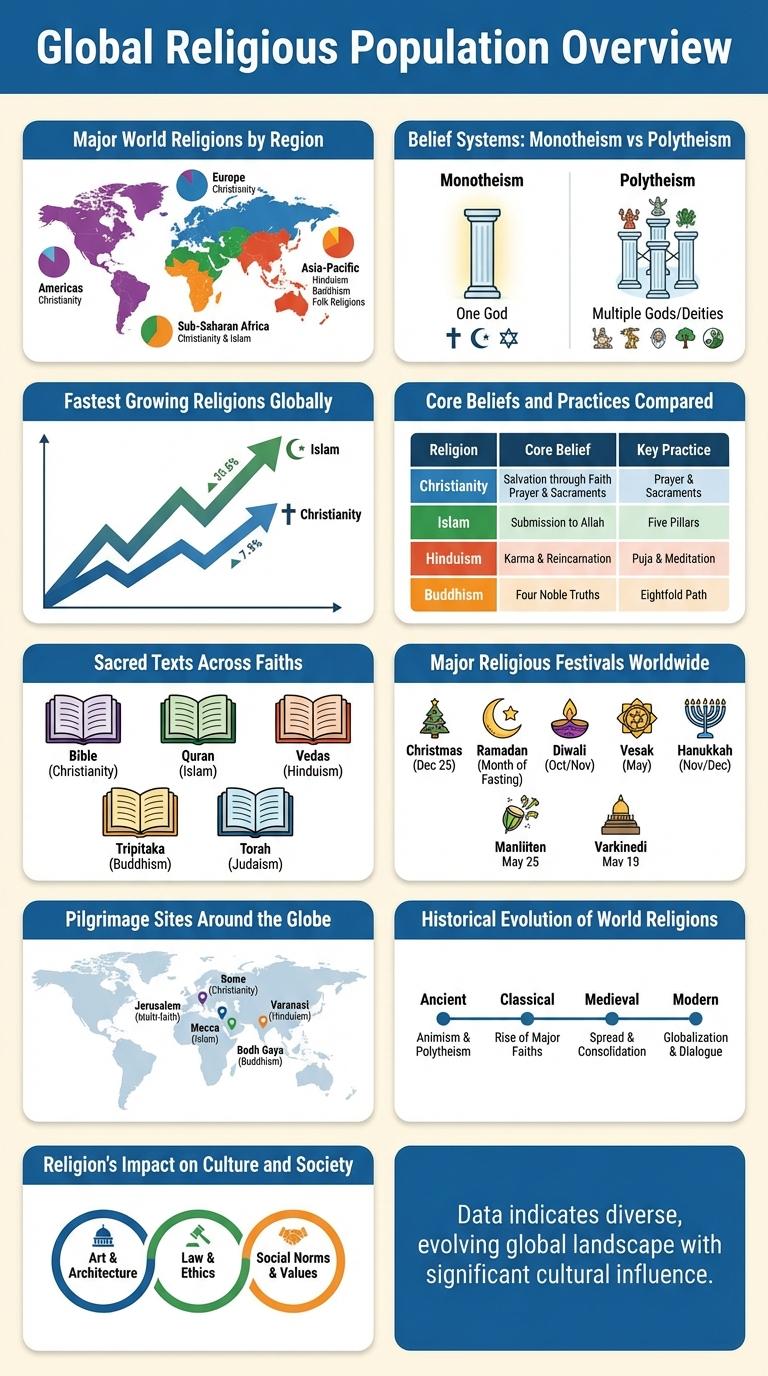
Exploring the diverse landscape of world religions reveals the rich tapestry of human belief systems shaping cultures across the globe. Visualizing this information through an infographic highlights the distribution, followers, and key tenets of major faiths. This powerful tool offers a concise yet comprehensive overview of spiritual diversity and its global impact.
Global Religious Population Overview
The global religious landscape is diverse, with billions of adherents across multiple faiths worldwide. Understanding population distribution highlights the cultural and social significance of these religions.
- Christianity dominates globally - Christianity is the largest religion, with approximately 2.4 billion followers worldwide, representing about 31% of the global population.
- Islam is the second largest - Islam has over 1.9 billion adherents, accounting for roughly 25% of the world's population, growing fastest in Africa and Asia.
- Other major religions include Hinduism and Buddhism - Hinduism has approximately 1.2 billion followers predominantly in India, while Buddhism accounts for around 500 million adherents mainly in East and Southeast Asia.
Major World Religions by Region
Major world religions vary significantly across different regions, shaping cultural and social dynamics globally. Understanding these religious distributions provides insight into regional traditions and community practices.
- Christianity dominates the Americas and Europe - Predominantly practiced in North and South America as well as Europe, Christianity influences many cultural norms and holidays.
- Islam is prevalent in the Middle East and North Africa - The Middle East and North Africa are core regions for Islam, reflecting deep historical and cultural connections to the religion.
- Buddhism is mainly found in East and Southeast Asia - Countries like China, Thailand, and Japan have significant Buddhist populations, with the religion influencing art, philosophy, and daily life.
Religious landscapes continue to evolve with migration, demographic shifts, and cultural exchange.
Belief Systems: Monotheism vs Polytheism
World religions are broadly categorized into monotheistic and polytheistic belief systems. These systems shape cultural values, rituals, and worldviews across different societies.
- Monotheism - Belief in a single, all-powerful deity, as seen in religions like Christianity, Islam, and Judaism.
- Polytheism - Worship of multiple gods or deities, common in Hinduism, ancient Greek religion, and Shinto.
- Global Distribution - Monotheism dominates in the Middle East and parts of Europe, while polytheism is more prevalent in South Asia and indigenous cultures.
Fastest Growing Religions Globally
The fastest growing religions globally include Islam, Christianity, and Hinduism, driven by factors such as high birth rates and conversions. Islam experiences rapid expansion in regions such as Africa and Asia due to demographic trends and missionary activities. Christianity grows quickly in sub-Saharan Africa and parts of Asia, while Hinduism's growth is concentrated in India and the diaspora.
Core Beliefs and Practices Compared
World religions share diverse core beliefs and practices that shape cultures and societies globally. Understanding these similarities and differences promotes respect and harmony among people.
Christianity centers on the belief in Jesus Christ as the savior and practices include prayer, baptism, and attending church. Islam emphasizes submission to Allah, with core practices like the Five Pillars: prayer, fasting, charity, pilgrimage, and faith declaration. Hinduism embraces concepts of karma and dharma, practicing rituals such as meditation, yoga, and worship at temples.
Sacred Texts Across Faiths
Sacred texts serve as the foundational guides for religious beliefs and practices across world religions. Prominent scriptures include the Bible in Christianity, the Quran in Islam, the Vedas in Hinduism, the Tripitaka in Buddhism, and the Torah in Judaism. These texts provide moral teachings, spiritual insights, and historical narratives essential to their respective faith communities.
| Religion | Sacred Text |
|---|---|
| Christianity | Bible |
| Islam | Quran |
| Hinduism | Vedas |
| Buddhism | Tripitaka |
| Judaism | Torah |
Major Religious Festivals Worldwide
Religious festivals around the world celebrate the rich diversity of faiths and cultures, marking significant events and traditions sacred to each religion. These festivals often involve rituals, prayers, feasts, and communal gatherings, reflecting deep spiritual and cultural meanings.
Major religious festivals include Christmas for Christians, Eid al-Fitr for Muslims, Diwali for Hindus, Vesak for Buddhists, and Yom Kippur for Jews. Each festival highlights unique practices and values, fostering unity and devotion among believers globally.
Pilgrimage Sites Around the Globe
Pilgrimage sites around the globe attract millions of faithful from diverse religious traditions each year. These sacred destinations hold deep spiritual significance, often symbolizing key historical or divine events.
Notable locations include Mecca, the holiest city in Islam, where Muslims perform the Hajj pilgrimage annually. Other prominent sites include the Vatican City for Catholics, Varanasi in Hinduism, Lumbini in Buddhism, and the Western Wall in Judaism.
Historical Evolution of World Religions
| Religion | Historical Evolution |
|---|---|
| Hinduism | Originated around 1500 BCE in the Indus Valley; evolved through Vedic traditions and later incorporation of diverse beliefs and practices. |
| Buddhism | Founded in the 5th century BCE by Siddhartha Gautama in India; spread across Asia promoting the Four Noble Truths and the Eightfold Path. |
| Christianity | Emerged in the 1st century CE from Judaic traditions; centered on the life and teachings of Jesus Christ; expanded through the Roman Empire and beyond. |
| Islam | Started in the 7th century CE in the Arabian Peninsula with Prophet Muhammad; rapidly expanded across Middle East, North Africa, and Asia. |
| Judaism | One of the oldest monotheistic religions, dating back to around 2000 BCE; developed through covenantal traditions and the Hebrew Bible. |