
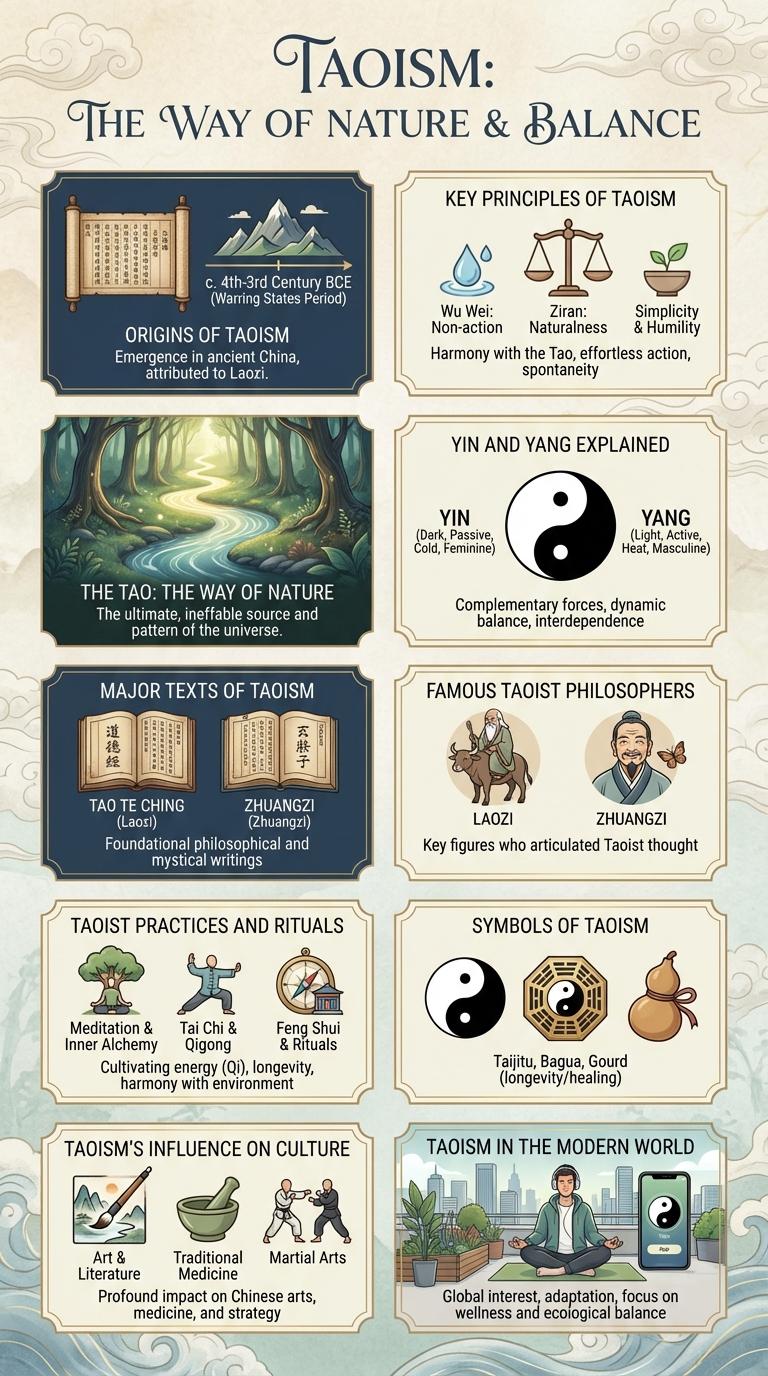
Taoism, an ancient Chinese philosophy, centers on living in harmony with the Tao, or "the Way." It emphasizes simplicity, spontaneity, and balance, guiding individuals toward inner peace and natural flow. This infographic visually explores Taoist principles, key symbols, and influential texts to deepen understanding of its timeless wisdom.
Origins of Taoism
Taoism is an ancient Chinese philosophy emphasizing living in harmony with the Tao, which means "the Way". It originated around the 4th century BCE during the Eastern Zhou Dynasty, influencing Chinese culture, spirituality, and governance.
The foundation of Taoism is attributed to Laozi, a legendary sage believed to have authored the Tao Te Ching. Taoism developed as a response to social and political turmoil, offering a path to simplicity and balance through natural order.
- Laozi - Traditionally considered the founder and author of the Tao Te Ching, central to Taoist thought.
- Eastern Zhou Dynasty - The historical period (770-256 BCE) during which Taoism began to take shape.
- Tao Te Ching - The classic text expressing Taoist philosophy on living in harmony with the Tao.
- Philosophical Roots - Taoism arose as a spiritual and philosophical reaction to political instability in ancient China.
- Natural Order - Taoism emphasizes aligning with the natural world and its rhythms as a means of achieving balance.
Key Principles of Taoism
Taoism is an ancient Chinese philosophy centered on living harmoniously with the Tao, or "The Way." It emphasizes simplicity, spontaneity, and balance in life.
- Tao (The Way) - The fundamental principle that represents the natural order and flow of the universe.
- Wu Wei (Non-Action) - Acting effortlessly in harmony with nature rather than forcing outcomes.
- Yin and Yang - The complementary forces that create balance and unity in all aspects of life.
Understanding these key principles helps cultivate peace, balance, and alignment with nature.
The Tao: The Way of Nature
Taoism centers on the Tao, often called "The Way," representing the natural order of the universe. This philosophy encourages living harmoniously with the rhythms of nature, emphasizing simplicity, spontaneity, and balance. Understanding the Tao leads to a peaceful life aligned with the flow of the natural world.
Yin and Yang Explained
Taoism centers on the balance of opposing forces symbolized by Yin and Yang. These forces represent harmony and the natural flow of life in the universe.
Yin and Yang illustrate how seemingly contrary energies complement and interconnect with each other to create balance.
- Yin represents the feminine - It includes qualities like darkness, passivity, and receptivity.
- Yang represents the masculine - It embodies brightness, activity, and strength.
- Interdependence of Yin and Yang - Neither can exist without the other, emphasizing unity in diversity.
Major Texts of Taoism
What are the major texts of Taoism that shape its philosophy? Taoism primarily revolves around three classic texts: the Tao Te Ching, the Zhuangzi, and the Daozang. These works collectively offer a deep understanding of Taoist thought, spirituality, and practice.
| Text | Description |
|---|---|
| Tao Te Ching | Attributed to Laozi, it consists of 81 short chapters teaching the principles of Tao, emphasizing simplicity, humility, and harmony with nature. |
| Zhuangzi | Written by the philosopher Zhuang Zhou, this text uses stories and parables to explore relativity, spontaneity, and freedom from societal norms. |
| Daozang | A vast Taoist canon compiled over centuries, containing scriptures, rituals, and commentaries essential for Taoist religious practice. |
Famous Taoist Philosophers
Taoism is an ancient Chinese philosophy centered on living harmoniously with the Tao, or "the Way." It emphasizes simplicity, spontaneity, and naturalness as paths to wisdom and balance.
Famous Taoist philosophers have profoundly influenced Eastern thought and spirituality. Laozi, the legendary founder of Taoism, authored the Tao Te Ching, a foundational text. Zhuangzi expanded Taoist ideas through allegories and parables, focusing on relativity and freedom from societal norms. Other notable figures include Wang Bi and Wang Chongyang, who contributed to the development and interpretation of Taoist philosophy throughout history.
Taoist Practices and Rituals
Taoist practices and rituals center around harmony with the Tao, the natural order of the universe. Common rituals include meditation, Tai Chi, and offering incense to deities and ancestors. These practices aim to cultivate inner peace, balance, and spiritual longevity.
Symbols of Taoism
Taoism, an ancient Chinese philosophy, emphasizes living in harmony with the Tao, the fundamental principle that is the source of all existence. Its symbols represent deep spiritual concepts central to Taoist beliefs.
The Yin-Yang symbol illustrates the balance between opposites, such as light and dark or male and female, reflecting the interconnectedness of all things. The Bagua, eight trigrams arranged in a circle, signifies natural forces and the dynamic balance within the universe.
Taoism's Influence on Culture
| Aspect | Impact of Taoism |
|---|---|
| Art | Taoist principles inspire traditional Chinese landscape painting, emphasizing harmony with nature and fluid brushwork. |
| Literature | Classical poetry and philosophical texts reflect Taoism's themes of simplicity, spontaneity, and balance. |
| Martial Arts | Taoism shapes Tai Chi and Qigong practices through the cultivation of qi (energy) and natural movement. |
| Architecture | Designs incorporate Taoist cosmology, achieving harmony with the environment through Feng Shui principles. |
| Festivals & Rituals | Taoist religious ceremonies and seasonal celebrations influence cultural festivals across East Asia. |