
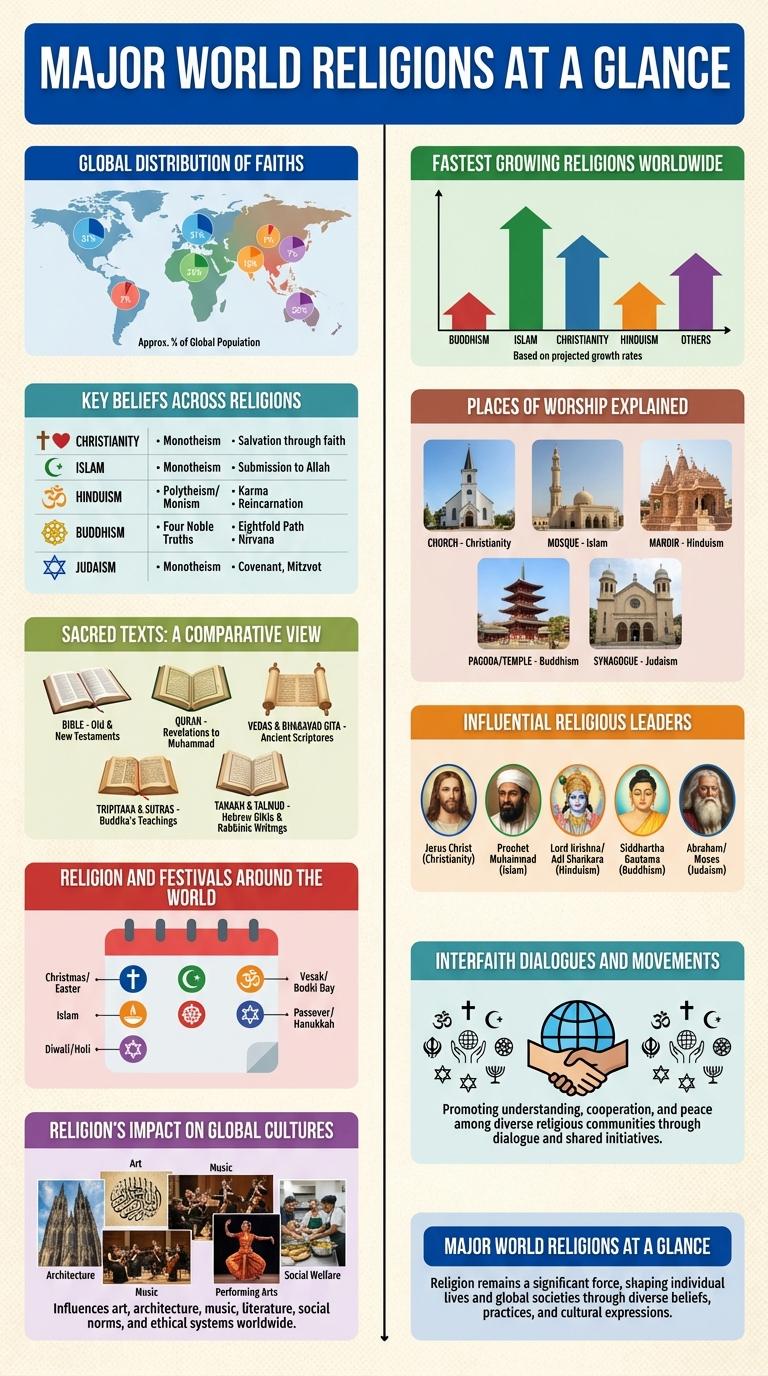
Religious infographics visually convey complex beliefs, practices, and historical data in a clear and engaging format. They highlight key aspects such as demographics, sacred texts, rituals, and cultural impact across different faiths. These tools enhance understanding by simplifying intricate religious information for diverse audiences.
Major World Religions at a Glance
Religion plays a significant role in cultures and societies worldwide. Understanding the major world religions helps promote tolerance and global awareness.
Christianity, Islam, Hinduism, Buddhism, and Judaism are the five largest religions by followers. Each has unique beliefs, practices, and historical origins that shape its identity.
Global Distribution of Faiths
The global distribution of major religions reflects diverse cultural and historical factors influencing belief systems worldwide. Understanding where religions are predominantly practiced helps reveal patterns of faith across continents and nations.
- Christianity dominates the Americas and Europe - Over 2.3 billion adherents primarily reside in the Americas, Europe, and sub-Saharan Africa, making it the largest religion globally.
- Islam is concentrated in the Middle East, North Africa, and parts of Asia - About 1.9 billion Muslims mostly live in the Middle East, South Asia, and Southeast Asia, shaping the religious landscape of these regions.
- Buddhism is prevalent in East and Southeast Asia - Approximately 500 million Buddhists are primarily found in countries like China, Japan, Thailand, and Myanmar.
Fastest Growing Religions Worldwide
| Religion | Growth Rate |
|---|---|
| Islam | 2.9% annually |
| Christianity (Pentecostalism) | 3.0% annually |
| Hinduism | 1.7% annually |
| Buddhism | 1.5% annually |
| Judaism | 1.2% annually |
Key Beliefs Across Religions
Religions across the world share core beliefs that shape the values and practices of their followers. Understanding these key beliefs reveals common themes such as the nature of the divine, moral codes, and life after death.
Most religions emphasize the existence of a higher power or supreme being, with varied interpretations ranging from monotheism to polytheism. Ethical guidelines, often derived from sacred texts, guide followers in leading righteous lives. Concepts of afterlife, reincarnation, or spiritual liberation are central to many faiths, reflecting diverse views on human existence beyond death.
Places of Worship Explained
Places of worship are central to religious practices and provide a dedicated space for communal and individual spiritual activities. Different religions have unique architectural styles and customs associated with their worship spaces.
- Church - Christian places of worship where believers gather for prayer, sermons, and sacraments.
- Mosque - Islamic centers for prayer, community events, and Quranic study.
- Temple - Hindu or Buddhist sacred buildings used for rituals, meditation, and festivals.
Sacred Texts: A Comparative View
Sacred texts form the foundation of many world religions, conveying spiritual teachings and moral guidance. These texts vary widely in style, length, and origin but serve similar roles in religious communities.
- The Bible - Central to Christianity, it consists of the Old Testament and the New Testament, detailing the history and teachings of Jesus Christ.
- The Quran - The Islamic sacred book, believed to be the literal word of God as revealed to Prophet Muhammad.
- The Bhagavad Gita - A key Hindu scripture presenting a dialogue on duty and righteousness within the epic Mahabharata.
- The Tripitaka - Also known as the Pali Canon, it is the traditional scripture of Theravada Buddhism, containing teachings of the Buddha.
- The Torah - The foundational text of Judaism, comprising the first five books of the Hebrew Bible and outlining religious laws and history.
Understanding the diversity and significance of sacred texts enhances interfaith dialogue and respect among religious traditions.
Influential Religious Leaders
Influential religious leaders have shaped spiritual beliefs and social values across cultures throughout history. Figures such as Jesus Christ, Prophet Muhammad, Buddha, and Guru Nanak founded major world religions, influencing billions worldwide. Contemporary leaders continue to inspire through advocacy, humanitarian efforts, and interfaith dialogue.
Religion and Festivals Around the World
What are some of the major religions celebrated worldwide and their key festivals?
Religions like Christianity, Islam, Hinduism, Buddhism, and Judaism have rich traditions and vibrant festivals. These celebrations play a crucial role in cultural identity and community bonding across the globe.
| Religion | Key Festival(s) |
|---|---|
| Christianity | Christmas, Easter |
| Islam | Eid al-Fitr, Eid al-Adha |
| Hinduism | Diwali, Holi |
| Buddhism | Vesak (Buddha Day) |
| Judaism | Passover, Hanukkah |
Interfaith Dialogues and Movements
Interfaith dialogues foster understanding and respect among diverse religious communities by promoting open communication and shared values. Key movements such as the Parliament of the World's Religions and the United Religions Initiative encourage collaboration on social justice, peacebuilding, and environmental sustainability. These efforts help reduce religious conflicts and build a more inclusive global society.