
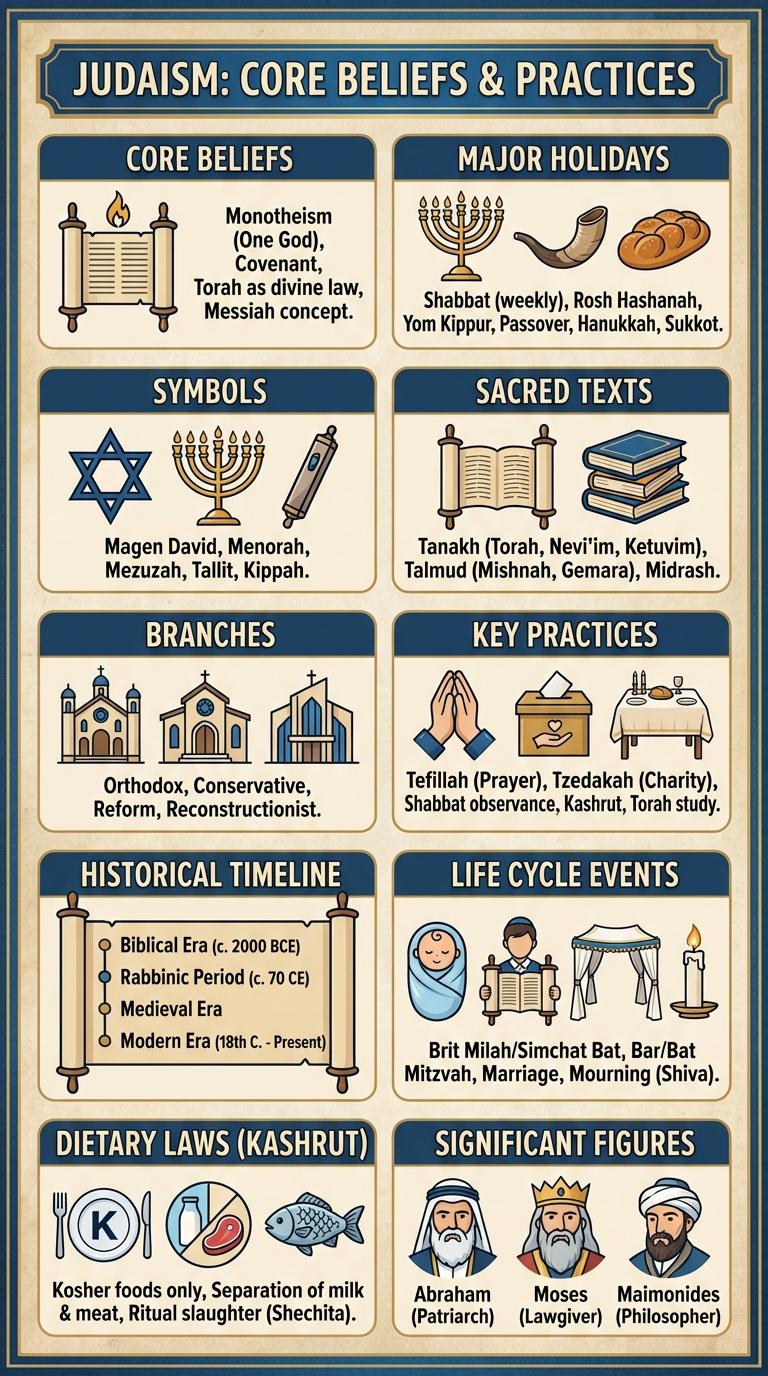
Judaism is one of the oldest monotheistic religions, with rich traditions and a profound historical impact. Key beliefs focus on the covenant between God and the Jewish people, emphasizing ethics, law, and community. This infographic visualizes essential aspects of Judaism, including its core teachings, rituals, and cultural heritage.
Core Beliefs of Judaism
Judaism is one of the oldest monotheistic religions, centered on the belief in a single, all-powerful God. Its core beliefs shape the spiritual and ethical life of Jewish communities worldwide.
The foundational principles guide Jewish worship, law, and identity through sacred texts and traditions.
- Monotheism - Judaism emphasizes belief in one, indivisible God who is the creator and ruler of the universe.
- Covenant - The special covenant between God and the Jewish people establishes a unique relationship and responsibilities.
- Torah - The Torah, including the written and oral law, serves as the central guide for Jewish life and practice.
Major Jewish Holidays
| Holiday | Significance |
|---|---|
| Passover (Pesach) | Commemorates the Exodus from Egypt and liberation from slavery |
| Rosh Hashanah | Jewish New Year, a time for reflection and repentance |
| Yom Kippur | Day of Atonement, the holiest day focused on fasting and prayer |
| Hanukkah | Festival of Lights, celebrates the rededication of the Second Temple in Jerusalem |
| Shavuot | Marks the giving of the Torah at Mount Sinai |
Symbols of Judaism
Judaism is rich in symbols that convey its religious beliefs and cultural identity. These symbols carry deep spiritual significance and are integral to Jewish rituals and traditions.
- Star of David - A six-pointed star representing the connection between God and humanity, often seen on synagogues and the Israeli flag.
- Menorah - A seven-branched candelabrum symbolizing the ancient Temple in Jerusalem and the light of divine wisdom.
- Mezuzah - A small scroll placed on doorposts inscribed with biblical verses, serving as a sign of faith and protection for the home.
Jewish Sacred Texts
Judaism centers around several sacred texts that guide religious practices and beliefs. These texts include the Torah, the Tanakh, and the Talmud, which together form the foundation of Jewish law and theology.
The Torah, also known as the Five Books of Moses, is the most important Jewish text, containing laws and ethical teachings. The Tanakh is the Hebrew Bible, comprising the Torah, Prophets (Nevi'im), and Writings (Ketuvim). The Talmud is a comprehensive compilation of oral law and rabbinic discussions that interpret the Torah's commandments.
Branches of Judaism
Judaism is composed of several branches, each with unique beliefs, practices, and interpretations of Jewish law. The three main branches are Orthodox, Conservative, and Reform Judaism.
Orthodox Judaism maintains strict adherence to traditional Jewish law and rituals. Conservative Judaism balances tradition with modernity, adapting some practices while preserving core beliefs.
Key Jewish Practices
Judaism centers on a rich tapestry of religious practices that shape Jewish identity and community life. Observing the Sabbath and following dietary laws are fundamental aspects that guide daily routines and spiritual reflection.
Prayer plays a crucial role, with three daily services connecting individuals to God. Celebrating festivals like Passover and Yom Kippur reinforces historical memories and communal bonds.
Historical Timeline of Judaism
What are the key milestones in the historical timeline of Judaism? Judaism began over 3,000 years ago in the ancient Near East, rooted in the covenant between God and Abraham. This timeline highlights significant events that shaped Jewish religious and cultural identity through centuries.
| Period | Event |
|---|---|
| circa 2000 BCE | Abraham's Covenant - Foundation of Jewish faith and identity |
| circa 1300 BCE | Exodus from Egypt - Moses leads the Israelites to freedom |
| circa 1000 BCE | Establishment of the Kingdom of Israel under King David |
| 586 BCE | Babylonian Exile - Destruction of First Temple and diaspora roots |
| 70 CE | Destruction of Second Temple by Romans, significant shift in worship |
Life Cycle Events in Judaism
Life cycle events in Judaism mark significant spiritual and communal milestones. These include Brit Milah (circumcision) for newborn boys, Bar and Bat Mitzvah ceremonies celebrating religious coming of age, and marriage rituals symbolizing union and covenant. Funerary customs honor the deceased and emphasize respect, mourning, and remembrance within the Jewish tradition.
Jewish Dietary Laws (Kashrut)
Judaism includes specific dietary laws known as Kashrut that outline permissible foods for observant Jews. These laws are detailed in the Torah and shape daily eating habits and food preparation.
- Kosher Animals - Permitted land animals must have cloven hooves and chew cud, such as cows and sheep, while fish must have fins and scales.
- Prohibition of Mixing Meat and Dairy - Meat and dairy products cannot be cooked or eaten together to maintain ritual purity and separation.
- Proper Slaughtering (Shechita) - Animals must be slaughtered by a trained individual to ensure a quick and humane death, making the meat kosher.
Kashrut influences Jewish culture and religious observance by guiding ethical and spiritual eating practices.