
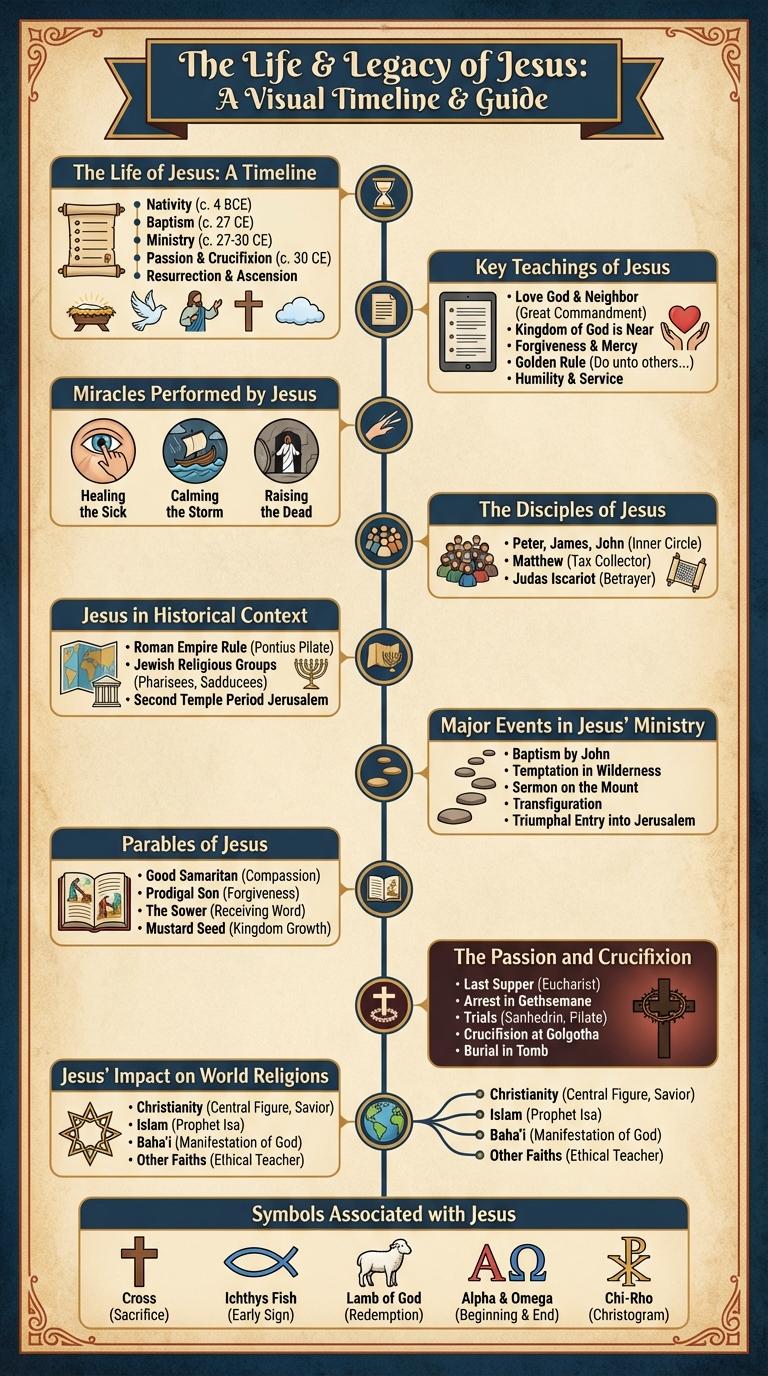
The infographic visually presents key aspects of Jesus' life, teachings, and impact on Christianity, offering a concise overview for easy understanding. It highlights significant events such as his birth, ministry, miracles, and resurrection, emphasizing his role as a spiritual leader. The design combines informative text with engaging graphics to enhance learning and retention.
The Life of Jesus: A Timeline
The Life of Jesus: A Timeline presents key events in the life of Jesus Christ, central to Christian faith and history. This infographic highlights major milestones from his birth to his resurrection.
Jesus was born in Bethlehem around 4 BCE, marking the beginning of his earthly life. His ministry started approximately at age 30, spreading teachings of love, compassion, and salvation.
Key events include his baptism by John the Baptist, preaching miracles, and parables that attracted followers. The timeline culminates in his crucifixion and resurrection, foundational events for Christianity.
This concise timeline aids understanding of Jesus' impact on religious history and culture. It provides a clear overview for educational and devotional purposes.
Key Teachings of Jesus
Jesus taught the importance of love, emphasizing love for God and love for others as the greatest commandments. He preached forgiveness, encouraging people to forgive others to receive God's mercy. His teachings highlighted humility, compassion, and the promise of eternal life for those who follow his path.
Miracles Performed by Jesus
Jesus performed numerous miracles that demonstrated his divine power and compassion. These miracles include healing the sick, raising the dead, and controlling nature. Each miracle served as a testament to his message of faith and salvation.
The Disciples of Jesus
| Disciple | Role and Key Facts |
|---|---|
| Peter | Also known as Simon Peter; leader of the twelve; first to confess Jesus as the Messiah; traditionally recognized as the first Pope. |
| James (son of Zebedee) | One of the "Sons of Thunder"; brother of John; part of Jesus' inner circle; first apostle martyred. |
| John | Brother of James; "Beloved Disciple"; author of the Gospel of John, three epistles, and Revelation. |
| Andrew | Brother of Peter; the first disciple called by Jesus; known for bringing others to Christ. |
| Thomas | Also called Didymus; known as "Doubting Thomas" for questioning Jesus' resurrection until seeing proof. |
Jesus in Historical Context
Jesus of Nazareth lived during the early first century CE, a period marked by Roman occupation of Judea. His life coincided with significant social, political, and religious upheaval in the region.
Born in Bethlehem and raised in Galilee, Jesus was a Jewish preacher and religious leader whose teachings challenged existing Jewish norms and Roman authority. The historical context includes the rule of Herod the Great, the Roman emperor Augustus, and the rise of various Jewish sects. His crucifixion under Pontius Pilate reflects the tensions between Roman governance and emerging Christian beliefs.
Major Events in Jesus' Ministry
Jesus' ministry is marked by significant events that highlight his teachings, miracles, and the foundation of Christian faith. These major moments shaped the religious landscape and continue to inspire millions worldwide.
- Baptism by John the Baptist - Jesus was baptized in the Jordan River, signifying the start of his public ministry.
- Miracle of Turning Water into Wine - This first recorded miracle at the wedding in Cana symbolizes Jesus' divine power and compassion.
- Sermon on the Mount - Jesus delivered core teachings including the Beatitudes, outlining principles for righteous living.
- Feeding of the 5,000 - Jesus miraculously fed a large crowd with five loaves and two fishes, demonstrating his care and ability to provide.
- Crucifixion and Resurrection - His death and resurrection form the cornerstone of Christian belief in salvation and eternal life.
Parables of Jesus
Jesus used parables as powerful teaching tools to convey spiritual truths through simple stories. These narratives engaged listeners and revealed deeper meanings about the Kingdom of God.
- The Parable of the Good Samaritan - Illustrates the importance of compassion and loving one's neighbor beyond cultural boundaries.
- The Parable of the Prodigal Son - Demonstrates God's forgiveness and unconditional love for repentant sinners.
- The Parable of the Sower - Describes how different responses to God's word affect spiritual growth and fruitfulness.
The Passion and Crucifixion
What events define the Passion of Jesus Christ?
The Passion refers to the series of suffering and trials Jesus endured before his death. It encompasses his arrest, trial, scourging, and journey to the crucifixion site.
Where did the Crucifixion of Jesus take place?
Jesus was crucified at Golgotha, also known as Calvary, just outside Jerusalem's walls. This location became central to Christian faith as the site of Jesus' sacrificial death.
Why is the Crucifixion significant in Christian theology?
The Crucifixion symbolizes Jesus' sacrifice for humanity's sins. Christians believe this act redeems believers and offers salvation.
How long did Jesus hang on the cross during the Crucifixion?
Jesus hung on the cross for approximately six hours. During this time, he experienced intense suffering before his death.
What events followed the Crucifixion of Jesus?
After Jesus died, he was buried in a tomb, which was sealed and guarded. Christians commemorate his resurrection as the triumph over death and sin.
Jesus' Impact on World Religions
Jesus of Nazareth remains a central figure whose teachings shaped multiple world religions. His influence extends beyond Christianity, impacting diverse faith traditions globally.
- Christianity - Founded on Jesus' life and teachings, Christianity is the largest religion worldwide with over 2.4 billion adherents.
- Islam - Jesus (Isa) is recognized as a prophet and the Messiah in Islam, highlighting his spiritual importance to over 1.9 billion Muslims.
- Judaism - While Judaism does not accept Jesus as the Messiah, his historical presence influences Jewish-Christian dialogues.
- Baha'i Faith - Views Jesus as one of many divine messengers who progressively revealed God's will across eras.
- Impact on Ethics - Jesus' teachings on love, compassion, and forgiveness have profoundly shaped ethical frameworks worldwide.
Jesus' legacy continues to inspire religious thought, interfaith understanding, and cultural values globally.