
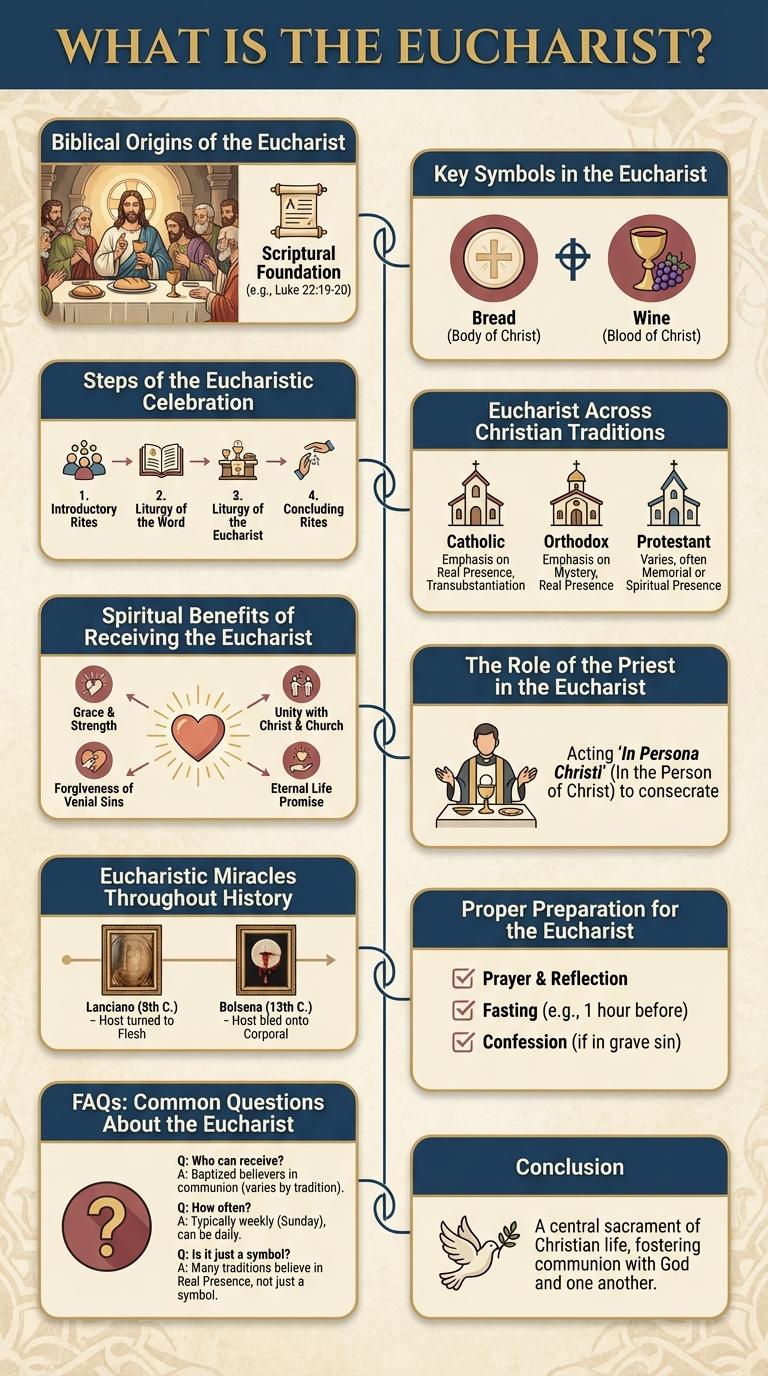
The Eucharist is a central sacrament in Christian worship symbolizing the body and blood of Christ. This infographic visually breaks down its biblical origins, significance, and traditional practices. Key elements such as the Last Supper, the act of communion, and its spiritual meaning are clearly illustrated for deeper understanding.
What Is the Eucharist?
The Eucharist is a central Christian sacrament commemorating the Last Supper of Jesus Christ. It involves consecrating bread and wine, symbolizing the body and blood of Christ.
This rite signifies spiritual nourishment and unity among believers in the Christian faith.
- Spiritual Meal - The Eucharist represents the body and blood of Christ used as a spiritual food to strengthen faith.
- Remembrance - It serves as a memorial of Jesus' sacrifice and his command to "do this in remembrance of me."
- Communion - Participation in the Eucharist unites Christians with Christ and each other in a shared sacred experience.
Biblical Origins of the Eucharist
The Eucharist is a central Christian sacrament rooted in biblical teachings. It commemorates the Last Supper of Jesus Christ with his disciples before his crucifixion.
- Last Supper Institution - Jesus established the Eucharist during the Passover meal as recorded in the Synoptic Gospels (Matthew 26:26-28, Mark 14:22-24, Luke 22:19-20).
- Bread and Wine Symbolism - The bread represents Jesus' body and the wine his blood, signifying sacrifice and new covenant with humanity.
- Pauline References - Apostle Paul's First Letter to the Corinthians (1 Corinthians 11:23-26) emphasizes the importance of partaking in the Eucharist in remembrance of Christ.
The Eucharist serves as a spiritual nourishment and a profound expression of faith based on scriptural foundations.
Key Symbols in the Eucharist
The Eucharist centers on key symbols that represent the body and blood of Christ. The bread symbolizes Christ's body, broken for believers, while the wine represents His blood, shed for the forgiveness of sins. These elements emphasize sacrifice, communion, and spiritual nourishment in Christian worship.
Steps of the Eucharistic Celebration
The Eucharistic Celebration is a central ritual in Christian worship, commemorating the Last Supper of Jesus Christ. It involves a series of sacred steps that lead to the consecration and sharing of bread and wine.
The celebration begins with the Introductory Rites, where the congregation gathers and prayers set a reverent tone. The Liturgy of the Word follows, featuring scripture readings and a homily that reflect on God's message. The Liturgy of the Eucharist culminates in the consecration of the bread and wine, which become the Body and Blood of Christ, followed by Communion and concluding prayers.
Eucharist Across Christian Traditions
The Eucharist is a central rite in Christianity symbolizing the body and blood of Jesus Christ through bread and wine. Different Christian traditions interpret and practice the Eucharist in unique theological and liturgical ways.
- Roman Catholicism - Believes in transubstantiation, where bread and wine become the actual body and blood of Christ.
- Eastern Orthodoxy - Emphasizes the mystery of transformation, affirming the real presence without defining the exact process.
- Protestantism - Views vary; many see the Eucharist as symbolic or a means of spiritual presence.
- Anglicanism - Holds a middle ground, affirming a real presence while often avoiding detailed explanations of the change.
- Lutheranism - Teaches sacramental union, meaning Christ's body and blood coexist with the bread and wine during Communion.
Spiritual Benefits of Receiving the Eucharist
| Spiritual Benefit | Description |
|---|---|
| Union with Christ | Receiving the Eucharist deepens the believer's intimate connection with Jesus, fostering spiritual unity. |
| Grace and Strength | The sacrament imparts divine grace that strengthens the soul to resist temptation and grow in holiness. |
| Forgiveness of Venial Sins | Regular reception of the Eucharist cleanses minor sins and nurtures spiritual renewal. |
| Spiritual Nourishment | The Eucharist feeds the soul with the Body and Blood of Christ, sustaining spiritual life and vitality. |
| Communal Bond | Participation in the Eucharist unites the faithful into one body, strengthening the Church community. |
The Role of the Priest in the Eucharist
The priest plays a central role in the Eucharist, acting as the mediator between the congregation and God. Through the priest, the sacrifice of Christ is made present during the Mass.
The priest consecrates the bread and wine, transforming them into the Body and Blood of Christ. This sacred act enables the faithful to receive Communion, uniting them with Christ and the Church.
Eucharistic Miracles Throughout History
The Eucharist is central to Catholic faith, symbolizing the body and blood of Christ. Throughout history, numerous Eucharistic miracles have reinforced believers' faith by demonstrating the divine presence.
One famous miracle occurred in Lanciano, Italy, where the consecrated host transformed into actual flesh and blood in the 8th century. Another notable event happened in Buenos Aires, Argentina, in 1996, when a consecrated host visibly turned into human tissue analyzed as cardiac muscle.
Proper Preparation for the Eucharist
What is the proper preparation for receiving the Eucharist? Proper preparation involves examining one's conscience and seeking forgiveness through the Sacrament of Reconciliation. This ensures a worthy and reverent reception of the Body and Blood of Christ.
Why is fasting important before the Eucharist? Fasting for at least one hour before Communion helps the faithful focus spiritually and shows respect for the sacrament. It prepares the body and soul to receive Christ in a pure and devout manner.
How should one approach the Eucharist with reverence? Approaching the Eucharist quietly and prayerfully demonstrates reverence and gratitude. It reflects recognition of the Eucharist's sacred mystery and profound significance.
What role does faith play in preparing for the Eucharist? Faith deepens understanding and appreciation of the Eucharist as the true presence of Christ. A sincere belief encourages a more meaningful and transformative communion experience.
Are there any spiritual attitudes recommended before Communion? Cultivating humility, trust, and love prepares the heart to receive grace abundantly. These attitudes foster unity with Christ and the Church community during the sacrament.