
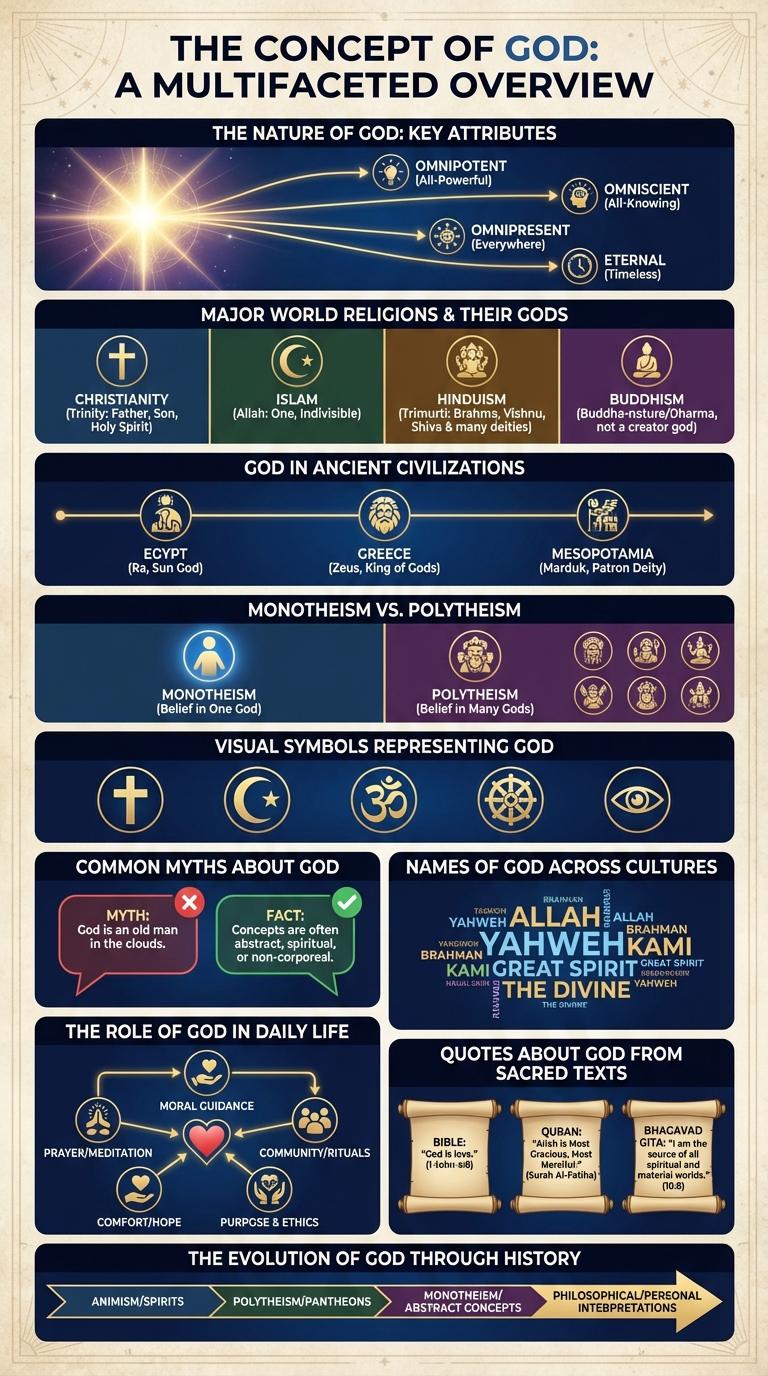
Infographics about God visually represent complex religious concepts, making them easier to understand and explore. They use symbols, scriptures, and artistic designs to convey the attributes, significance, and diverse interpretations of the divine. This approach enhances engagement and knowledge retention for viewers seeking spiritual insights.
The Nature of God: Key Attributes
What are the essential attributes that define the nature of God?
God is traditionally understood as omnipotent, omniscient, and omnipresent. These attributes emphasize God's unlimited power, complete knowledge, and presence everywhere at all times.
How does God's attribute of omnipotence influence believers' faith?
Omnipotence means God has unlimited power to create and control the universe. This attribute assures believers of God's ability to provide and protect.
What does omniscience reveal about God's understanding?
Omniscience signifies God's perfect knowledge of all things, past, present, and future. It highlights God's wisdom and the foundation for divine justice and guidance.
Why is God's omnipresence significant in spirituality?
Omnipresence denotes God's presence everywhere simultaneously, ensuring no place is beyond divine reach. It fosters a sense of comfort and accountability among followers.
How do believers interpret God's attributes in daily life?
Believers see God's attributes as a source of hope, strength, and moral insight. The nature of God inspires faith, devotion, and ethical living worldwide.
Major World Religions and Their Gods
Major world religions each center around distinct deities or divine figures that shape their beliefs and practices. Christianity worships God, characterized as a Trinity of Father, Son, and Holy Spirit. Hinduism includes a vast pantheon with key gods like Vishnu, Shiva, and Devi embodying different aspects of the divine.
Islam venerates Allah, the singular, all-powerful God revealed through the Prophet Muhammad. Buddhism, while diverse, often focuses on enlightened beings such as the Buddha rather than a creator god. Judaism worships Yahweh, emphasizing a covenantal relationship with the one God of Israel.
God in Ancient Civilizations
God played a central role in the belief systems of ancient civilizations, influencing culture, law, and daily life. Diverse deities reflected the values, fears, and hopes of these societies.
- Mesopotamian Gods - Ancient Mesopotamians worshipped gods like Anu and Enlil who governed natural forces and human destiny.
- Egyptian Deities - The Egyptians revered gods such as Ra and Osiris, embodying creation, the afterlife, and cosmic order.
- Greek Pantheon - Greek gods like Zeus and Athena represented power, wisdom, and human traits in myths and rituals.
Monotheism vs. Polytheism
God is a central concept in many religions, representing divine power and ultimate authority. Different belief systems vary in their understanding of God's nature and number.
- Monotheism - The belief in a single, all-powerful God who governs the universe.
- Polytheism - The belief in multiple gods, each with distinct roles and attributes.
- Religious Practices - Monotheistic religions often focus on worship of one deity, while polytheistic religions involve rituals dedicated to various gods.
Understanding the differences between monotheism and polytheism helps in exploring the diverse ways humans relate to the divine.
Visual Symbols Representing God
Visual symbols have long been used to represent diverse concepts of God across cultures and religions. These symbols convey theological ideas and spiritual attributes in simple, recognizable forms.
- The Cross - A central symbol in Christianity representing the crucifixion and resurrection of Jesus Christ, embodying sacrifice and salvation.
- The Om Symbol - A sacred sound and spiritual icon in Hinduism signifying the essence of ultimate reality and consciousness.
- The Star of David - A hexagram symbol commonly associated with Judaism representing divine protection and connection between God and humanity.
Common Myths About God
Common myths about God often depict Him as a strict judge who only punishes sins. Many people mistakenly believe God is distant and uninvolved in human affairs. Another myth is that God favors certain groups over others, whereas most teachings emphasize divine impartiality and unconditional love.
Names of God Across Cultures
The concept of God varies widely across different cultures, each attributing unique names and characteristics to the divine. These names often reflect the cultural values, beliefs, and languages of their respective societies.
In Christianity, God is commonly referred to as Yahweh or Jehovah, emphasizing a personal and covenantal relationship with humans. Hinduism recognizes many deities with names like Brahman, Vishnu, and Shiva, representing different aspects of the supreme reality.
The Role of God in Daily Life
God plays a central role in the daily lives of millions, providing guidance, comfort, and purpose. Believers often turn to prayer and meditation to connect with the divine and find strength in challenges.
Religious practices influence moral decisions, social behavior, and community involvement. Faith in God inspires hope, resilience, and a sense of belonging among individuals worldwide.
Quotes About God From Sacred Texts
| Sacred Text | Quote About God |
|---|---|
| The Bible | "God is love." - 1 John 4:8 |
| The Quran | "Indeed, Allah is with the patient." - Quran 2:153 |
| The Bhagavad Gita | "I am the source of all spiritual and material worlds." - Bhagavad Gita 10:8 |
| The Torah | "Hear, O Israel: The Lord our God, the Lord is one." - Deuteronomy 6:4 |
| The Tripitaka | "All tremble at violence; all fear death." - Dhammapada 129 |