
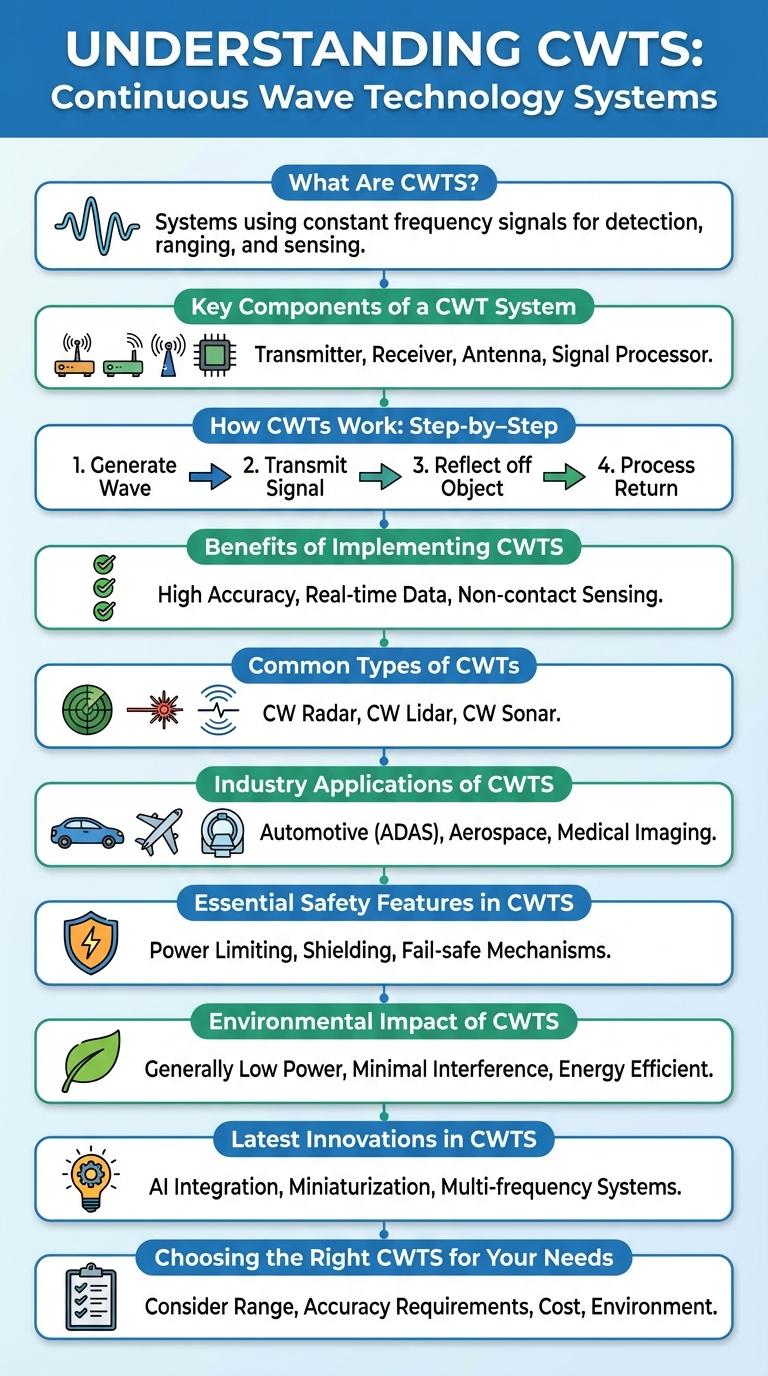
The infographic illustrates key components and benefits of the Civic Welfare Training Service (CWTS) program. It highlights essential skills developed, community projects undertaken, and the impact on student volunteers and local communities. Visual data clearly presents the program's role in fostering social responsibility and civic engagement.
What Are CWTS?
What Are CWTS?
CWTS stands for Civic Welfare Training Service, an essential component of the National Service Training Program (NSTP) in the Philippines. It focuses on developing students' community service skills and promoting civic responsibility through various welfare projects.
Key Components of a CWT System
The CWTS (Centralized Waste Tracking System) ensures efficient monitoring of waste management activities. It integrates various stakeholders to maintain compliance and environmental safety.
Key components include data collection modules, real-time tracking, and automated reporting tools. These features streamline waste handling processes and improve accountability across all levels.
How CWTS Work: Step-by-Step
The Center for World University Rankings (CWTS) evaluates global universities using detailed metrics. Its ranking system focuses on research performance, impact, and collaboration to provide accurate results.
- Data Collection - Collects publication and citation data from sources like Web of Science to assess research output.
- Performance Indicators - Measures research productivity, citation impact, and scientific collaboration to evaluate universities.
- Normalization - Adjusts data for subject field differences and institutional size for fair comparison.
- Composite Scoring - Aggregates multiple indicators into a single score to rank university performance globally.
- Publication of Rankings - Releases annual rankings highlighting the top institutions across various categories and regions.
CWTS rankings help students and policymakers understand university strengths and guide strategic decisions.
Benefits of Implementing CWTS
CWTS, or Community Welfare Training Service, enhances students' social responsibility through hands-on community projects. Implementing CWTS promotes civic engagement, leadership skills, and practical problem-solving abilities. These benefits foster holistic development and contribute to sustainable community growth.
Common Types of CWTS
CWTS, or Community Welfare and Training Service, encompasses various programs aimed at enhancing community development and social responsibility. These programs engage students and participants in hands-on activities that promote civic awareness and practical skills.
Common types of CWTS include Environmental Protection, which involves activities like tree planting and waste management. Another type is Disaster Risk Reduction, focusing on preparedness and response training in vulnerable communities.
Industry Applications of CWTS
CWTS (Centre for Science and Technology Studies) provides critical insights into scientific research trends and innovation patterns. Its data-driven analyses support various industry applications.
Industries leverage CWTS to identify emerging technologies and collaboration networks. CWTS metrics guide R&D investment decisions and benchmark scientific performance. These applications enhance strategic planning across sectors like pharmaceuticals, energy, and IT.
Essential Safety Features in CWTS
| Essential Safety Feature | Importance in CWTS |
|---|---|
| Proper Personal Protective Equipment (PPE) | Minimizes risk of injury by protecting students during community service activities |
| Emergency Contact Protocols | Ensures quick communication and response in case of accidents or health emergencies |
| Site Risk Assessment | Identifies potential hazards at community sites to prevent accidents |
| First Aid Training | Prepares students to provide immediate care in emergencies, reducing severity of injuries |
| Supervision by Trained Personnel | Provides guidance and monitoring to maintain safety standards during activities |
Environmental Impact of CWTS
CWTS (Community Water Treatment Systems) significantly improve local water quality and public health. They reduce environmental contamination and promote sustainable water resource management.
- Reduction of Water Pollution - CWTS minimize pollutants by filtering contaminants from wastewater before release.
- Conservation of Aquatic Ecosystems - Clean water discharge helps protect fish, plants, and overall biodiversity in nearby rivers and lakes.
- Lower Carbon Footprint - Many CWTS use energy-efficient technologies, decreasing greenhouse gas emissions associated with water treatment.
Latest Innovations in CWTS
The Center for World University Rankings (CWTS) continuously evolves by integrating advanced bibliometric indicators and machine learning algorithms to enhance global university evaluations. Recent innovations include the adoption of AI-driven data analytics to provide more accurate assessments of academic impact and research collaboration networks. CWTS also emphasizes transparency and reproducibility by offering open-access data visualization tools, enabling institutions to benchmark performance effectively.