
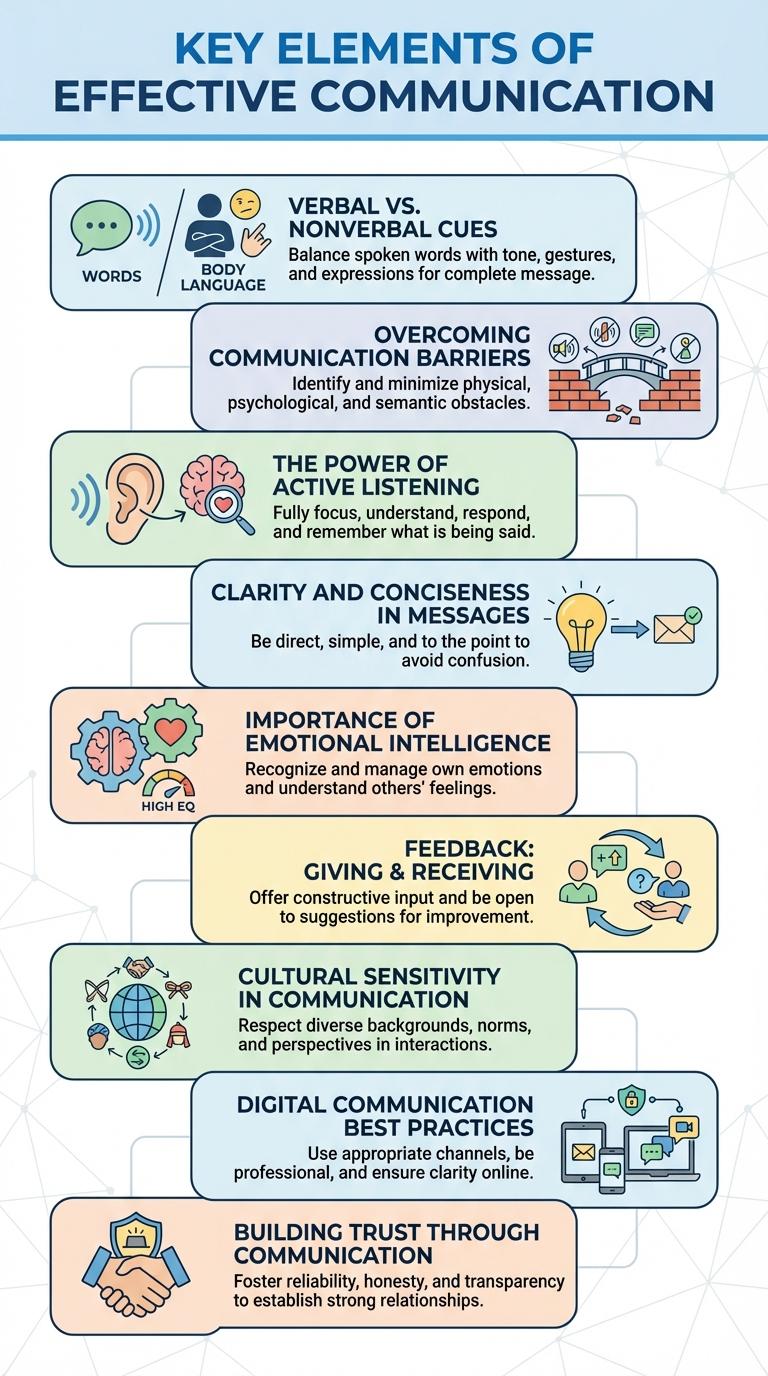
Effective communication is essential for building strong relationships and achieving successful outcomes in both personal and professional settings. Visual tools like infographics simplify complex information, making it easier to understand and retain key concepts. This infographic highlights practical tips and strategies for mastering effective communication skills.
Key Elements of Effective Communication
| Key Element | Description |
|---|---|
| Clarity | Expressing ideas clearly and directly to avoid misunderstanding. |
| Active Listening | Fully concentrating, understanding, and responding to the speaker's message. |
| Nonverbal Communication | Using body language, facial expressions, and gestures to reinforce the message. |
| Empathy | Understanding and sharing the feelings of others to build trust and rapport. |
| Feedback | Providing constructive responses to ensure the message is understood and improved. |
Verbal vs. Nonverbal Cues
Effective communication relies on both verbal and nonverbal cues to convey messages clearly. Verbal communication includes spoken or written words, while nonverbal communication comprises body language, facial expressions, and tone of voice. Understanding the balance between these cues enhances clarity and helps prevent misunderstandings.
Overcoming Communication Barriers
Effective communication requires identifying and overcoming common barriers such as language differences, cultural misunderstandings, and emotional biases. Recognizing these obstacles helps create a clearer exchange of ideas and stronger connections.
Active listening and empathy play crucial roles in breaking down communication barriers. Using clear language, confirming understanding, and fostering an open environment enhances message delivery and reception.
The Power of Active Listening
Active listening is a vital skill that enhances effective communication by fully engaging with the speaker's message. It helps build trust and ensures accurate understanding between participants.
The power of active listening lies in paying close attention, providing feedback, and withholding judgment. It fosters empathy, reduces misunderstandings, and strengthens relationships. Mastering this skill leads to clearer, more productive conversations in both personal and professional settings.
Clarity and Conciseness in Messages
Effective communication hinges on clarity and conciseness to ensure messages are understood quickly and accurately. Streamlined communication reduces misunderstandings and improves audience engagement.
- Clear Language - Use simple, direct words to convey your message without ambiguity.
- Focused Content - Stick to relevant information to avoid overwhelming the receiver.
- Brief Sentences - Short sentences enhance readability and reduce cognitive load.
Mastering clarity and conciseness transforms communication into an efficient and impactful exchange of ideas.
Importance of Emotional Intelligence
Emotional intelligence is a critical component of effective communication, enabling individuals to understand and manage their own emotions as well as recognize the emotions of others. This skill fosters empathy, reduces misunderstandings, and promotes positive interactions in both personal and professional settings.
High emotional intelligence enhances active listening and helps tailor messages to the audience's emotional state, improving clarity and connection. Leaders with strong emotional intelligence can motivate teams, resolve conflicts, and create collaborative environments that boost productivity.
Feedback: Giving & Receiving
How can giving and receiving feedback improve communication?
Effective feedback strengthens understanding between individuals. It promotes growth and resolves misunderstandings quickly.
| Giving Feedback | Receiving Feedback |
|---|---|
| Be specific and objective. | Listen actively without interrupting. |
| Focus on behavior, not personality. | Ask clarifying questions. |
| Use positive language to encourage. | Stay open-minded and avoid defensiveness. |
| Provide actionable suggestions. | Reflect on feedback for self-improvement. |
| Choose the right time and place. | Express gratitude for the input. |
Cultural Sensitivity in Communication
Cultural sensitivity in communication enhances understanding and fosters respect among diverse groups. Recognizing and adapting to cultural differences prevents misunderstandings and promotes inclusive interactions. Emphasizing empathy and active listening builds trust and strengthens global relationships.
Digital Communication Best Practices
Effective digital communication enhances clarity and fosters collaboration across remote and hybrid teams. Adopting best practices ensures messages are understood and responses are timely.
Mastering digital communication tools improves productivity and reduces misunderstandings in professional environments.
- Use Clear and Concise Language - Simplify messages to avoid ambiguity and ensure recipients easily grasp the information.
- Choose the Right Platform - Select communication channels that fit the message purpose, such as email for formal updates and instant messaging for quick queries.
- Maintain Professional Tone - Keep communication respectful and appropriate to build trust and credibility within digital interactions.