
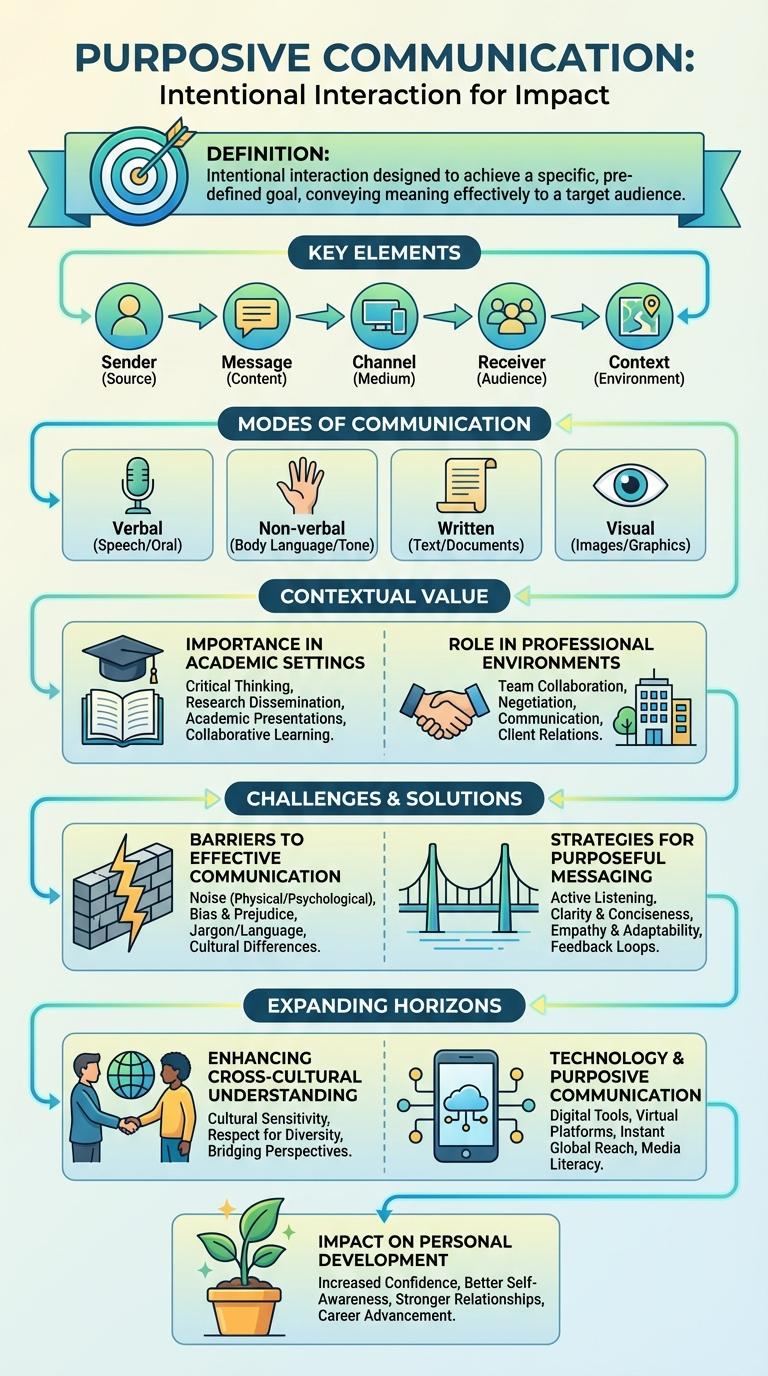
Purposive communication focuses on conveying clear and effective messages tailored to specific audiences and objectives. It emphasizes the importance of choosing appropriate language, tone, and channels to achieve desired outcomes. This approach enhances understanding, fosters engagement, and drives meaningful interactions.
Definition of Purposive Communication
| Term | Definition |
|---|---|
| Purposive Communication | Deliberate and goal-oriented communication designed to convey clear messages for specific purposes. |
| Key Feature | Intentionality in message delivery aimed at achieving effective understanding and response. |
| Communication Types | Includes verbal, non-verbal, written, and digital forms tailored to distinct audiences and objectives. |
| Objective | To inform, persuade, motivate, or entertain while ensuring clarity and relevance. |
| Context | Applied in academic, professional, and social settings to enhance interaction outcomes. |
Key Elements of Purposive Communication
Purposive communication is the intentional exchange of messages designed to achieve specific goals. It emphasizes clarity, relevance, and effectiveness in conveying information to targeted audiences.
- Clarity - Ensures the message is easily understood without ambiguity.
- Audience Awareness - Tailors communication based on the audience's needs, backgrounds, and preferences.
- Purposefulness - Focuses on delivering messages aligned with specific objectives or desired outcomes.
- Feedback - Encourages responses that help verify understanding and improve the communication process.
- Context - Considers situational factors that influence how messages are interpreted.
Effective purposive communication enhances interaction and achieves intended results in various settings.
Modes of Purposive Communication
Purposive communication utilizes specific modes to effectively convey messages tailored to audience needs. These modes include verbal, nonverbal, and visual communication, each serving distinct purposes in ensuring clarity and engagement. Understanding the appropriate mode enhances the impact and effectiveness of communication in various contexts.
Importance in Academic Settings
Purposive communication plays a vital role in academic settings by ensuring clear and effective exchange of ideas among students and educators. It enhances understanding, promotes critical thinking, and supports collaborative learning.
Mastering purposive communication helps students present arguments logically and engage in meaningful discussions. Instructors benefit by conveying concepts clearly, which improves student comprehension and academic success.
Role in Professional Environments
Purposive communication plays a critical role in professional environments by enabling clear, concise, and effective information exchange. It fosters collaboration, reduces misunderstandings, and enhances decision-making processes among team members and stakeholders. Mastery of purposive communication contributes to building strong workplace relationships and advancing organizational goals.
Barriers to Effective Communication
What are common barriers to effective purposive communication? Barriers such as language differences, cultural misunderstandings, and emotional interference can distort the intended message. Identifying these obstacles helps improve clarity and mutual understanding in communication.
Strategies for Purposeful Messaging
Purposeful messaging in communication ensures that the intended message reaches the audience clearly and effectively. Tailoring content to the audience's needs enhances understanding and engagement.
Key strategies include knowing your audience, choosing the appropriate medium, and crafting clear, concise messages. Using feedback mechanisms and consistent messaging further reinforces the communication's purpose.
Enhancing Cross-Cultural Understanding
Purposive communication plays a crucial role in bridging cultural gaps and fostering mutual respect. It promotes clearer understanding and effective interactions across diverse cultures.
- Active Listening - Engaging attentively helps capture cultural nuances and prevents misunderstandings.
- Cultural Sensitivity - Recognizing and respecting cultural differences enhances communication effectiveness.
- Nonverbal Cues - Understanding body language improves interpretation across diverse cultures.
Technology and Purposive Communication
Purposive communication integrates technology to enhance the clarity and effectiveness of messages. Emerging digital tools shape how individuals and organizations convey purposeful information in real-time.
- Real-Time Interaction - Technology enables instant communication, allowing messages to be delivered and received promptly with minimal delay.
- Multimedia Support - Incorporating visuals, audio, and video aids in crafting meaningful and engaging messages tailored to diverse audiences.
- Global Connectivity - Digital platforms facilitate cross-cultural communication, expanding the reach of purposive interactions beyond geographical limits.