
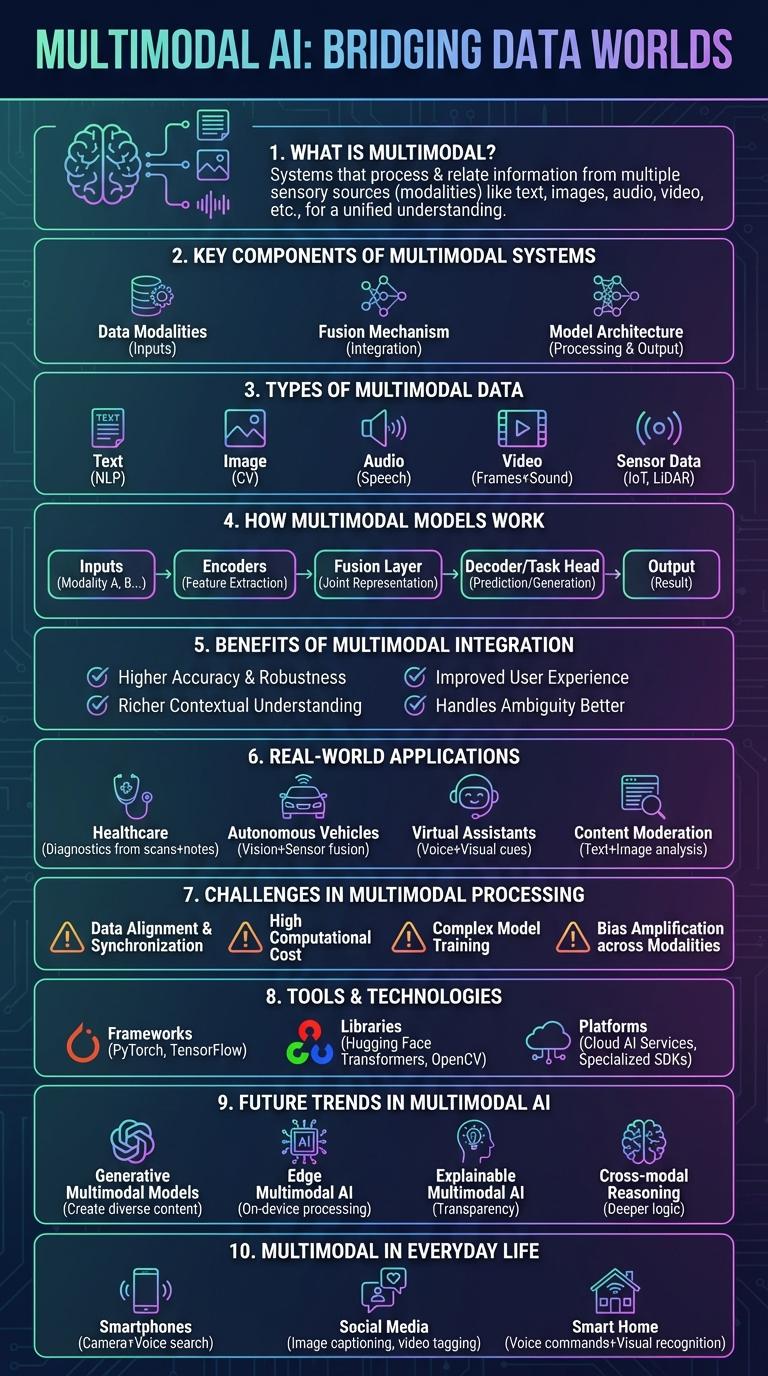
Multimodal communication combines text, images, audio, and video to enhance information delivery and audience engagement. This infographic visually breaks down the components and benefits of multimodal approaches in education, marketing, and digital media. It highlights how integrating multiple modes creates richer, more effective communication experiences.
What is Multimodal?
What is multimodal communication? Multimodal communication involves using multiple modes such as text, images, sound, and gestures to convey information effectively. It enhances understanding by engaging various senses simultaneously.
Key Components of Multimodal Systems
Multimodal systems integrate multiple modes of input and output to enhance user interaction and experience. These systems process data from various sources such as speech, gesture, and text to deliver comprehensive results.
- Input Modalities - Diversified data channels like voice, touch, and visual signals enable versatile user interaction.
- Fusion Engine - Combines and processes input data from different modalities to understand user intent accurately.
- Output Modalities - Delivers responses through various forms such as speech synthesis, visual display, or haptic feedback.
Types of Multimodal Data
Multimodal data integrates information from multiple sources such as text, images, audio, and sensor data. Common types include visual data like images and videos, auditory data such as speech and music, and textual data from documents and social media. Combining these diverse data types enhances analysis, enabling richer insights and more accurate models.
How Multimodal Models Work
Multimodal models integrate data from multiple sources such as text, images, and audio to enhance understanding and output quality. These models process and analyze diverse data types simultaneously, enabling more comprehensive interpretation.
They use neural networks designed to handle different modalities by extracting relevant features from each input type. These features are then combined in a unified representation, allowing the model to make context-aware predictions and generate richer responses.
Benefits of Multimodal Integration
Multimodal integration combines data from various sources like text, image, audio, and video to create a cohesive understanding. This approach enhances accuracy and richness in data interpretation, enabling more comprehensive insights.
Benefits include improved decision-making through diverse data perspectives and enhanced user experience by providing contextually relevant information. Multimodal systems enable advanced applications in fields such as healthcare, autonomous vehicles, and natural language processing.
Real-world Applications of Multimodal AI
Multimodal AI combines data from multiple sources such as text, images, audio, and video to deliver comprehensive insights and solutions. Real-world applications include healthcare diagnostics where AI analyzes medical images and patient records simultaneously, enhancing accuracy and speed. In autonomous driving, multimodal AI processes visual, radar, and sensor data to ensure safe navigation and decision-making.
Challenges in Multimodal Processing
Multimodal processing integrates data from multiple sources like text, images, and audio to enhance machine understanding. It faces unique challenges due to the complexity of synchronizing diverse data types and formats.
Key challenges impact accuracy, efficiency, and scalability in multimodal systems.
- Data Alignment - Ensuring temporal and semantic synchronization between modalities like video and audio is complex.
- Feature Fusion - Combining heterogeneous features from text, images, and sound into a unified representation is difficult.
- Noise and Ambiguity - Handling noisy, incomplete, or ambiguous data across modalities affects model reliability.
Tools & Technologies for Multimodal Analysis
Multimodal analysis integrates data from multiple modes such as text, audio, and video to provide comprehensive insights. Advanced tools and technologies enable efficient processing and interpretation of diverse data types for improved decision-making.
- Natural Language Processing (NLP) - Extracts meaning from textual data by analyzing syntax, semantics, and sentiment.
- Computer Vision - Processes and interprets visual data from images and videos for object recognition and scene understanding.
- Audio Signal Processing - Analyzes sound patterns to identify speech, emotions, and acoustic features.
- Multimodal Fusion Platforms - Combine inputs from various modalities to create unified representations for deeper analysis.
- Deep Learning Frameworks - Utilize neural networks to model complex relationships across different data types efficiently.
These technologies collectively enhance the accuracy and depth of multimodal data interpretation.
Future Trends in Multimodal AI
| Future Trend | Description |
|---|---|
| Advanced Multimodal Reasoning | AI systems integrating vision, language, and audio for deeper context understanding and decision-making. |
| Cross-Modal Learning | Models capable of transferring knowledge across modalities to enhance accuracy and reduce data requirements. |
| Real-Time Multimodal Interaction | Enhanced AI interfaces supporting seamless communication through speech, gestures, and visual cues in real-time. |
| Improved Multimodal Fusion Techniques | Innovations in combining disparate data types to create unified representations facilitating better predictions. |
| Ethical and Explainable Multimodal AI | Focus on transparency and fairness in AI decisions involving multiple data sources and complex inputs. |