
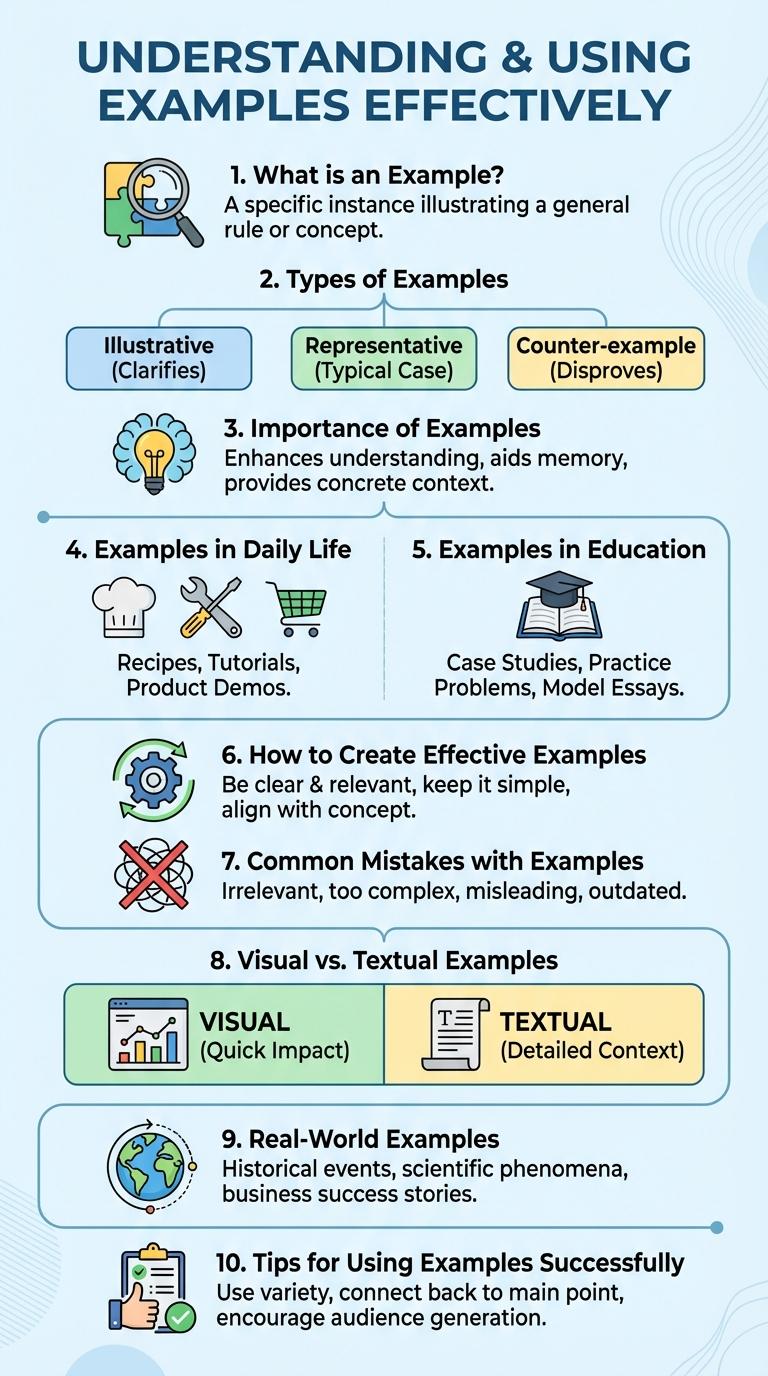
An infographic about examples visually presents key information through clear, concise graphics and text, making complex concepts easier to understand. By highlighting specific examples with vibrant colors and icons, it enhances retention and engagement. This approach effectively communicates data and ideas for diverse audiences.
What is an Example?
| What is an Example? | Description |
|---|---|
| Definition | An example is a specific instance or case used to illustrate or explain a concept, idea, or principle. |
| Purpose | Examples clarify understanding, provide evidence, and support arguments in communication and learning. |
| Types | Examples include real-life cases, hypothetical scenarios, analogies, and demonstrations. |
| Usage | Used in education, writing, presentations, and problem-solving to make abstract information concrete. |
| Benefit | Enhances comprehension, retention, and engagement by linking theory to practical application. |
Types of Examples
What are the main types of examples used in communication? Examples can be categorized into specific and general types. Specific examples illustrate detailed instances, while general examples provide broader patterns.
How do representative examples differ from non-representative ones? Representative examples accurately reflect the overall group or concept. Non-representative examples may mislead by highlighting unusual or extreme cases.
What role do hypothetical examples play in explanations? Hypothetical examples create imaginary scenarios to clarify complex ideas. They help audiences understand potential outcomes without real-world constraints.
Why are statistical examples important in presenting data? Statistical examples use numbers and percentages to support claims with evidence. They provide quantifiable proof to strengthen arguments.
How do personal examples enhance storytelling? Personal examples draw from individual experiences to connect emotionally with the audience. They make content relatable and memorable.
Importance of Examples
Examples play a crucial role in enhancing understanding by providing concrete illustrations of abstract concepts. They bridge the gap between theory and practice, making complex ideas more accessible.
Using relevant examples improves retention and engagement, helping learners apply knowledge effectively. Examples serve as valuable tools for clarification and deeper comprehension in various fields.
Examples in Daily Life
Infographics simplify complex information by using visuals and concise text, making data easier to understand. Examples in daily life include weather forecasts, nutritional labels, and traffic signs that convey essential information quickly. These visuals enhance communication, aid decision-making, and improve information retention.
Examples in Education
Examples in education enhance understanding by providing concrete illustrations of abstract concepts. Effective examples improve student engagement and retention of information.
- Case Studies - Detailed real-life situations help students apply theoretical knowledge to practical scenarios.
- Interactive Simulations - Digital models allow learners to experiment and observe outcomes in a controlled environment.
- Visual Aids - Charts, diagrams, and infographics support comprehension by simplifying complex information.
How to Create Effective Examples
Creating effective examples enhances understanding and retention. Clear, relevant examples bridge theory and real-world application.
- Be Specific - Use concrete details to make the example relatable and precise.
- Align With Objectives - Ensure examples directly support the key points or learning goals.
- Use Simple Language - Avoid jargon to keep examples accessible to a broad audience.
Common Mistakes with Examples
An infographic about common mistakes provides clear visual examples to enhance understanding. It highlights frequent errors in various contexts, such as grammar, design, or data interpretation. Each mistake is paired with a corresponding example to illustrate the issue effectively.
Visual vs. Textual Examples
Visual examples use images, charts, or diagrams to convey information quickly and effectively. They enhance understanding by providing a clear and immediate representation of concepts.
Textual examples rely on written descriptions or explanations to illustrate ideas in detail. They offer depth and context, allowing for more precise communication of complex information.
Real-World Examples
Infographics simplify complex information using visual elements. Real-world examples showcase their effectiveness in communication and engagement.
- Business Reporting - Infographics present financial data clearly, aiding quick decision-making.
- Educational Content - Students comprehend topics faster through visually organized facts.
- Marketing Campaigns - Brands increase user interaction by illustrating product benefits graphically.
These real-world applications demonstrate the versatility and power of infographics in various industries.