
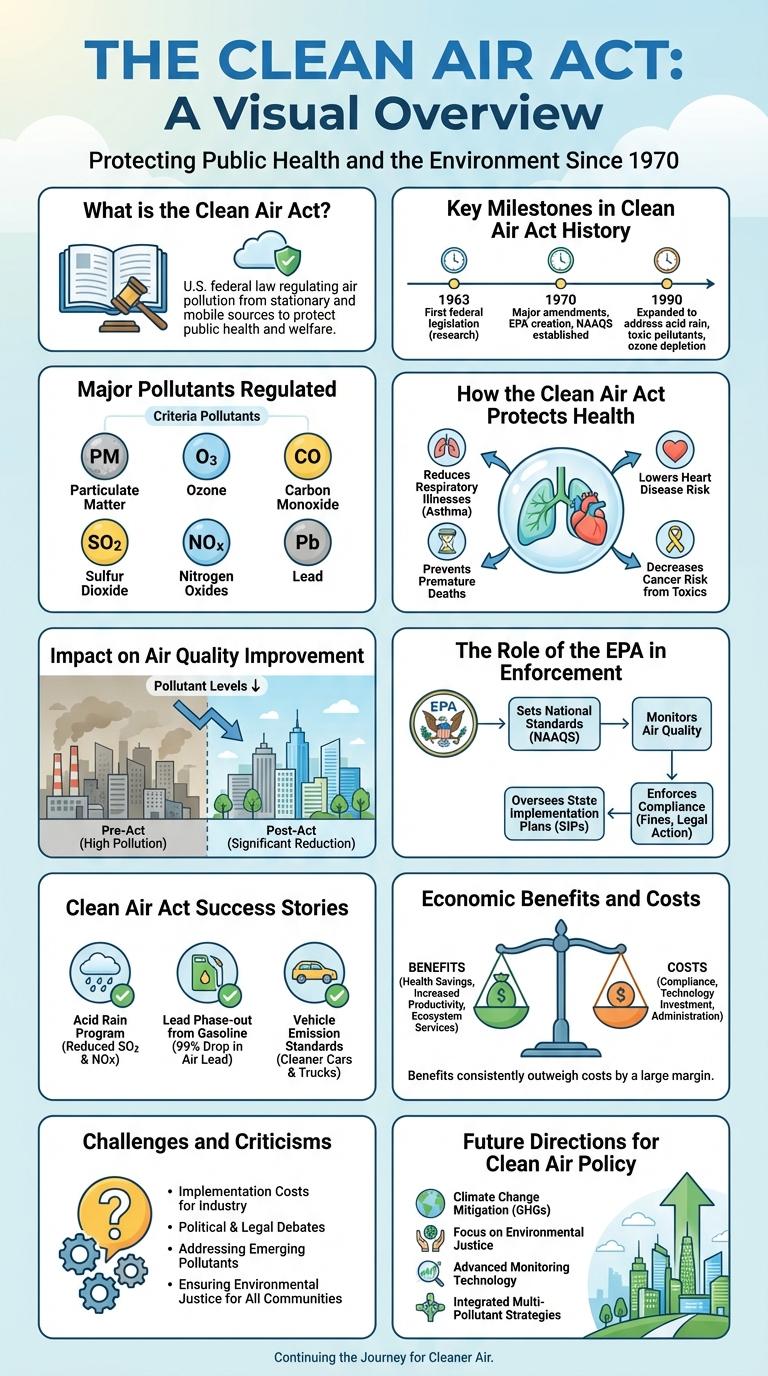
The Clean Air Act is a cornerstone of environmental law that regulates air emissions from stationary and mobile sources to protect public health and the environment. It sets limits on pollutants such as ozone, particulate matter, and carbon monoxide, driving improvements in air quality nationwide. This infographic highlights key provisions, milestones, and the ongoing impact of the Clean Air Act on air pollution control.
What is the Clean Air Act?
The Clean Air Act is a comprehensive federal law that regulates air emissions from stationary and mobile sources in the United States. It aims to ensure that air quality meets health-based standards to protect public health and the environment.
Enacted in 1970, the Clean Air Act authorizes the Environmental Protection Agency (EPA) to set limits on harmful pollutants. These regulations cover pollutants such as carbon monoxide, sulfur dioxide, nitrogen dioxide, and particulate matter.
Key Milestones in Clean Air Act History
The Clean Air Act (CAA) is a landmark environmental law in the United States aimed at reducing air pollution and protecting public health. Enacted in 1970, it established comprehensive federal regulations to control emissions from both stationary and mobile sources.
Key milestones include the original 1970 law, the 1977 amendments addressing state implementation challenges, and the significant 1990 amendments targeting acid rain, ozone depletion, and toxic air pollutants. These milestones have shaped the framework for air quality standards and enforcement mechanisms nationwide.
Major Pollutants Regulated
| Major Pollutant | Description |
|---|---|
| Particulate Matter (PM2.5 and PM10) | Fine particles that can penetrate lungs and bloodstream, causing respiratory issues and cardiovascular diseases. |
| Ground-level Ozone (O3) | Formed from reactions between volatile organic compounds (VOCs) and nitrogen oxides (NOx) under sunlight, leading to smog and respiratory problems. |
| Carbon Monoxide (CO) | A colorless, odorless gas from incomplete combustion of fossil fuels, interfering with oxygen delivery in the body. |
| Sulfur Dioxide (SO2) | Produced by burning sulfur-containing fossil fuels, causes acid rain and respiratory irritation. |
| Nitrogen Oxides (NOx) | Emitted from vehicle engines and industrial processes, contributes to smog formation and respiratory problems. |
How the Clean Air Act Protects Health
The Clean Air Act is a comprehensive federal law that regulates air emissions from stationary and mobile sources. It authorizes the Environmental Protection Agency (EPA) to establish National Ambient Air Quality Standards (NAAQS) to protect public health and the environment.
The Act reduces harmful pollutants like particulate matter, ozone, and carbon monoxide, which can cause respiratory and cardiovascular diseases. By limiting emissions from factories, vehicles, and power plants, it decreases asthma attacks, lung cancer risks, and premature deaths. Regular updates to standards ensure continued protections against emerging air quality threats.
Impact on Air Quality Improvement
The Clean Air Act has played a critical role in reducing air pollution across the United States. It established legal standards that led to measurable improvements in air quality and public health.
- Significant Reduction in Emissions - The Act has helped decrease emissions of major pollutants such as sulfur dioxide (SO2) and nitrogen oxides (NOx) by over 70% since its implementation.
- Improved Urban Air Quality - Cities have experienced a marked decrease in smog and particulate matter, leading to clearer skies and healthier living conditions.
- Enhanced Public Health Outcomes - Lower pollution levels have contributed to reductions in respiratory illnesses, cardiovascular diseases, and premature deaths linked to poor air quality.
The Role of the EPA in Enforcement
The Environmental Protection Agency (EPA) plays a crucial role in enforcing the Clean Air Act by setting and monitoring air quality standards across the United States. The EPA conducts inspections, issues fines, and mandates corrective actions to ensure compliance with air pollution regulations. This enforcement protects public health and the environment by reducing harmful emissions from industrial sources and vehicles.
Clean Air Act Success Stories
The Clean Air Act has significantly reduced air pollution in the United States, leading to improved public health and environmental protection. Key success stories include a dramatic decrease in emissions of harmful pollutants such as sulfur dioxide and nitrogen oxides, which cause acid rain and smog. These achievements have contributed to cleaner air in cities, decreased respiratory illnesses, and protected ecosystems nationwide.
Economic Benefits and Costs
What are the economic benefits of the Clean Air Act?
The Clean Air Act has significantly reduced air pollution, leading to improved public health and fewer medical expenses. Businesses benefit from a healthier workforce, which boosts productivity and reduces absenteeism.
How does the Clean Air Act impact costs for industries?
Industries face compliance costs to meet emission standards, which can involve updating equipment and processes. However, many companies have innovated to achieve these standards cost-effectively, resulting in long-term savings and competitive advantages.
| Economic Benefits | Economic Costs |
|---|---|
| Reduced healthcare expenses by $2 trillion | Average compliance cost per company: $2 million |
| Increased worker productivity | Costs associated with equipment upgrades |
| Growth in green technology sectors | Initial investment in pollution control technologies |
| Job creation in clean energy industries | Potential short-term job shifts in polluting industries |
Challenges and Criticisms
The Clean Air Act has significantly improved air quality but faces ongoing challenges and criticisms. These concerns highlight the complexities of environmental regulation and enforcement.
- Compliance Costs - Industries often report high expenses to meet stringent emission standards, impacting economic growth.
- Enforcement Gaps - Variability in state-level enforcement leads to inconsistent air quality improvements across regions.
- Technological Limitations - Some pollution control technologies struggle to keep pace with emerging contaminants and modern industrial processes.