
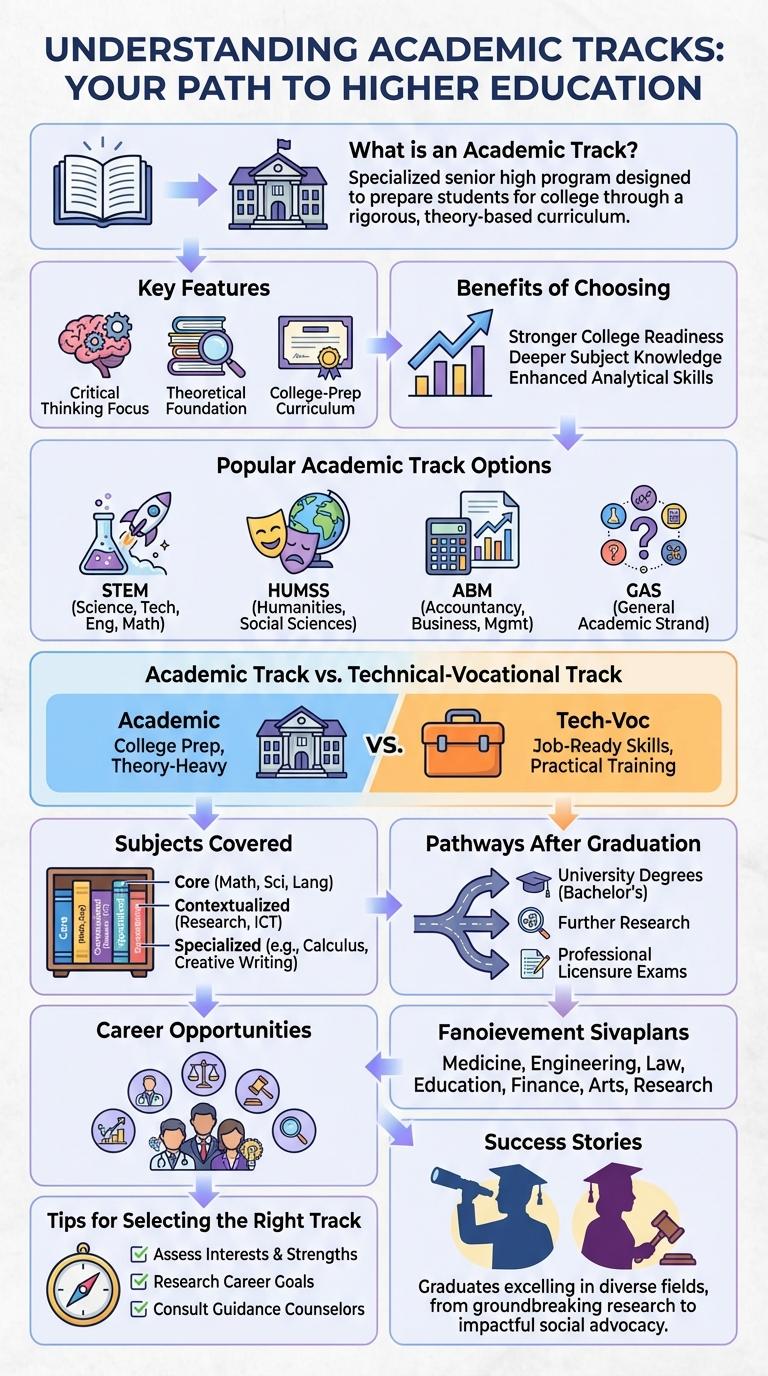
The academic track offers students a focused curriculum designed to prepare them for higher education and specialized fields of study. It emphasizes core subjects such as mathematics, science, language, and social studies, fostering critical thinking and analytical skills. This infographic highlights key components, benefits, and career pathways associated with the academic track.
What is an Academic Track?
The Academic Track is a specialized program designed to prepare senior high school students for college education. It emphasizes theoretical knowledge and research skills in various core subjects. This track helps develop critical thinking and analytical abilities essential for higher learning.
Key Features of Academic Tracks
Academic tracks provide specialized pathways tailored to students' educational goals and career interests. These tracks emphasize core subjects and advanced concepts to prepare learners for higher education and professional fields.
- Focused Curriculum - Academic tracks offer coursework concentrated on sciences, mathematics, humanities, or social sciences to develop expertise.
- Preparation for Higher Education - Designed to equip students with critical thinking and research skills essential for college success.
- Skill Development - Encourages analytical, problem-solving, and communication skills through rigorous academic challenges.
Benefits of Choosing an Academic Track
The academic track provides a strong foundation for students aiming to pursue higher education and specialized careers. It develops critical thinking, analytical skills, and in-depth knowledge in core subject areas.
- Focused Curriculum - Offers specialized courses that prepare students for college-level academic challenges.
- Enhanced Critical Thinking - Encourages analytical and problem-solving skills essential for academic success.
- Better University Opportunities - Increases chances of acceptance into prestigious universities and competitive programs.
- Career Readiness - Builds a solid knowledge base for professional courses such as medicine, engineering, and law.
- Academic Excellence - Promotes a disciplined learning environment that fosters intellectual growth and achievement.
Popular Academic Track Options
Academic tracks offer specialized pathways tailored to students' career goals and interests. Popular options include STEM (Science, Technology, Engineering, and Mathematics), GAS (General Academic Strand), HUMSS (Humanities and Social Sciences), ABM (Accountancy, Business, and Management), and CARE (Caregiving and other health-related courses). Each track provides focused subjects that prepare students for tertiary education and future professions.
Academic Track vs. Technical-Vocational Track
| Academic Track | Technical-Vocational Track |
|---|---|
| Prepares students for higher education and university degree programs | Focuses on practical skills and training for immediate employment |
| Includes strands like Science, Technology, Engineering, and Mathematics (STEM), Humanities and Social Sciences (HUMSS), Accountancy, Business and Management (ABM), and General Academic Strand (GAS) | Offers specializations such as Electronics, Cookery, Automotive Servicing, Electrical Installation, and Beauty Care |
| Emphasizes theoretical knowledge, research, and academic skills development | Provides hands-on experience, technical skills, and job readiness certification |
| Graduates typically continue studies in colleges and universities | Graduates often enter the workforce immediately or pursue technical diploma programs |
| Curriculum designed for analytical thinking, problem-solving, and academic excellence | Curriculum tailored to industry standards and skill proficiency for specific trades |
Subjects Covered in Academic Tracks
Academic tracks offer specialized subjects tailored to students' interests and career goals. These tracks help learners focus on areas such as Science, Humanities, and Business, providing a strong foundation for higher education.
Core subjects in the Science track include Biology, Chemistry, Physics, and Mathematics, which prepare students for STEM-related careers. The Humanities track covers History, Literature, Philosophy, and Social Sciences, fostering critical thinking and cultural awareness. Business track students study Economics, Accountancy, Marketing, and Business Management to develop practical skills for the corporate world.
Pathways After Graduation
The academic track offers specialized pathways designed to equip students with essential skills for higher education and the workforce. Graduates can pursue various fields, including STEM, Humanities, and Social Sciences, each tailored to specific career goals.
Pathways after graduation include enrolling in university degree programs, entering vocational training, or joining professional certification courses. These options provide flexibility for graduates to align their education with personal interests and industry demands.
Career Opportunities from Academic Tracks
What career opportunities can you pursue after choosing an academic track? Academic tracks provide specialized knowledge that opens doors to various professional fields. These tracks prepare students for careers in science, technology, engineering, mathematics, and humanities.
| Academic Track | Career Opportunities |
|---|---|
| Science, Technology, Engineering, and Mathematics (STEM) | Engineer, Data Scientist, Biotechnologist, IT Specialist |
| Humanities and Social Sciences | Lawyer, Psychologist, Historian, Social Worker |
| Accountancy, Business, and Management (ABM) | Accountant, Marketing Specialist, Financial Analyst, Entrepreneur |
| Arts and Design | Graphic Designer, Animator, Architect, Creative Director |
| Health Sciences | Nurse, Medical Technologist, Pharmacist, Physical Therapist |
Tips for Selecting the Right Academic Track
Choosing the right academic track is crucial for aligning your education with your career goals and personal interests. Understanding your strengths and long-term objectives helps in making an informed decision.
Researching the curriculum and future opportunities of each track provides clarity on what to expect. Consulting with academic advisors and professionals can guide you towards the best fit for your aspirations.