
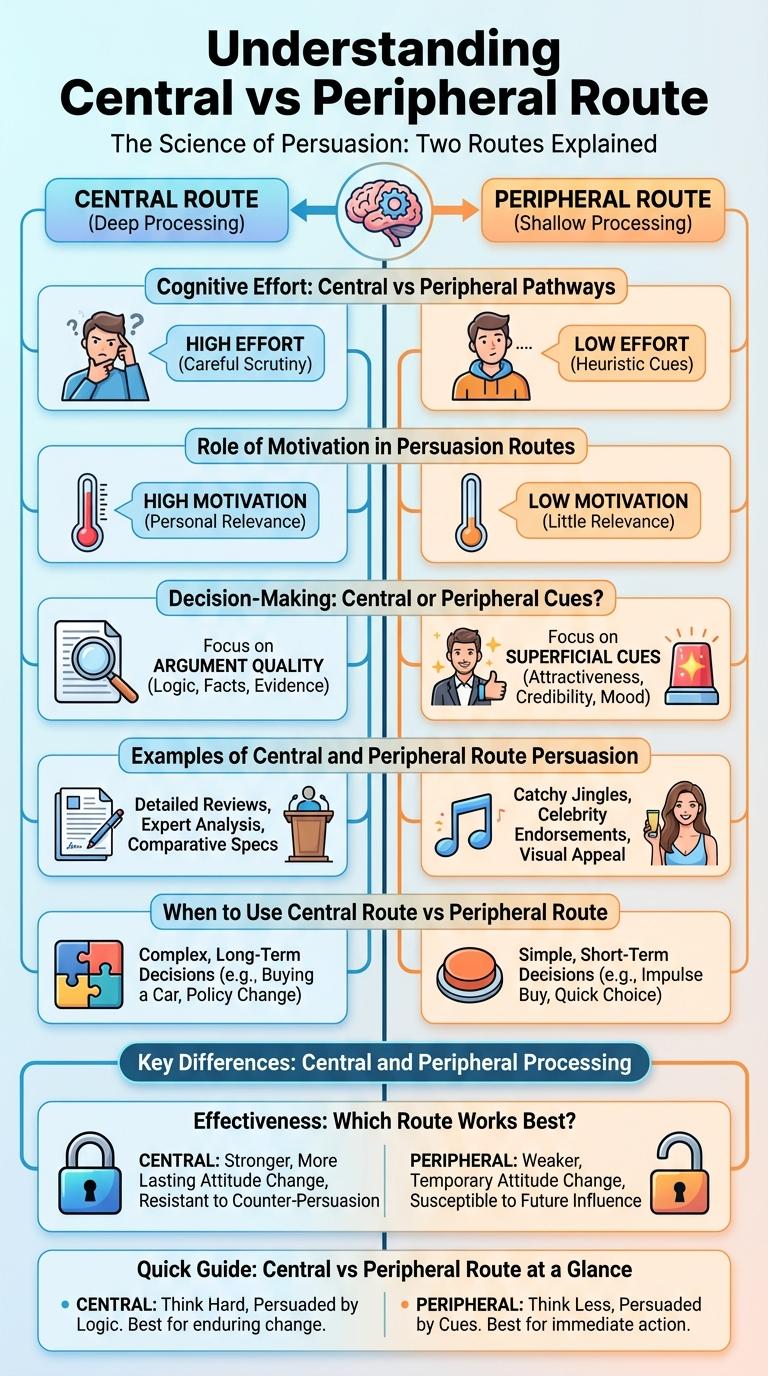
The central route and peripheral route represent two distinct paths in the process of persuasion, each influencing decision-making through different mechanisms. The central route focuses on logical reasoning and the careful evaluation of arguments, leading to lasting attitude change. In contrast, the peripheral route relies on superficial cues such as attractiveness or credibility, resulting in more temporary persuasion effects.
Understanding Central vs Peripheral Route
What distinguishes the central route from the peripheral route in persuasion? The central route involves careful and thoughtful consideration of the message content, leading to lasting attitude change. The peripheral route relies on superficial cues, such as source attractiveness or credibility, resulting in temporary attitude shifts.
Key Differences: Central and Peripheral Processing
The central route and peripheral route represent two distinct methods of information processing in persuasion. Each route influences decision-making based on different cognitive engagement levels.
- Focus on Argument Quality - Central processing emphasizes critical evaluation of message content and logical reasoning.
- Reliance on Cues - Peripheral processing depends on superficial cues like attractiveness or credibility rather than message depth.
- Durability of Attitude Change - Attitudes formed via the central route tend to be more persistent and resistant to counter-persuasion.
- Effort Level - Central processing requires high cognitive effort and motivation from the individual.
- Decision Speed - Peripheral processing often leads to faster, automatic decisions with minimal cognitive load.
The Science of Persuasion: Two Routes Explained
The science of persuasion is explained through two main routes: the central route and the peripheral route. These routes describe how people process persuasive messages differently based on their motivation and ability to think critically.
The central route involves careful and thoughtful consideration of the message content, leading to lasting attitude change. The peripheral route relies on superficial cues such as attractiveness or credibility, resulting in temporary attitude shifts.
When to Use Central Route vs Peripheral Route
The central route to persuasion is most effective when the audience is motivated and able to process detailed information. Use this route for complex messages that require critical thinking and long-lasting attitude change.
The peripheral route works best when the audience has low motivation or ability to analyze the message deeply. It relies on surface cues like attractiveness or credibility, leading to temporary or superficial attitude change.
Decision-Making: Central or Peripheral Cues?
The central route to decision-making involves careful analysis of information, focusing on the quality and strength of arguments presented. In contrast, the peripheral route relies on superficial cues such as attractiveness, credibility, or emotional appeal rather than detailed scrutiny. Choosing between central or peripheral cues depends on factors like motivation, ability, and relevance to the decision at hand.
| Central Route | Peripheral Route |
|---|---|
| High cognitive effort | Low cognitive effort |
| Focus on argument quality | Focus on external cues |
| Long-lasting attitude change | Temporary attitude change |
| Motivated and able audience | Unmotivated or distracted audience |
| Example: detailed product reviews | Example: celebrity endorsements |
Role of Motivation in Persuasion Routes
| Central Route | Peripheral Route |
|---|---|
|
Role of Motivation: High motivation to process information drives deep, thoughtful evaluation of message content. Processing Type: Systematic, analytical, focused on strong arguments. Outcome: Long-lasting attitude change based on message quality. Example: Consumers carefully comparing product features before purchase. Context: Relevant personal interest or involvement encourages central route engagement. |
Role of Motivation: Low motivation results in reliance on superficial cues rather than message content. Processing Type: Heuristic, automatic, influenced by peripheral signals. Outcome: Temporary attitude change dependent on external factors. Example: Choosing a brand because of celebrity endorsement without detailed evaluation. Context: Limited personal relevance or cognitive effort supports peripheral route processing. |
Cognitive Effort: Central vs Peripheral Pathways
The central route of persuasion requires high cognitive effort, engaging individuals in thoughtful and deliberate processing of information. In contrast, the peripheral route involves low cognitive effort, relying on superficial cues such as attractiveness or credibility to influence attitudes. Understanding the difference in cognitive effort helps marketers tailor messages effectively to their target audience's processing style.
Examples of Central and Peripheral Route Persuasion
The central route to persuasion involves thoughtful consideration of the arguments presented, leading to lasting attitude change. The peripheral route relies on superficial cues, such as attractiveness or credibility, resulting in temporary attitude shifts.
An example of central route persuasion is a consumer carefully evaluating the features and benefits of a new smartphone before making a purchase. In contrast, peripheral route persuasion occurs when the same consumer buys a smartphone because a celebrity endorses it or due to an appealing advertisement design. Central route persuasion typically requires motivation and ability to process the message deeply, while peripheral route persuasion depends on external triggers and heuristic cues.
Effectiveness: Which Route Works Best?
The central route to persuasion relies on thoughtful consideration of arguments, leading to lasting attitude change. The peripheral route depends on superficial cues, producing quick but often temporary effects.
Effectiveness varies based on audience motivation and ability to process information, with the central route being more durable when engaged.
- Central Route Strength - Produces enduring attitude change through deep cognitive processing.
- Peripheral Route Speed - Generates rapid responses based on surface-level cues like attractiveness or authority.
- Audience Engagement - Central route works best when the audience is motivated and capable of critical thinking.