
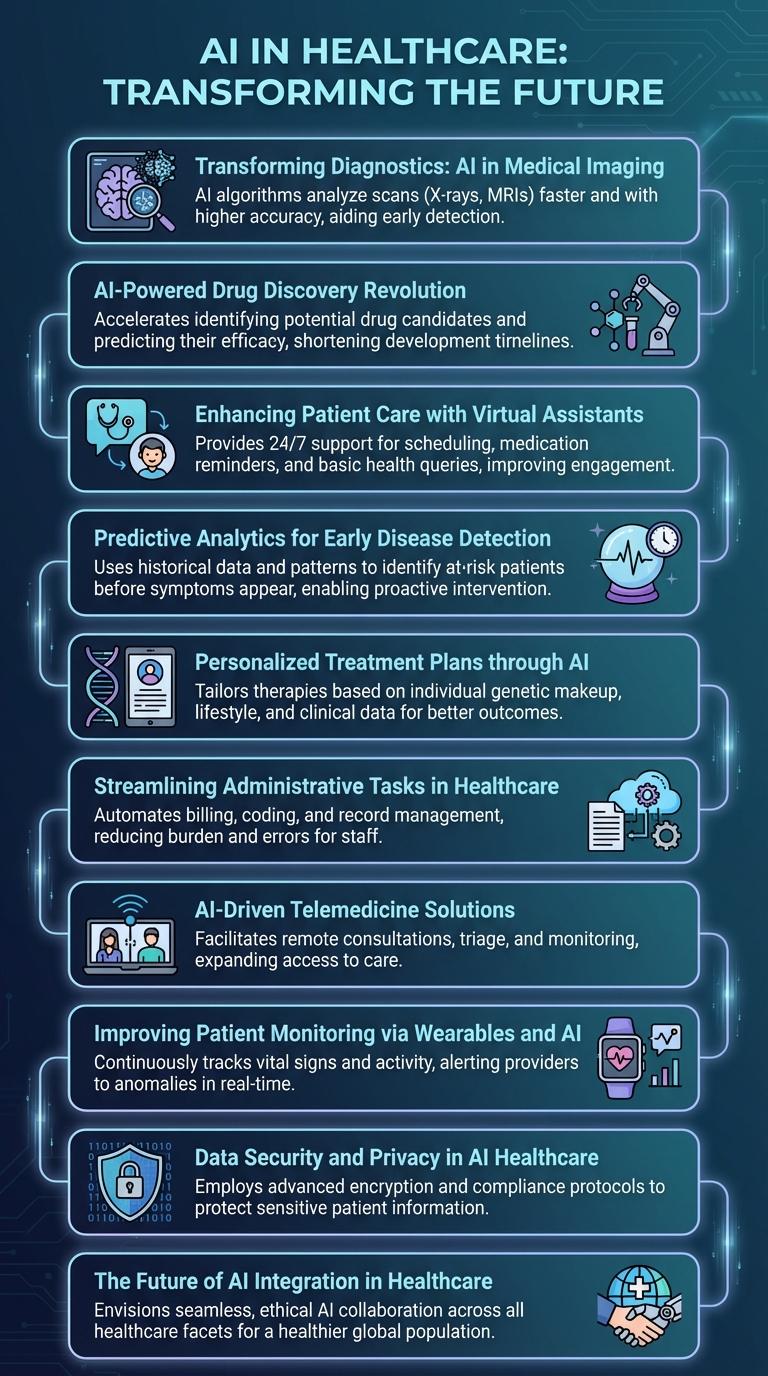
AI is transforming healthcare by enhancing diagnostic accuracy, personalizing treatment plans, and streamlining administrative tasks. Machine learning algorithms analyze vast amounts of medical data to identify patterns and predict patient outcomes more efficiently than traditional methods. This infographic highlights key applications, benefits, and challenges of AI-driven technologies in modern healthcare systems.
Transforming Diagnostics: AI in Medical Imaging
| Aspect | Details |
|---|---|
| AI Technology | Deep learning algorithms, convolutional neural networks (CNNs) |
| Applications | Detecting tumors, analyzing X-rays, MRI interpretation, CT scan analysis |
| Benefits | Increased diagnostic accuracy, faster image processing, early disease detection |
| Impact | Reduces human error, supports radiologists, improves patient outcomes |
| Future Prospects | Integration with electronic health records, real-time diagnostics, personalized treatment plans |
AI-Powered Drug Discovery Revolution
AI is transforming drug discovery by accelerating the identification of potential drug candidates and reducing research costs. Machine learning algorithms analyze vast datasets to predict molecular behavior and optimize drug design.
- Accelerated Target Identification - AI processes biological data to quickly identify promising therapeutic targets.
- Predictive Molecular Modeling - Deep learning models simulate drug-target interactions to forecast efficacy and toxicity.
- Reduced Time to Market - AI-driven automation shortens preclinical testing phases, speeding clinical trial preparation.
Enhancing Patient Care with Virtual Assistants
How are virtual assistants transforming patient care in healthcare? Virtual assistants streamline communication between patients and providers, offering 24/7 support. They help monitor patient symptoms, schedule appointments, and provide medication reminders, improving overall healthcare outcomes.
Predictive Analytics for Early Disease Detection
Artificial intelligence revolutionizes healthcare by enabling predictive analytics to identify diseases at early stages. This proactive approach improves patient outcomes and reduces treatment costs significantly.
- Early Detection - AI algorithms analyze patient data to detect subtle patterns indicative of emerging diseases before symptoms appear.
- Risk Assessment - Machine learning models evaluate genetic, lifestyle, and clinical factors to predict individual disease risk with high accuracy.
- Personalized Interventions - Predictive analytics help tailor preventive measures and treatment plans specific to each patient's needs.
Implementing AI-driven predictive analytics enhances preventive healthcare and supports timely medical decisions.
Personalized Treatment Plans through AI
AI in healthcare enables the development of personalized treatment plans by analyzing vast amounts of patient data, including genetics, lifestyle, and medical history. This approach improves accuracy in diagnosis and tailors therapies to individual needs, enhancing patient outcomes.
Machine learning algorithms identify patterns and predict responses to treatments, allowing healthcare providers to adjust plans dynamically. Personalized AI-driven care reduces adverse effects and increases the efficiency of medical interventions.
Streamlining Administrative Tasks in Healthcare
AI technology is revolutionizing healthcare by streamlining administrative tasks, reducing errors, and optimizing resource allocation. This transformation enhances efficiency and allows medical professionals to focus more on patient care.
Automated systems powered by AI handle scheduling, billing, and patient record management, significantly cutting down processing time. AI-driven data analysis improves decision-making and reduces administrative overhead.
- Automated Scheduling - AI systems optimize appointment bookings to minimize wait times and ensure efficient use of healthcare providers' time.
- Smart Billing Solutions - AI detects billing errors and automates claims processing, reducing administrative costs and payment delays.
- Electronic Health Record (EHR) Management - AI enhances EHR accuracy and accessibility by automating data entry and retrieval tasks, improving patient data handling.
AI-Driven Telemedicine Solutions
AI-driven telemedicine solutions revolutionize healthcare by providing remote patient monitoring, virtual consultations, and real-time diagnostics. These technologies utilize machine learning algorithms to analyze patient data, improve diagnosis accuracy, and personalize treatment plans. The integration of AI in telemedicine enhances accessibility, reduces healthcare costs, and ensures timely medical intervention worldwide.
Improving Patient Monitoring via Wearables and AI
AI-powered wearables revolutionize patient monitoring by providing continuous, real-time health data. These devices detect early signs of medical conditions and enable timely interventions. Healthcare providers leverage AI algorithms to analyze wearable data, improving patient outcomes and reducing hospital readmissions.
Data Security and Privacy in AI Healthcare
AI in healthcare revolutionizes patient care through advanced data analysis and predictive modeling. Protecting sensitive health information remains a critical concern as AI systems handle vast amounts of personal data.
Data security in AI healthcare involves encryption, access controls, and secure data storage to prevent unauthorized access. Privacy regulations such as HIPAA and GDPR guide the ethical use of patient data in AI applications. Continuous monitoring and risk assessments help maintain trust and compliance in AI-driven healthcare solutions.