
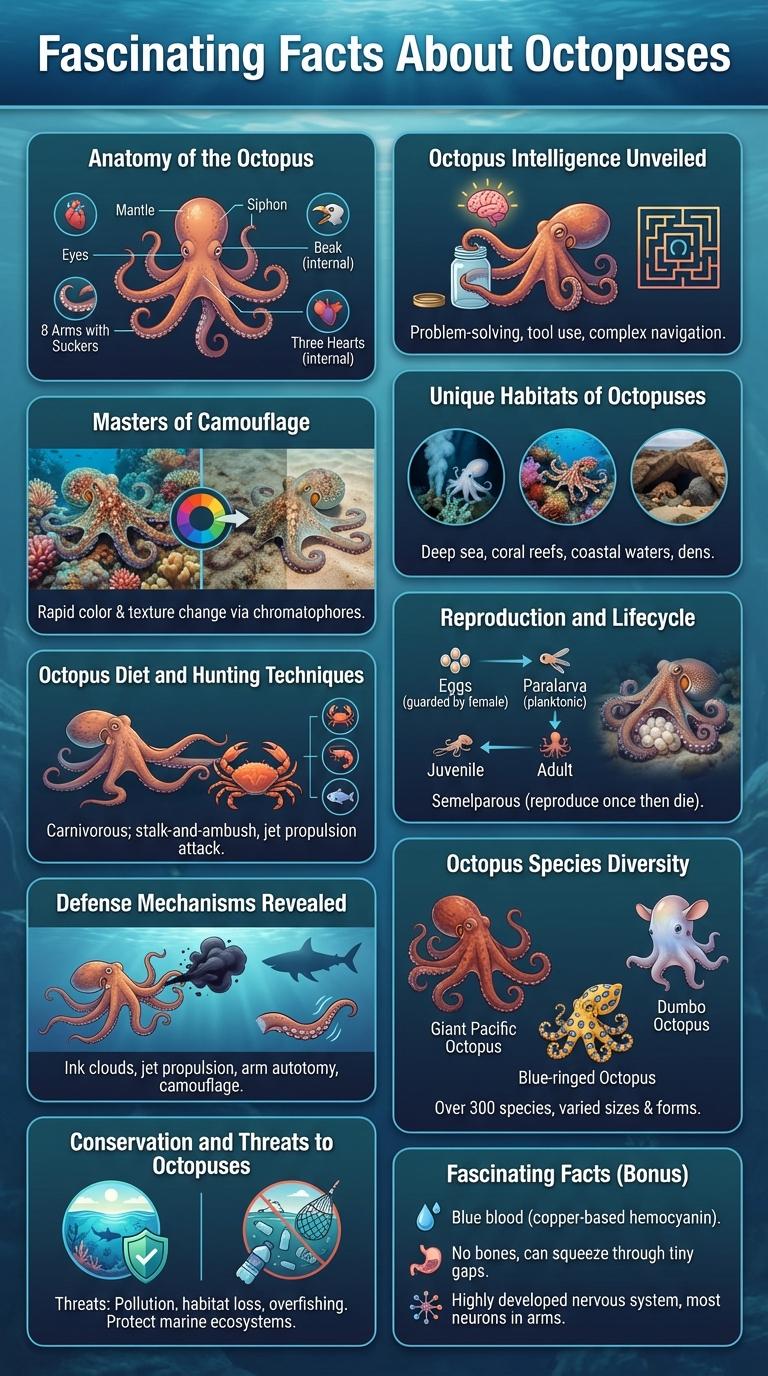
Octopuses are fascinating marine creatures known for their intelligence, camouflage abilities, and unique physiology. Their eight arms, highly developed nervous system, and ability to squeeze into tight spaces make them unparalleled in the ocean world. This infographic highlights key facts about octopus behavior, anatomy, and habitat.
Fascinating Facts About Octopuses
Octopuses possess three hearts and blue blood, which helps them survive in deep ocean environments. Their soft bodies and lack of a skeleton allow them to squeeze through tiny crevices.
These intelligent creatures can change color and texture instantly for camouflage or communication. They have remarkable problem-solving skills and are known to use tools in the wild.
Anatomy of the Octopus
The octopus has a unique anatomy featuring a soft, bulbous body and eight flexible arms lined with suction cups. Its large brain is highly developed for invertebrates, allowing advanced problem-solving and camouflage skills. The octopus lacks a skeleton, enabling it to squeeze through tiny spaces, while its blue blood contains hemocyanin for efficient oxygen transport in cold, low-oxygen environments.
Octopus Intelligence Unveiled
The octopus is known for its remarkable intelligence among marine animals, demonstrating advanced problem-solving skills and the ability to use tools. Research shows octopuses can navigate mazes, open jars, and exhibit short- and long-term memory. Their complex nervous system, with two-thirds of neurons located in their arms, enables independent arm movement and sensory processing, highlighting their unique cognitive abilities.
Masters of Camouflage
The octopus is a master of camouflage, capable of changing its skin color and texture in an instant. Specialized cells called chromatophores, iridophores, and leucophores enable rapid visual transformation.
These adaptations help the octopus blend seamlessly into diverse environments, from coral reefs to rocky ocean floors. Camouflage protects octopuses from predators and aids in ambushing prey effectively.
Unique Habitats of Octopuses
Octopuses inhabit diverse and unique marine environments ranging from shallow reefs to deep ocean floors. Their adaptability allows them to thrive in various habitats worldwide.
- Coral Reefs - Octopuses use coral crevices for shelter and hunting grounds, blending with vibrant surroundings.
- Kelp Forests - These provide abundant cover and rich feeding opportunities with dense underwater vegetation.
- Deep-Sea Vents - Some species adapt to extreme conditions near hydrothermal vents, surviving high pressure and temperature.
Each habitat offers specialized conditions that support octopus survival and behavioral adaptations.
Octopus Diet and Hunting Techniques
What does an octopus eat to survive in the ocean? Octopuses primarily consume crabs, shrimp, and small fish. Their diet depends on availability and habitat, showcasing their adaptability as predators.
How does an octopus hunt its prey effectively? Octopuses use camouflage and stealth to approach prey closely. They also employ their eight arms to capture and immobilize food quickly.
What special hunting technique helps octopuses catch hard-shelled prey? Octopuses can drill into shells using their sharp beak and secrete venom to paralyze prey. This method allows them to feed on animals protected by tough exteriors.
How do octopuses use their intelligence in hunting? They solve problems and manipulate objects to access hidden prey. Tool use and strategic planning enhance their hunting success.
Why is the octopus' diet important to marine ecosystems? By preying on a variety of species, octopuses help maintain healthy oceanic food webs. Their role supports biodiversity and ecosystem balance.
Reproduction and Lifecycle
| Aspect | Details |
|---|---|
| Reproduction Method | Sexual reproduction with internal fertilization |
| Breeding Behavior | Males use a specialized arm called hectocotylus to transfer spermatophores to females |
| Egg Laying | Females lay thousands of eggs in protected dens or crevices |
| Parental Care | Females guard and oxygenate the eggs until hatching, often without feeding |
| Lifecycle Duration | Ranges from 6 months to 2 years; most species die shortly after reproduction |
Defense Mechanisms Revealed
The octopus employs remarkable defense mechanisms that ensure its survival in diverse marine environments. These adaptations enable quick escape, camouflage, and deterrence against predators.
Octopuses combine physical and behavioral tactics for protection, showcasing one of the ocean's most advanced survival strategies.
- Ink Release - Octopuses eject a cloud of dark ink to obscure attackers' vision and facilitate a swift getaway.
- Camo Skin - Specialized skin cells called chromatophores allow octopuses to instantly change color and texture, blending seamlessly with their surroundings.
- Jet Propulsion - Quick expulsion of water through their siphon enables octopuses to rapidly escape threats by shooting backward.
Octopus Species Diversity
Octopuses belong to a diverse group of marine animals known for their intelligence and adaptability. Their species diversity showcases a wide range of sizes, habitats, and behaviors found across the world's oceans.
- Over 300 recognized species - Octopuses are classified into more than 300 distinct species, each adapted to different marine environments.
- Range of habitats - Species occupy diverse habitats, from shallow coastal waters to deep ocean floors.
- Varied sizes and colors - Octopus species vary dramatically in size, coloration, and camouflage abilities to suit their ecological niches.