
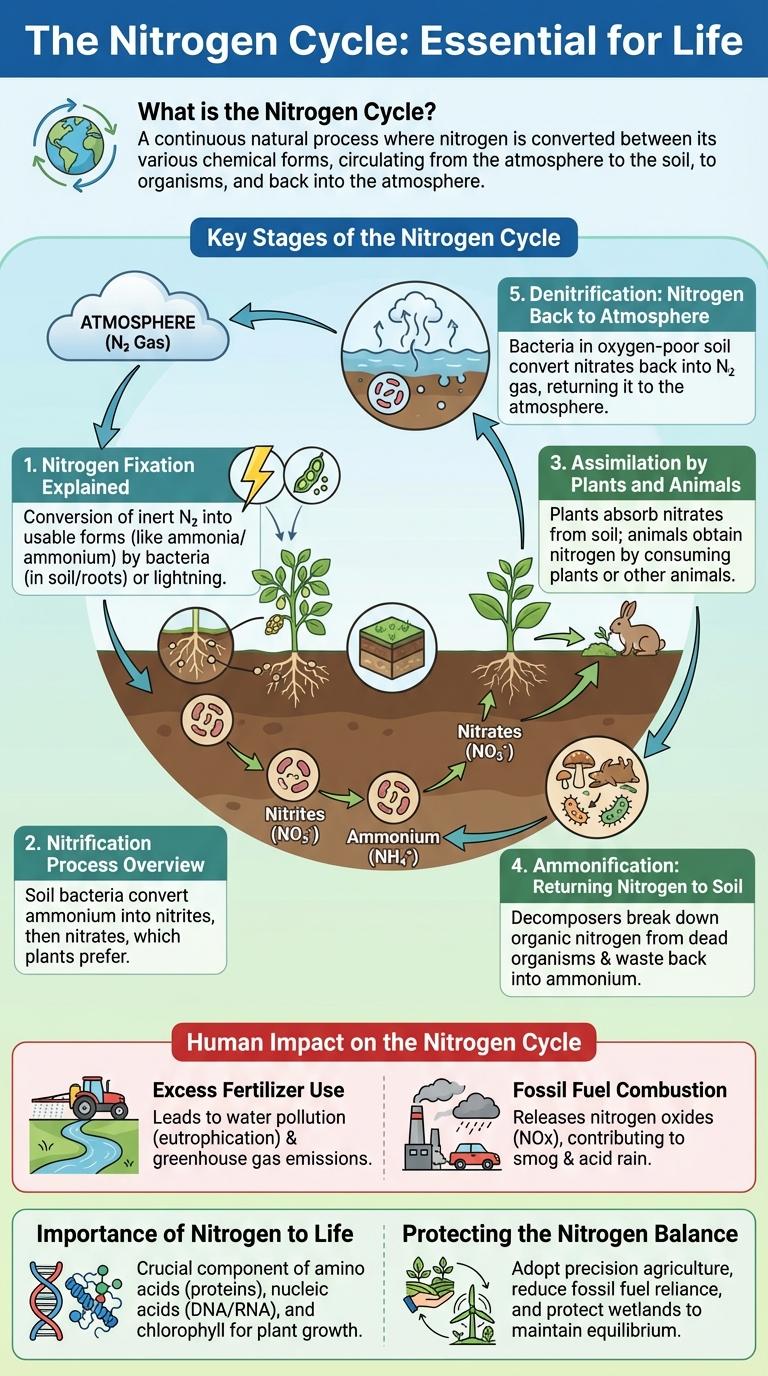
The nitrogen cycle illustrates how nitrogen moves through the environment, transforming between different chemical forms essential for life. This process involves key stages such as nitrogen fixation, nitrification, assimilation, ammonification, and denitrification, each supporting ecosystem health and agricultural productivity. Understanding the nitrogen cycle helps reveal the balance necessary to sustain plant growth and reduce environmental impact.
What is the Nitrogen Cycle?
The nitrogen cycle is a natural process that moves nitrogen through the atmosphere, soil, plants, and animals. It is essential for converting nitrogen into forms usable by living organisms.
- Nitrogen Fixation - Conversion of atmospheric nitrogen into ammonia by bacteria or lightning.
- Nitrification - Transformation of ammonia into nitrites and nitrates by soil bacteria.
- Denitrification - Conversion of nitrates back into nitrogen gas released into the atmosphere.
The nitrogen cycle supports ecosystem productivity by recycling nitrogen in various chemical forms.
Key Stages of the Nitrogen Cycle
The nitrogen cycle is a crucial natural process that converts nitrogen into various chemical forms, enabling its availability to living organisms. Key stages include nitrogen fixation, nitrification, assimilation, ammonification, and denitrification.
Nitrogen fixation involves bacteria converting atmospheric nitrogen (N2) into ammonia (NH3). Nitrification transforms ammonia into nitrites (NO2-) and nitrates (NO3-), which plants can absorb during assimilation.
Nitrogen Fixation Explained
What is nitrogen fixation and why is it important in the nitrogen cycle?
Nitrogen fixation is the process of converting atmospheric nitrogen (N2) into a form usable by living organisms, such as ammonia (NH3). This step is crucial because most organisms cannot utilize inert nitrogen gas directly, making nitrogen fixation essential for plant growth and ecosystem productivity.
Nitrification Process Overview
The nitrification process is a crucial part of the nitrogen cycle where ammonia is converted into nitrate. It occurs in two main steps: ammonia is first oxidized to nitrite by bacteria such as Nitrosomonas, then nitrite is further oxidized to nitrate by Nitrobacter species. This process enhances soil fertility by making nitrogen available in a form easily absorbed by plants.
Assimilation by Plants and Animals
The nitrogen cycle is essential for transferring nitrogen through different ecosystems. Assimilation by plants and animals plays a critical role in converting nitrogen into organic forms for growth and development.
Plants absorb nitrogen primarily as nitrate (NO3-) and ammonium (NH4+) from the soil. Animals obtain nitrogen by consuming plants or other animals, incorporating it into proteins and nucleic acids.
- Plant Assimilation - Plants take up nitrates and ammonium ions from the soil and convert them into amino acids and proteins.
- Animal Assimilation - Animals ingest nitrogen by eating plants or herbivores, assimilating nitrogen into bodily tissues such as muscles and enzymes.
- Ecological Impact - Assimilation sustains the nitrogen flow within food webs, supporting biodiversity and ecosystem productivity.
Ammonification: Returning Nitrogen to Soil
| Process | Ammonification |
|---|---|
| Description | Breakdown of organic nitrogen compounds from dead plants, animals, and waste into ammonia (NH3) or ammonium ions (NH4+) |
| Key Organisms | Decomposers such as bacteria and fungi |
| Role in Nitrogen Cycle | Converts organic nitrogen into inorganic ammonia, making nitrogen available for plants and other microbes |
| Environmental Impact | Maintains soil fertility by replenishing nitrogen content essential for plant growth |
| Chemical Equation | Organic Nitrogen (proteins, nucleic acids) - NH3/NH4+ |
Denitrification: Nitrogen Back to Atmosphere
Denitrification is a crucial process in the nitrogen cycle where bacteria convert nitrates in the soil back into nitrogen gas (N2), releasing it into the atmosphere. This step helps maintain the balance of nitrogen in the ecosystem by preventing the accumulation of excess nitrates.
Specialized denitrifying bacteria such as Pseudomonas and Clostridium perform this process under anaerobic conditions. Denitrification completes the nitrogen cycle by returning nitrogen to its gaseous form, making it available once again for atmospheric input.
Human Impact on the Nitrogen Cycle
The nitrogen cycle is crucial for maintaining ecosystem balance by recycling nitrogen through the atmosphere, soil, and organisms. Human activities have significantly altered this cycle, causing environmental challenges.
Industrial agriculture introduces excessive nitrogen fertilizers, leading to nutrient runoff and water pollution. Fossil fuel combustion releases nitrogen oxides, contributing to air pollution and acid rain. Wastewater and deforestation further disrupt natural nitrogen processes, intensifying ecosystem imbalance.
Importance of Nitrogen to Life
The nitrogen cycle is essential for all living organisms as nitrogen is a critical component of amino acids, proteins, and nucleic acids. Without nitrogen, plants cannot grow, which disrupts the entire food chain and ecosystem balance. This cycle continuously converts nitrogen into various chemical forms that sustain life and promote biodiversity.