
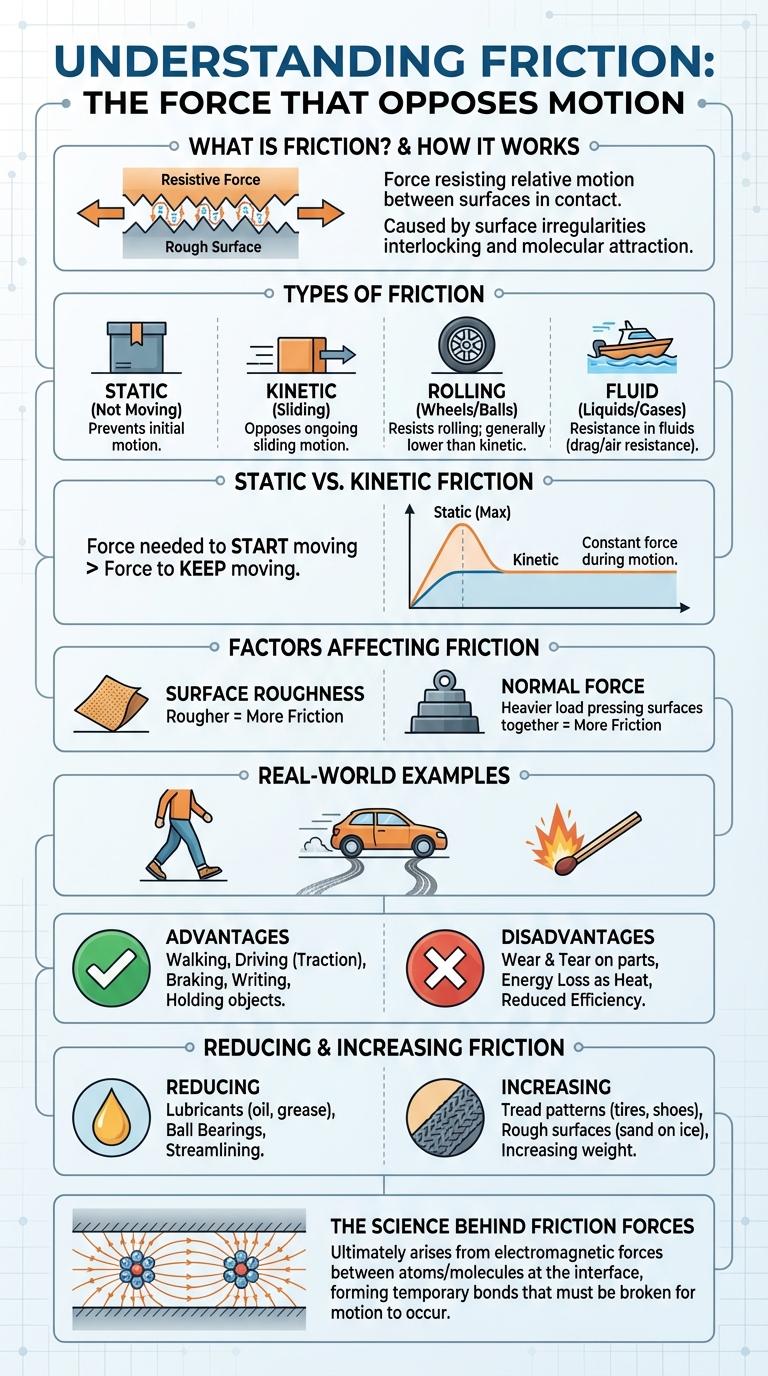
Friction is a force that resists the motion of objects sliding or rolling against each other. It plays a crucial role in everyday life, affecting everything from walking and driving to the functioning of machines. Understanding friction helps improve safety, efficiency, and performance across various applications.
What Is Friction?
What is friction? Friction is the force that opposes the motion of objects sliding or moving past each other. It plays a crucial role in everyday activities by providing resistance that slows down or stops motion.
Types of Friction
Friction is the resistance that occurs when two surfaces move against each other. It plays a crucial role in everyday activities, from walking to driving.
There are four main types of friction: static, sliding, rolling, and fluid friction. Static friction acts between surfaces that are not moving relative to each other, preventing motion. Sliding friction occurs when two surfaces slide past one another, opposing the movement.
How Friction Works
Friction is a force that opposes the motion of objects in contact. It arises from the interactions between the surfaces of materials.
- Surface Roughness - Microscopic irregularities on surfaces cause resistance when they slide against each other.
- Normal Force - The force pressing two surfaces together increases friction proportionally.
- Types of Friction - Static friction prevents motion, while kinetic friction acts during movement.
Factors Affecting Friction
Friction is the resistance that one surface or object encounters when moving over another. Understanding the factors affecting friction helps in various applications from engineering to daily activities.
- Surface Texture - Rougher surfaces create more friction while smoother surfaces reduce it.
- Normal Force - Increased force pressing the two surfaces together results in higher friction.
- Material Type - Different materials have intrinsic friction coefficients that determine friction strength.
Static vs. Kinetic Friction
Friction is the resistive force that occurs when two surfaces interact. It plays a critical role in motion by opposing the relative movement between objects.
- Static Friction - Acts between surfaces at rest relative to each other and prevents motion from starting.
- Kinetic Friction - Occurs when surfaces slide past one another and opposes ongoing motion.
- Difference in Magnitude - Static friction is generally stronger than kinetic friction, requiring more force to initiate motion than to maintain it.
Understanding the distinctions between static and kinetic friction is essential for applications in physics and engineering.
Real-World Examples of Friction
Friction is the resistance that one surface or object encounters when moving over another. It plays a crucial role in everyday activities, affecting how objects start, stop, and move.
In real-world scenarios, friction helps cars grip the road, allowing safe driving and efficient braking. It also enables walking and running by preventing slipping between our shoes and the ground.
Advantages of Friction
Friction plays a crucial role in everyday life by providing the necessary grip for walking and driving, preventing slips and falls. It enables machinery and vehicles to function efficiently by allowing controlled movement and stopping power. Moreover, friction aids in heat generation, which is essential in processes like braking and friction welding.
Disadvantages of Friction
Friction causes wear and tear on moving parts, leading to reduced efficiency and increased maintenance costs. It generates unwanted heat, which can damage components and decrease system performance. High friction levels require more energy input, increasing operational expenses and environmental impact.
Reducing and Increasing Friction
| Reducing Friction | Increasing Friction |
|---|---|
| Use lubricants such as oil or grease to create a smooth surface | Add textured surfaces or rough materials to enhance grip |
| Polish surfaces for minimal resistance in mechanical parts | Apply rubber coatings or mats to prevent slipping |
| Design aerodynamic shapes to reduce air friction | Implement sandpaper or abrasive materials in brakes |
| Use ball bearings to convert sliding friction into rolling friction | Increase contact area or pressure between surfaces |
| Employ smooth wheels on vehicles for efficient movement | Utilize tire treads to boost traction on roads |