
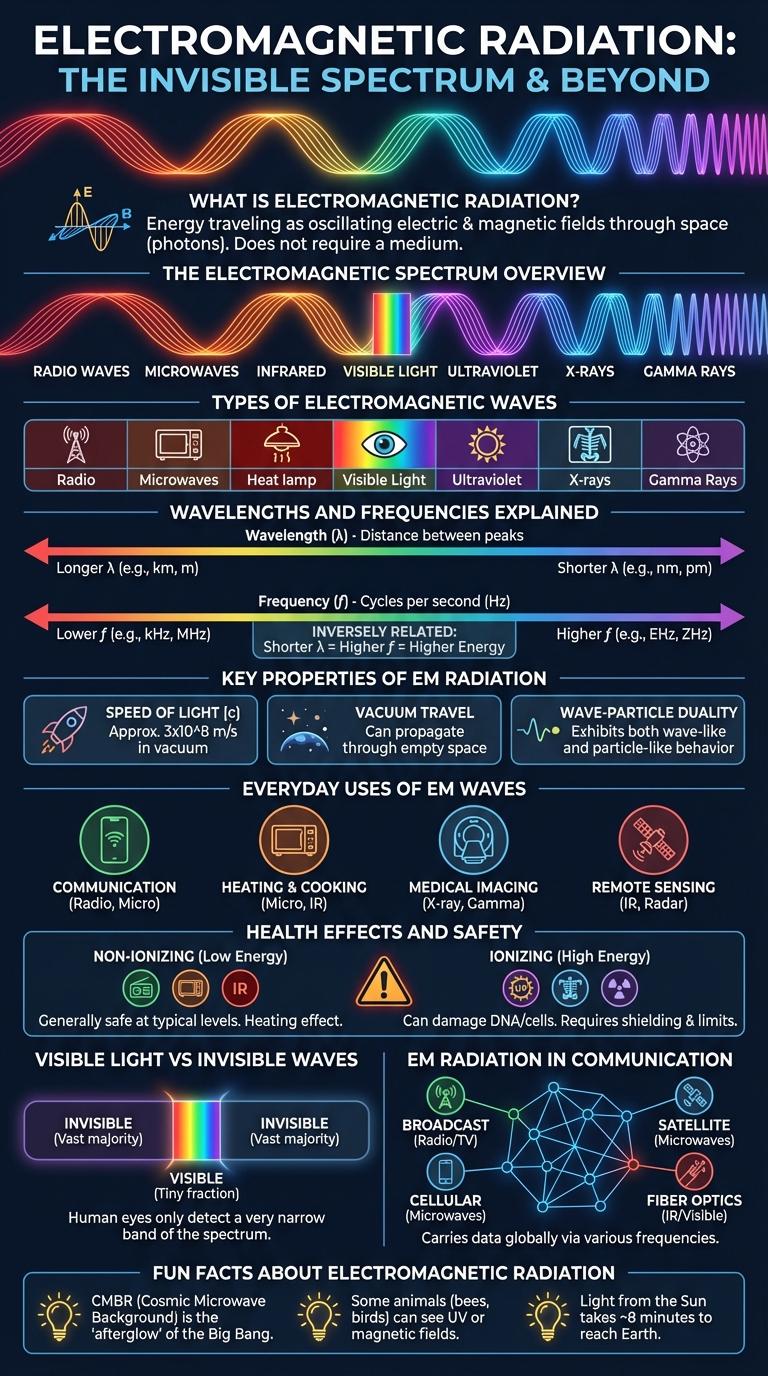
Electromagnetic radiation encompasses a wide spectrum of energy waves, from radio waves to gamma rays, each with unique wavelengths and frequencies. This infographic illustrates the different types of EM radiation, their sources, and their effects on technology and human health. Understanding this spectrum helps in grasping how EM radiation interacts with the environment and daily life.
What is Electromagnetic Radiation?
Electromagnetic radiation (EM radiation) consists of waves of electric and magnetic fields that propagate through space. It includes a broad range of frequencies from radio waves to gamma rays.
- Energy Transmission - EM radiation transfers energy through electromagnetic waves without requiring a medium.
- Wave-Particle Duality - EM radiation exhibits both wave-like and particle-like properties, behaving as photons in quantum mechanics.
- Frequency Spectrum - The electromagnetic spectrum ranges from low-frequency radio waves to high-frequency gamma rays, each with distinct applications and effects.
The Electromagnetic Spectrum Overview
The electromagnetic spectrum encompasses all types of electromagnetic radiation, ranging from radio waves to gamma rays. It describes the different wavelengths and frequencies of radiation emitted by various sources in the universe.
Radio waves have the longest wavelengths and lowest frequencies, making them ideal for communication technologies. Gamma rays have the shortest wavelengths and highest frequencies, often produced by nuclear reactions and cosmic events.
Types of Electromagnetic Waves
Electromagnetic radiation consists of waves with varying wavelengths and frequencies. These waves form a spectrum ranging from radio waves to gamma rays.
- Radio Waves - Used in communication systems and have the longest wavelengths.
- Microwaves - Utilized in cooking and radar technology with shorter wavelengths than radio waves.
- Infrared Waves - Emitted by warm objects and used in remote controls and thermal imaging.
- Visible Light - The only electromagnetic waves detectable by the human eye.
- Gamma Rays - Produced by radioactive atoms and cosmic sources, possessing the shortest wavelengths.
Each type of electromagnetic wave has unique properties and applications based on its wavelength and frequency.
Wavelengths and Frequencies Explained
Electromagnetic radiation encompasses a range of wavelengths and frequencies that determine its properties and interactions. Wavelength and frequency are inversely related, affecting how EM waves behave across the spectrum.
- Wavelength - The distance between successive crests of a wave, measured in meters.
- Frequency - The number of wave cycles passing a point per second, measured in hertz (Hz).
- Inverse Relationship - Higher frequency waves have shorter wavelengths, while lower frequency waves have longer wavelengths.
Key Properties of EM Radiation
Electromagnetic (EM) radiation consists of waves with electric and magnetic fields oscillating perpendicular to each other. It spans a wide spectrum, including radio waves, microwaves, infrared, visible light, ultraviolet, X-rays, and gamma rays. Key properties include wavelength, frequency, speed in a vacuum (approximately 3 x 10^8 m/s), and energy, which is proportional to frequency.
Everyday Uses of EM Waves
Electromagnetic (EM) radiation encompasses a broad spectrum of waves used daily in communication, healthcare, and entertainment. Radio waves enable wireless communication such as Wi-Fi and broadcasting, while microwaves are essential for cooking and radar technology. Visible light powers vision and photography, ultraviolet rays assist in sterilization, and infrared waves are used in thermal imaging and remote controls.
Health Effects and Safety
Electromagnetic (EM) radiation encompasses a range of wavelengths from radio waves to gamma rays, each with varying energy levels. Exposure to high-frequency EM radiation, such as X-rays and gamma rays, can damage cells and DNA, increasing cancer risk.
Low-frequency EM radiation, like radio waves and microwaves, is generally considered safe at typical exposure levels but prolonged exposure may cause thermal effects. Safety guidelines set by organizations such as WHO and ICNIRP help regulate exposure limits to protect public health.
Visible Light vs Invisible Waves
| Visible Light | Invisible Electromagnetic Waves |
|---|---|
| Wavelength range: 400-700 nanometers | Wavelengths outside visible range (e.g., radio, infrared, ultraviolet, X-rays, gamma rays) |
| Detected by human eyes as colors | Not visible to human eyes; require special instruments for detection |
| Used in everyday vision, photography, and illumination | Utilized in communication (radio waves), thermal imaging (infrared), medical imaging (X-rays), and sterilization (ultraviolet/gamma rays) |
| Frequency range approximately 430-750 THz | Frequency ranges vary widely; for example, radio waves (3 kHz to 300 GHz), gamma rays (>10^19 Hz) |
| Energy levels moderate, enabling visible sensation without damage at typical exposures | Energy levels vary; higher-energy waves like X-rays and gamma rays can be harmful in high doses |
EM Radiation in Communication
Electromagnetic (EM) radiation plays a crucial role in modern communication systems. It enables wireless transmission of data over various distances and frequencies.
Radio waves, microwaves, and infrared radiation are commonly used in communication technologies like radio broadcasting, Wi-Fi, and satellite transmissions. EM radiation carries signals by modulating amplitude, frequency, or phase, allowing efficient data transfer. Understanding the spectrum and properties of EM waves optimizes communication performance and reduces interference.