
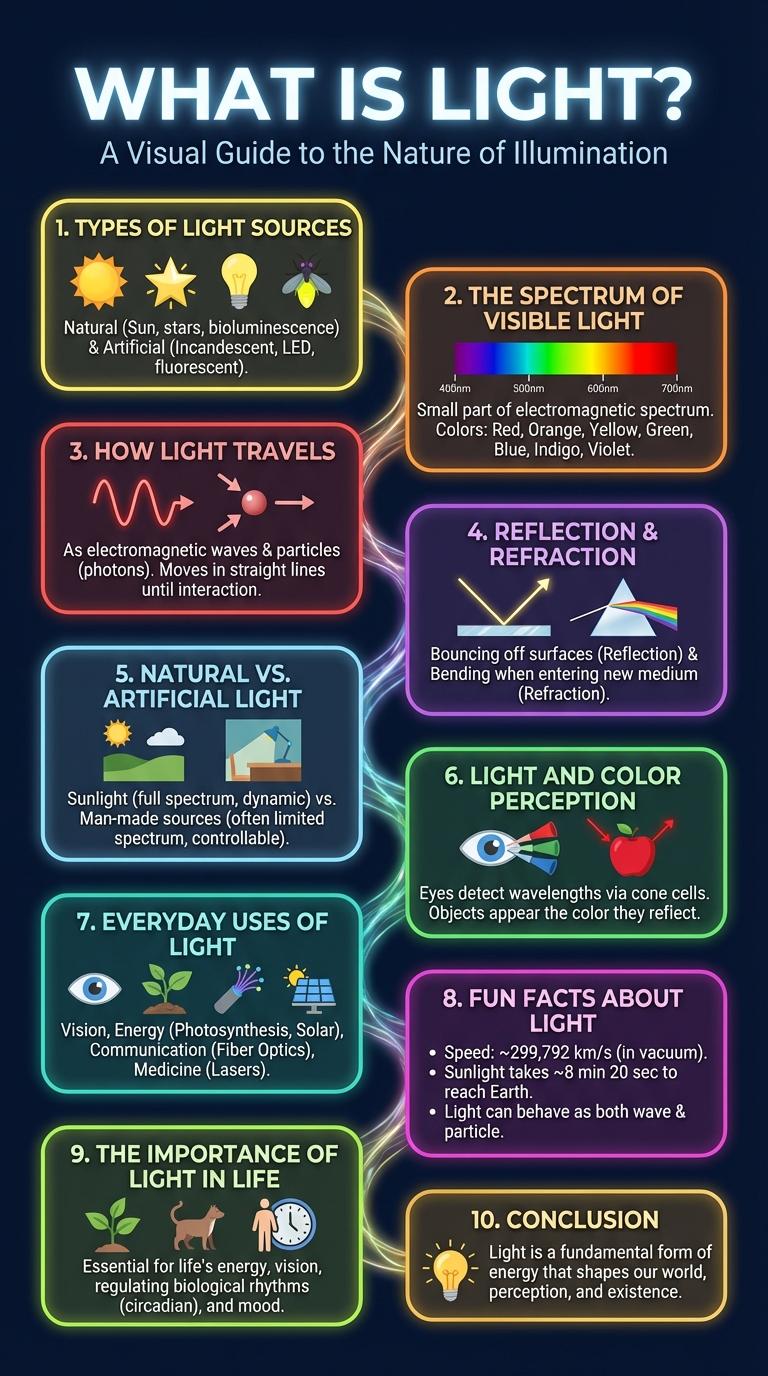
Infographics about light visually break down complex concepts like wavelengths, energy, and color spectra into easily digestible information. They highlight the importance of light in daily life, from natural sunlight to artificial illumination. By presenting data graphically, these infographics help deepen understanding of how light impacts vision, technology, and the environment.
What is Light?
Light is electromagnetic radiation visible to the human eye, enabling us to see the world around us. It travels in waves and exhibits properties of both particles and waves, known as photons. Light sources include the sun, artificial bulbs, and lasers, which emit light at various wavelengths and intensities.
Types of Light Sources
Light sources can be broadly categorized into natural and artificial types. Natural light primarily comes from the sun, while artificial light sources include incandescent bulbs, fluorescent lamps, and LEDs. Each type has distinct characteristics, applications, and energy efficiency levels.
The Spectrum of Visible Light
Visible light consists of a spectrum of colors that can be seen by the human eye. This spectrum ranges from red to violet, each color corresponding to different wavelengths of light.
The visible light spectrum plays a crucial role in various fields such as physics, biology, and technology by enabling color perception and light-based applications.
- Red Light - Represents the longest wavelength in the visible spectrum, around 620-750 nanometers.
- Green Light - Falls in the middle of the spectrum, with wavelengths approximately 495-570 nanometers.
- Violet Light - Has the shortest wavelength visible to the human eye, between 380-450 nanometers.
How Light Travels
Light travels in straight lines called rays, enabling it to move efficiently through space. These rays extend from the light source to objects, allowing us to see.
When light rays encounter different materials, they can reflect, refract, or be absorbed. Reflection occurs when light bounces off surfaces, while refraction bends light as it passes through transparent substances like water or glass. Absorption happens when materials take in light energy, often converting it to heat.
Reflection & Refraction
Light exhibits unique behaviors when it interacts with different surfaces and mediums. Reflection and refraction are two fundamental optical phenomena that explain how light changes direction.
- Reflection - Light bounces off a surface, changing direction but staying in the same medium.
- Law of Reflection - The angle of incidence equals the angle of reflection on a smooth surface.
- Refraction - Light bends as it passes from one medium to another due to a change in speed.
- Refractive Index - A measure of how much light slows down in a material, affecting the degree of bending.
- Total Internal Reflection - Occurs when light reflects completely inside a medium without passing through the boundary.
Natural vs. Artificial Light
| Natural Light | Artificial Light |
|---|---|
| Source: Sun | Source: Man-made devices (bulbs, LEDs) |
| Spectrum: Full spectrum with balanced wavelengths | Spectrum: Variable, often limited or specialized wavelengths |
| Intensity: Changes throughout the day | Intensity: Controllable and constant |
| Benefits: Supports circadian rhythms, boosts mood and vitamin D synthesis | Benefits: Provides consistent illumination, extends usable hours |
| Impact: Eco-friendly, free but weather-dependent | Impact: Energy consumption, potential glare and eye strain |
Light and Color Perception
Light is electromagnetic radiation that is visible to the human eye, enabling color perception. Different wavelengths correspond to different colors in the visible spectrum.
The human eye contains photoreceptor cells called cones, which detect color by responding to red, green, and blue light. The brain processes signals from cones to interpret millions of colors based on light wavelengths.
Everyday Uses of Light
How does light impact our everyday activities? Light enables us to see and interact with the world around us, enhancing safety and comfort. It powers devices like smartphones and helps plants grow through photosynthesis.
Fun Facts About Light
Light travels at a speed of approximately 299,792 kilometers per second, making it the fastest thing in the universe. It takes only about 8 minutes for sunlight to reach Earth from the Sun.
Visible light is only a small part of the electromagnetic spectrum, which also includes ultraviolet and infrared light. Humans can see about 10 million different colors created by varying light wavelengths.