
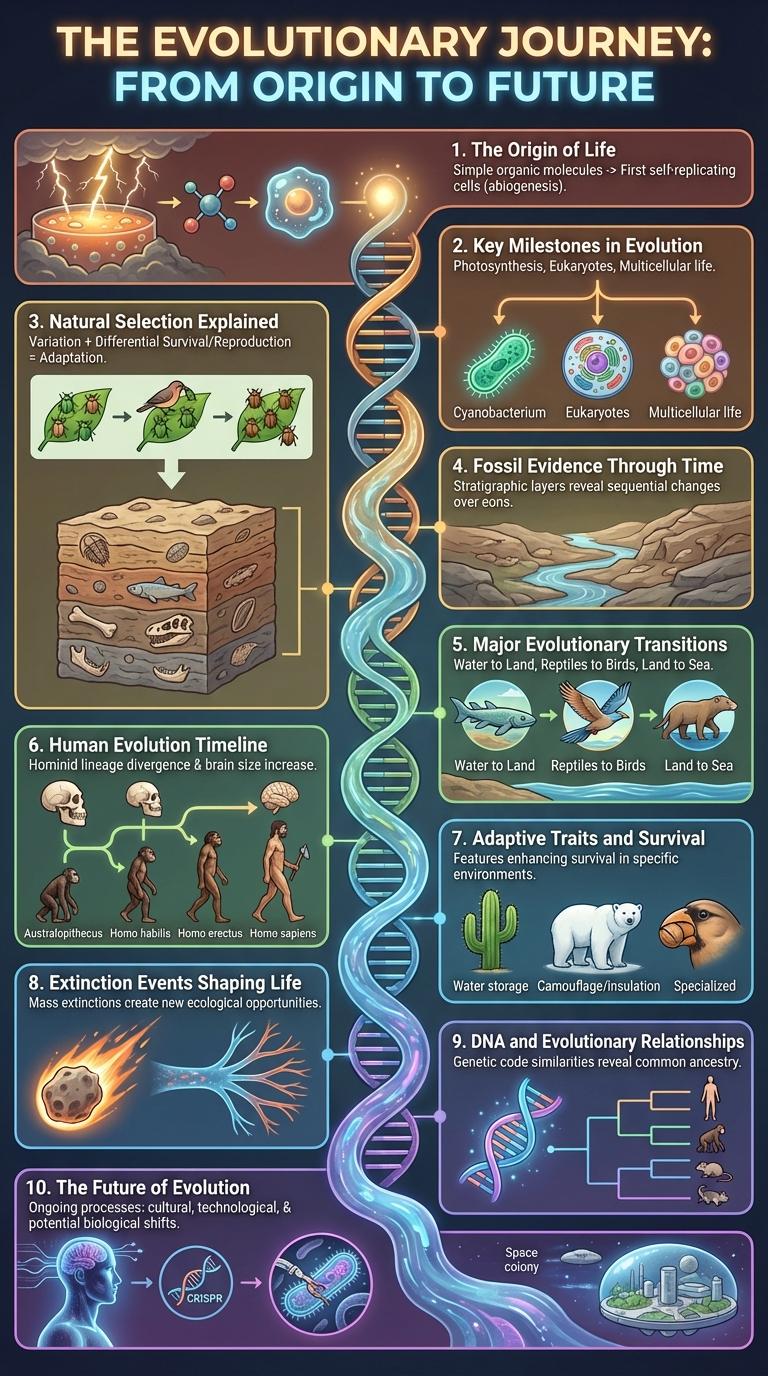
Infographics visually depict the complex process of evolution, highlighting key stages and significant species transformations over millions of years. They break down scientific data into clear, engaging visuals that illustrate genetic variation, natural selection, and common ancestry. By combining imagery and concise information, these infographics make the concept of evolution accessible and easy to understand.
The Origin of Life
The Origin of Life marks the beginning of biological existence on Earth, approximately 3.5 billion years ago. Simple molecules combined to form complex organic compounds, leading to the first self-replicating cells. This crucial event set the foundation for the vast diversity of life through the process of evolution.
Key Milestones in Evolution
| Milestone | Significance |
|---|---|
| Formation of Earth (4.5 billion years ago) | Foundation for life; creation of a habitable planet |
| Origin of Life (3.8 billion years ago) | First single-celled organisms emerged in oceans |
| Photosynthesis Begins (2.5 billion years ago) | Oxygen production increased; atmosphere transformation |
| Emergence of Eukaryotic Cells (1.6 billion years ago) | Complex cells with nuclei evolved; enabled multicellularity |
| Colonization of Land (500 million years ago) | Plants and animals adapted to terrestrial environments |
Natural Selection Explained
What is natural selection and how does it drive evolution?
Natural selection is the process where organisms better adapted to their environment tend to survive and produce more offspring. This mechanism leads to the gradual evolution of species by favoring beneficial traits over generations.
Fossil Evidence Through Time
Fossil evidence provides a critical timeline illustrating the evolution of life on Earth. Fossils found in sedimentary rock layers reveal gradual changes in species over millions of years. These preserved remains serve as physical records, tracing biological diversity and adaptation through geological epochs.
Major Evolutionary Transitions
The history of life on Earth is marked by several major evolutionary transitions that profoundly changed organisms and ecosystems. These transitions represent key steps in complexity, leading from simple cells to complex multicellular life.
Major evolutionary transitions include the emergence of eukaryotic cells, the development of multicellularity, and the rise of sexual reproduction. Each transition enabled new modes of cooperation, information transfer, and biological organization.
For example, the evolution of eukaryotic cells allowed compartmentalization of functions within cells, increasing efficiency. Multicellularity introduced specialization of cells and greater organismal complexity.
Sexual reproduction enhanced genetic diversity, improving adaptability and evolution rates. Understanding these transitions reveals how complexity in life forms progressively increased over billions of years.
Human Evolution Timeline
Human evolution traces the development of Homo sapiens from early ancestors over millions of years. This timeline highlights key milestones in the emergence and adaptation of modern humans.
- Australopithecus appeared around 4 million years ago - Early hominins that walked upright and showed primitive tool use.
- Homo habilis emerged approximately 2.4 million years ago - Known as the "handy man," this species showed advanced tool-making abilities.
- Homo sapiens evolved around 300,000 years ago - Anatomically modern humans developed complex language, culture, and technology.
Adaptive Traits and Survival
Adaptive traits are inherited characteristics that enhance an organism's ability to survive and reproduce in its environment. These traits evolve over generations through natural selection, allowing species to better fit their habitats.
Survival depends on how well organisms can adapt to changing conditions such as climate, predators, and food availability. Traits like camouflage, resistance to disease, and efficient metabolism increase survival chances. Over time, populations with advantageous traits thrive, driving the evolution of species.
Extinction Events Shaping Life
Mass extinction events have dramatically influenced the course of evolution by eliminating dominant species and allowing new life forms to emerge. These events reshaped biodiversity and ecosystems, leading to evolutionary innovations and the rise of new species.
Extinction events act as pivotal points in Earth's history, driving adaptive radiation and ecological shifts that shape life's complexity over millions of years.
- The Permian-Triassic Extinction - Occurred around 252 million years ago, wiping out approximately 96% of marine species and 70% of terrestrial vertebrates.
- The Cretaceous-Paleogene Extinction - Happened 66 million years ago, causing the demise of the dinosaurs and enabling mammals to dominate.
- The Ordovician-Silurian Extinction - Took place roughly 443 million years ago, leading to the loss of nearly 85% of marine species due to glaciation and sea level changes.
DNA and Evolutionary Relationships
DNA serves as the fundamental blueprint for all living organisms, encoding genetic information that guides development and function. Variations in DNA sequences accumulate over generations, driving evolutionary changes and species divergence.
Comparing DNA sequences among species reveals evolutionary relationships, helping to construct phylogenetic trees that map common ancestry. These genetic links provide insights into how species have evolved and adapted over millions of years.